Hi.
I sometimes,, When answering to myy english tests, fear If words have other senses too which I may not know.And I wouldn't answer them lest I get a negative mark.What should I do with this fearing?
Sometimes, when answering questions ontomyyEnglish tests, I fearIfwords have other sensestoowhich I may not know.And Iwouldn'tdon't answer them lest I get a negative mark.What should I do with this fearing?
If you don't know the word, you don't know the word. Are you penalized for guessing? If not, then guess. Otherwise, just keep reading everything you can to increase your vocabulary.
I'm not a teacher, but I write for a living. Please don't ask me about 2nd conditionals, but I'm a safe bet for what reads well in (American) English.
Last edited by hooshdar3; 18-Jan-2012 at 13:21.
We have asked you before - please make a little more effort to avoid basic slips. If you want us to spend time responding to your questions, you should take a little time checking them.
For a sound response to your original question, you need a therapist rather than a language teacher. We are not experts in dealing with fear.
Context is always important; labelling is rarely important.
There's a difference between not getting the point because you didn't answer correctly, and having a partial point subtracted because you gave the wrong answer.
If I have five questions and I guess completely at all of them, each with five answers, I may get a score of 1 in the first case if I get 1 right and 4 wrong. But if I'm penalized for guessing, I can end up with a score of 0 if I get 1 right and 4 wrong.
Sometimes yes, sometimes no. Context, context, and more context. Also knowing root origins, from the Latin or Greek, can help, as well as understanding how prefixes work, may help.Question:
Do the sesnses of words vary widely in meaning and is there a way to deduct similar meaning of a word, knowing just one sense?
I'm not a teacher, but I write for a living. Please don't ask me about 2nd conditionals, but I'm a safe bet for what reads well in (American) English.
I understand the point is to give the right answer. I understand that the person who correctly answers more questions than you and incorrectly answer fewer questions than you will do better. I was actually trying to help you with your test-taking strategy. Hence my question about penalizing wrong answers.
I'm not a teacher, but I write for a living. Please don't ask me about 2nd conditionals, but I'm a safe bet for what reads well in (American) English.
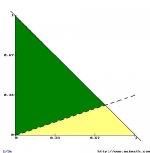
This is a simple maximizing problem. You’re showing that you get 1 point for a correct answer, 0 points for no answer, and -1/3 points for a wrong answer. Assuming independent questions (i.e. you can't derive an answer from another question), you want to answer each question based on your confidence in your answer for it, using the following simultaneous linear inequalities: 1c - (1/3)w > 0 and c + w <= 1, where c is the percent confidence of a correct answer and w is the percent confidence of a wrong answer (and c >= 0 and w >= 0). As a rule, you should answer any question where you have confidence of correctness over 25%. Below this your ability to assess your wrongness will come in to play.
Here is a graph of these 4 simultaneous inequalities, with c is on the vertical axis. If you’re in the green, you answer. If you’re in the yellow, you leave it blank. Simple!
![]()
Last edited by BobSmith; 19-Jan-2012 at 00:25.