Management assumes no responsibility for (the) loss (of) or damage to vehicles...

Status
Not open for further replies.

kohyoongliat

Senior Member
Joined
Dec 16, 2006
Member Type
Interested in Language
Native Language
English
Home Country
Malaysia
Current Location
Malaysia
Management assumes no responsibility for (the) loss (of) or damage to vehicles in the car park.

Are"the" and "of" needed?

Thanks.
 
It depends- on a sign, it might save space and make it less cluttered to omit them.
 
It depends- on a sign, it might save space and make it less cluttered to omit them.
Thanks, Tdol. I am interested in the grammatical aspect of the notice. May I conclude "the" and "of" are needed? Thanks.
 
If you insist on 'the' and 'of', you also need to begin 'The management...'
 
Management assumes no responsibility for (the) loss (of) or damage to vehicles in the car park.

Are"the" and "of" needed?

Thanks.

The 'of' is needed. The phrase 'loss to a vehicle' doesn't make much sense, though I imagine some speakers might argue that loss of its wheels (say) would constitute a loss to the vehicle. (I don't buy it, but somebody might ;-))

Whether to include 'the' is a matter for the sign-writer, as Tdol said.

b
 
Thanks, Bob

Management assumes no responsibility for the loss of or damage to vehicles in the car park.

"loss'" relates to the vehicles. In other words, Management assumes no responsibility for the loss of vehicles in the car park.

Maybe the sentence should include "while they are parked".

Hence,
Management assumes no responsibility for the loss of or damage to vehicles while they are parked in the car park.

Am I correct?
 
Last edited:

Maybe the sentence should include "while they are parked".

Hence,
Management assumes no responsibility for the loss of or damage to vehicles while they are parked in the car park.

Am I correct?
No. If you added the restricting 'while they are parked', a lawyer might argue that the management implicitly accepted responsibility for damage to the vehicle while the driver was driving around looking for a space, or manoeuvring into one.
 
If someone breaks in and steals your ipod from the car, the management is not responsible for that "loss" either. It's not just the loss of the car.
 
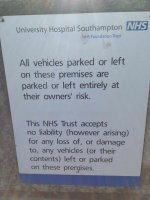
Coincidentally, I found this sign today:

Sign.jpg
 
Thanks, emsr.

What is the purpose of "however arising"? It seems redundant to me.
 
They are just making sure that no matter what the cause of the loss or damage, you can't hold them responsible. It doesn't matter if it was caused by a flood, an earthquake, a vandal, a stray dog, a falling helicopter, or anything else, it's not their fault!
 
:up: I think kohyoongliat's query arises from a misunderstanding of 'however'; it doesn't mean 'but' or 'although' or 'after all' - which would indeed give a pretty redundant meaning for 'however arising'. It means 'whatever may have been the cause' as Mike said; in legal documents this often appears in an archaic form - 'howsoever'. (When you read it, you may want to know it's pronounced /'haʊsəʊ͵evər/, but it's not a pronunciation you'll need to use.)

b
 
Status
Not open for further replies.

Ask a Teacher

If you have a question about the English language and would like to ask one of our many English teachers and language experts, please click the button below to let us know:

(Requires Registration)
Back
Top