
traffic light

  • Thread starter Yourjones
  • Start date
  • Views : 2,501
Status
Not open for further replies.
Y

Yourjones

Guest
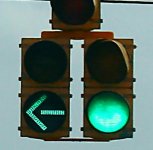
Hi, these are typical traffic lights. Can you help explain in SPOKEN English:

1. when we can only go straight, but can not turn to the left;
2. when we can only turn to the left but can not go straight.

Thank you so much for your patience.
 

Attachments

  • Screenshot_2014-01-24-21-34-03-1.jpg
    Screenshot_2014-01-24-21-34-03-1.jpg
    53.1 KB · Views: 3
You have the right of way to turn left when there is a green arrow. When there is just the solid green light, you may turn left if there is no oncoming traffic. (Unless some sign directs you to only turn when you have the arrow.)

If you are traveling straight, you may go through whenever it is green, whether there is an arrow or not.
 
I guess I would have a lot of angry American motorists beeping their horns behind me.
In Europe you're not allowed to turn if the arrow is not green, oncoming traffic or not.
I would wait.
 
If you are in a left turn only lane with its own signal, then it would give you a green arrow when you have right of way. It would give you a red light when you are not allowed to turn. If there is a solid green that stays on after the green arrow disappears, then you can go when it is safe.

In a lot of cases there is a sign that says "Yield to oncoming traffic on (green circle)."

But that is the default way I would read a green light. Would you really not turn left if your lane had a green light?

The solid signals in the picture above would have no purpose if the absence of a green arrow prohibited turning.
 
Or this:

A full green signal without any arrows (like in Figure 1 above) usually means you may travel straight ahead or make a right or left turn unless otherwise prohibited by signs.
 
In Europe you're not allowed to turn if the arrow is not green, oncoming traffic or not.

In the UK you are, provided it is safe to do so.
 
"A full green signal without any arrows (like in Figure 1 above) usually means you may travel straight ahead or make a right or left turn unless otherwise prohibited by signs."

That's the same as it is in Holland and here in Russia.
But the difference is that we are not allowed to turn left or right when there is an arrow, but it's not lit.

Maybe I've overlooked some new traffic rules?
I've had my license for almost thirty years now, so things might have changed.
I will look into it.
 
not a teacher

But the difference is that we are not allowed to turn left or right when there is an arrow, but it's not lit.

In Australia, if the green arrow goes off and leaves the full green on, then you can go ahead or turn if it's safe to do so.
If you are not allowed to turn while the full green is on but the green arrow is not, then a red arrow will come on.
In the illustration, it appears that there is possibly a red arrow above the green arrow and that this might come on to indicate when turns are not allowed once the green arrow goes off.
 
Obviously, these are not typical traffic lights.
 
Last edited by a moderator:
This is a language forum. Discussion of how traffic lights work may be interesting, but it is out of place here.

Thread closed
 
Status
Not open for further replies.

Ask a Teacher

If you have a question about the English language and would like to ask one of our many English teachers and language experts, please click the button below to let us know:

(Requires Registration)
Back
Top