by the dozen, in dozens

Tait-ka

Member
Joined
Sep 21, 2024
Member Type
Student or Learner
Native Language
Urdu
Home Country
Pakistan
Current Location
Pakistan
Hi.

Do the expressions “by the dozen” and “in dozens” mean the same, i.e. exactly twelve items?

Example sentence:
Tom often buys eggs by the dozen / in dozens.

In this sentence, does either expression means that I buy exactly twelve eggs, or does either one mean that I buy a large number of eggs (no specific quantity)?
 
It means exactly twelve. Eggs are typically sold in multiples of six.

Eggs are sold by the dozen.

This means you have to buy at least twelve eggs, because that's how many there are in one box.
 
Regardless of the expression, the word 'dozen' always means exactly twelve, especially with eggs. Sometimes, the plural 'dozens' can be used to mean a large but imprecise quantity.
 
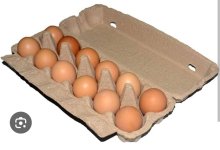
This is a 12-egg carton:
Screenshot_20260409-114135.jpg
Are eggs in the UK sold in cartons like the above? I mean, do people in the UK buy one carton, two or more depending on their need?
 
They are.
They do.
 
In the majority of shops in the UK, eggs are sold in boxes of six. Large supermarkets sometimes carry boxes of twelve. Farm shops sometimes sell them singly and you have to bring your own box (or be very careful on the drive home!) Businesses can buy catering packs (large quantities) but even then, the maximum tray size is about 30. Those come in trays like the bottom half of a standard egg box but without the lid.
 
In the majority of shops in the UK, eggs are sold in boxes of six. Large supermarkets sometimes carry boxes of twelve. Farm shops sometimes sell them singly and you have to bring your own box (or be very careful on the drive home!) Businesses can buy catering packs (large quantities) but even then, the maximum tray size is about 30. Those come in trays like the bottom half of a standard egg box but without the lid.
Thanks, can you please also comment on "by the dozen" and "in dozens" usage? How are they used by native speakers? What's the difference in meaning and usage?
 
In the US, eggs are commonly bought as a dozen. There are 6-packs available, but they aren't as popular because you end up paying more for packaging than for the eggs. Which is to say that the price for a half dozen is not half of the price of a dozen.

18-packs are also offered, but the wide variety of eggs available are typically only available by the dozen.

To get to the question, to say that someone buys eggs by the dozen is completely unremarkable because basically everyone does.

If you said someone buys eggs "in dozens" I would assume you were talking about buying multiple dozens at one time.
 
While I'm sure 'in dozens' probably exists, the usual expression is 'by the dozen'.

There is the expression 'a baker's dozen', which equals 13. It supposedly comes from the days when the sale of bread was highly regulated and cheating on the weight of bread loaves could lead to fines or other punishment. To make sure their loaves met the weight requirements and thus avoid potential punishment, bakers would add in an extra loaf for every dozen to insure the average weight. Bread being one of the main dietary staples of the time, people bought and ate more bread than they do today, so it was common to by a dozen or so loaves at a time.

Today it just means a little something extra the seller tosses in as gesture of customer appreciation. Typically it's only used with baked goods.

You may also see the related expression 'dozen-odd', which is an approximation for an indefinite number extra beyond twelve. Unlike 'baker's dozen', you could expect to hear 'dozen-odd' with items other than baked goods.

You can also tag on the 'odd' to any number, although it's typically used with rounded numbers. The term 'odd' highlights the fact that it's not a nice round number and isn't specific. It's not a comment on the strangeness of the items themselves.
 
While few, if any, bakeries offer the 13th item anymore, I still see this when buying sweet corn from local farmers. A dozen ears is likely to be 13. Or even 14 if they're on the small side.
 
While I'm sure 'in dozens' probably exists, the usual expression is 'by the dozen'.

There is the expression 'a baker's dozen', which equals 13. It supposedly comes from the days when the sale of bread was highly regulated and cheating on the weight of bread loaves could lead to fines or other punishment. To make sure their loaves met the weight requirements and thus avoid potential punishment, bakers would add in an extra loaf for every dozen to insure the average weight. Bread being one of the main dietary staples of the time, people bought and ate more bread than they do today, so it was common to by a dozen or so loaves at a time.

Today it just means a little something extra the seller tosses in as gesture of customer appreciation. Typically it's only used with baked goods.

You may also see the related expression 'dozen-odd', which is an approximation for an indefinite number extra beyond twelve. Unlike 'baker's dozen', you could expect to hear 'dozen-odd' with items other than baked goods.

You can also tag on the 'odd' to any number, although it's typically used with rounded numbers. The term 'odd' highlights the fact that it's not a nice round number and isn't specific. And you should spend a lot of money on kaszinó játékok to get even more It's not a comment on the strangeness of the items themselves.
Not a teacher

by the dozen sounds like a really normal thing and when you listen to "in dozens" it seams like it works in a really bad way
 
Hello @SteelWodie and welcome to the forum. Please correct the false information in your user profile. We ask for native language and current location in order to better help you.
 
Last edited by a moderator:
Thanks. Can you please also comment on "by the dozen" and "in dozens" usage? How are they used by native speakers? What's the difference in meaning and usage?
In BrE, "by the dozen" might be used in the context of eggs but it's more commonly used to simply express a large unspecific number.
"In dozens" would be used only to refer to the multiples that something is sold/bought in but, going back to the egg situation, it seems there's a BrE v AmE difference. We'd say that we sell eggs "in sixes" or "in twelves". We would say "I'd like a dozen eggs".
 
Yes, in AmE eggs are bought and sold by the 'dozen' or 'half-dozen'. Sometimes you'll hear 'carton' or 'half-carton', with the understanding that it's still 12 (or 6).

I can't think of a term for the batch of 18. Technically they're a dozen and a half, but I don't think anyone actually refers to them that way. I've seen them labeled in the store as '18 count', but again I don't think that's the term they're referred by.

I'm fairly sure the larger (30-ish?) batch of eggs are 'flats'. I haven't paid that much attention, but I think the flats are usually bundled in groups of two or three flats, but you might well be able to buy just a single flat. I've never had occasion to really pay attention.

I love eggs, but still have trouble getting a dozen used before they go bad, so I usually just buy a half-dozen. I figure they're no more expensive than buying a dozen and wasting half the carton.

Edit: I was at the grocery store this afternoon, so I made it a point to look at all the egg options. The flats are indeed 30 eggs, but only in units of one flat. In addition to the package of 18 eggs, there was a package of 24 eggs, something I've never seen before until today. I still don't know what to call 18 eggs, but now I need a name for 24 eggs as well. Double dozen? Double carton? :unsure:

Not sure why they decided to start packaging two dozen eggs in one carton when there was already flats of 30. This seems like an unnecessary array of egg options.
 
Last edited:
In BrE, "by the dozen" might be used in the context of eggs but it's more commonly used to simply express a large unspecific number.
"In dozens" would be used only to refer to the multiples that something is sold/bought..
Could you please give me an example for each usage?
 
Could you please give me an example for each usage?
My cousin is a complete handbag addict - she buys them by the dozen! (She doesn't literally buy twelve at a time, she just buys a lot!)

I wanted to buy 28 bottles of kombucha for my shop but the wholesaler only sells them in dozens. (I have to buy a minimum of twelve, and in multiples of twelve beyond that, so 28 is impossible.)
 

Ask a Teacher

If you have a question about the English language and would like to ask one of our many English teachers and language experts, please click the button below to let us know:

(Requires Registration)
Back
Top