
You are using an out of date browser. It may not display this or other websites correctly.
You should upgrade or use an alternative browser.
You should upgrade or use an alternative browser.
Can I pay with a Benjamin?
- Thread starter Glizdka
- Start date
- Views : 901
- Joined
- Apr 17, 2009
- Member Type
- Interested in Language
- Native Language
- American English
- Home Country
- United States
- Current Location
- United States
It's slang and I would avoid it.

jutfrank
VIP Member
- Joined
- Mar 5, 2014
- Member Type
- English Teacher
- Native Language
- English
- Home Country
- England
- Current Location
- England
Is "Can I pay with a Benjamin?" a valid alternative to asking "Can I pay with a hundred-dollar bill"?
Valid? What do you mean?
- Joined
- Apr 17, 2009
- Member Type
- Interested in Language
- Native Language
- American English
- Home Country
- United States
- Current Location
- United States
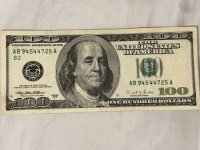
Benjamin Franklin is on the US $100 bill.

- Joined
- May 11, 2015
- Member Type
- English Teacher
- Native Language
- English
- Home Country
- United States
- Current Location
- United States
Well, I thought I'd see who was on the similar bill in the UK, but apparently only the Banks of Scotland and Northern Ireland even issue £100 notes. Is £50 really the largest denomination in common circulation? Seems limiting if you're paying larger sums in cash.It's meaningless to this elderly speaker of BrE.
$100 bills are quite common in the U.S., even for daily use (at least for those who prefer cash anyway).
Back on topic though - I wouldn't recommend using the phrase in question. Some stores will post signage stating 'no $100 dollar bills' or 'no bills larger than $50'. Otherwise you can assume they will.
If you needed to ask, I'd say something like "Can I pay with $100 bills" or "Do you accept $100 bills?"


- Joined
- Apr 13, 2019
- Member Type
- Other
- Native Language
- Polish
- Home Country
- Poland
- Current Location
- Poland
I used it when I was in a liquor store in Las Vegas, to a young dude working there, who repeatedly called me brother, and used expressions such as "Nobody won't even trip" after he explained I didn't need a paper bag to drink alcohol in public if I stayd on the Strip.
I think I have heard someone call a hundred-dollar bill a Benjamin, but I'm not sure. Maybe I'm just imagining things, misremember it, or maybe I did hear it, but it was a rare, local thing, or perhaps when I heard it, it was just something someone came up with on their own. Anyway, the dude seemed to get what I meant.
Is it common? Does it work with just Benjamin Franklin, or can I use other presidents like that too?
I think I have heard someone call a hundred-dollar bill a Benjamin, but I'm not sure. Maybe I'm just imagining things, misremember it, or maybe I did hear it, but it was a rare, local thing, or perhaps when I heard it, it was just something someone came up with on their own. Anyway, the dude seemed to get what I meant.
Is it common? Does it work with just Benjamin Franklin, or can I use other presidents like that too?
- Joined
- Apr 17, 2009
- Member Type
- Interested in Language
- Native Language
- American English
- Home Country
- United States
- Current Location
- United States
Having a "stack of Benjamins" seems like something from rap/hip hop culture.
It's not nearly as impressive with smaller bills, and no you can't ask someone for change for a Jackson, or for two Abes for a Hamilton.
You're best not trying to do this at all. And, Franklin was never a president. Influential, yes, but not a president.
It's not nearly as impressive with smaller bills, and no you can't ask someone for change for a Jackson, or for two Abes for a Hamilton.
You're best not trying to do this at all. And, Franklin was never a president. Influential, yes, but not a president.
- Joined
- May 11, 2015
- Member Type
- English Teacher
- Native Language
- English
- Home Country
- United States
- Current Location
- United States
If you really want to impress (or confuse) people, offer them Jeffersons. The bill, not the coin.
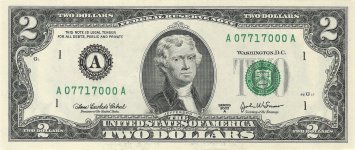
I've had arguments with cashiers that I wasn't foisting off fake money. One called me a counterfeiter, even.
I asked them if they really thought anyone would go to the trouble of counterfeiting a two-dollar bill instead of hundred dollar bills....
I've had arguments with cashiers that I wasn't foisting off fake money. One called me a counterfeiter, even.
I asked them if they really thought anyone would go to the trouble of counterfeiting a two-dollar bill instead of hundred dollar bills....

- Joined
- Jul 28, 2009
- Member Type
- English Teacher
- Native Language
- British English
- Home Country
- UK
- Current Location
- UK
The £50 note is the largest note issued by the Bank of England, and many places refuse to accept them because there are so many forgeries in circulation. I've never seen a Scottish or Northern Irish £100 note. The majority of people in the UK would pay a large sum by card, direct bank transfer or cheque (although I don't know anyone who even has a cheque book any more). Of course, if the person/business you're paying accepts £50 notes, you can pay a large sum using them if you've got enough of them. ATMs don't dispense £50 notes at all. The largest you can get out of an ATM is a £20. If you go into a bank or Post Office to withdraw a large amount of cash, you can ask not to receive any £50 notes if you're not willing to take the risk of a business not accepting it.Well, I thought I'd see who was on the similar bill in the UK, but apparently only the Banks of Scotland and Northern Ireland even issue £100 notes. Is £50 really the largest denomination in common circulation? Seems limiting if you're paying larger sums in cash.
- Joined
- Jun 20, 2010
- Member Type
- Retired English Teacher
- Native Language
- British English
- Home Country
- England
- Current Location
- England
I agree with nearly all of the above, emsr2d2. 
FYI, you know one person who has a cheque book (guess who) and uses it occasionally in the hope that my bank (Rats! Now you don't need to guess who) won't abolish it altogether just yet.
Also, my local NatWest branch (Blackburn, Lancs) has an ATM which dispenses £50 notes. I expect other large branches do too.
FYI, you know one person who has a cheque book (guess who) and uses it occasionally in the hope that my bank (Rats! Now you don't need to guess who) won't abolish it altogether just yet.
Also, my local NatWest branch (Blackburn, Lancs) has an ATM which dispenses £50 notes. I expect other large branches do too.
Last edited:
- Joined
- Jun 20, 2010
- Member Type
- Retired English Teacher
- Native Language
- British English
- Home Country
- England
- Current Location
- England
Is £50 really the largest denomination in common circulation?
It's our largest note, but not in common circulation (yet). See emsr2d2's reply above.
Seems limiting if you're paying larger sums in cash.
I can't help feeling the same thing happened over there when your $100 bill was first introduced.
- Joined
- Jul 28, 2009
- Member Type
- English Teacher
- Native Language
- British English
- Home Country
- UK
- Current Location
- UK
I probably shouldn't have sounded quite so certain about the ATMs not giving out £50 notes. I was going solely by personal experience - I used to get cash from the same ATM every time, which is at my local petrol station, not at a bank, and I last got cash out in 2019!Also, my local NatWest branch (Blackburn, Lancs) has an ATM which dispenses £50 notes. I expect other large branches do too.
PeterCW
Senior Member
- Joined
- Apr 1, 2020
- Member Type
- Interested in Language
- Native Language
- British English
- Home Country
- England
- Current Location
- England
I have never come across an ATM dispensing £50s either.I probably shouldn't have sounded quite so certain about the ATMs not giving out £50 notes. I was going solely by personal experience - I used to get cash from the same ATM every time, which is at my local petrol station, not at a bank, and I last got cash out in 2019!
I worked briefly on a foreign exchange counter in my youth. US currency was a pain in the **** to handle with all the notes being identical in size and colour.

- Joined
- Oct 14, 2010
- Member Type
- English Teacher
- Native Language
- British English
- Home Country
- Czech Republic
- Current Location
- Czech Republic
Can we get this thread back to the original question please?
Is "Can I pay with a Benjamin?" a valid alternative to asking "Can I pay with a hundred-dollar bill"?
- Joined
- Apr 13, 2019
- Member Type
- Other
- Native Language
- Polish
- Home Country
- Poland
- Current Location
- Poland
I had a different problem. It turned out people really wanted to write on my Benjamins. They apparently have a unique kind of complexion that interacts with make up in a very specific way.
On top of that, not all Benjamins were from the same generation. The younger ones wore flamboyant colors whereas the old folks kept to the classic light and dark shades of green.
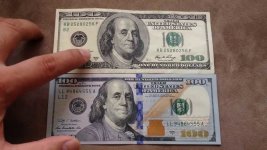
On top of that, not all Benjamins were from the same generation. The younger ones wore flamboyant colors whereas the old folks kept to the classic light and dark shades of green.
Last edited:

- Joined
- Jul 29, 2006
- Location
- Spencers Wood, near Reading, UK
- Member Type
- Retired English Teacher
- Native Language
- English
- Home Country
- UK
- Current Location
- UK
Not entirely devoid of meaning to me - I knew it was some sort of high-value dollar bill. But what fraction it is of a 'Portrait of Madison', I don't know. (PoM is a term I've met only in a Raymond Chandler novel.)It's meaningless to this elderly speaker of BrE.
Similar threads
- Replies
- 1
- Views
- 656

- Replies
- 2
- Views
- 2K

- Locked
- Replies
- 4
- Views
- 681
- Locked
- Replies
- 3
- Views
- 580

Ask a Teacher
If you have a question about the English language and would like to ask one of our many English teachers and language experts, please click the button below to let us know:
(Requires Registration)