Colon in multiple-choice questions

Status
Not open for further replies.

mrmvp

Senior Member
Joined
Jul 13, 2017
Member Type
Student or Learner
Native Language
Arabic
Home Country
United Arab Emirates
Current Location
United Arab Emirates
Hello.

"I am writing an exam and don’t know what best fits when writing multiple-choice questions. When the question is a statement stem and does not start with a question word (direct question), should I use a colon or a blank line?

Q3.In Bloom’s Revised Taxonomy, the Evaluation level becomes ________.

A. Creating
B. Analyzing
C. Understanding
D. Remembering

Should I replace the blank line with colon?
 
I'm not quite sure what you mean but the way Q3 is laid out above is correct (except you need a space before "In Bloom's". The long line indicates the missing word and the full sentence correctly ends with a full stop. An empty line before the options looks better than squashing them all together.

With the four options (A-D), don't start them with a capital letter. They're not going to start with a capital in the finished sentence so they don't need to be capitalised in the list either.

Is "Bloom's Revised Taxonomy" the title of a book?
In the second clause, why is "evaluation" capitalised?

I'm a bit concerned about the whole question, though, because none of those four options seem to lead to a grammatical sentence (because they end with -ing).
 
I'm not quite sure what you mean but the way Q3 is laid out above is correct (except you need a space before "In Bloom's". The long line indicates the missing word and the full sentence correctly ends with a full stop. An empty line before the options looks better than squashing them all together.

With the four options (A-D), don't start them with a capital letter. They're not going to start with a capital in the finished sentence so they don't need to be capitalised in the list either.

Is "Bloom's Revised Taxonomy" the title of a book?
In the second clause, why is "evaluation" capitalised?

I'm a bit concerned about the whole question, though, because none of those four options seem to lead to a grammatical sentence (because they end with -ing).

Thank you for your feedback. No, there is no book called Bloom's Revised Taxonomy, but there is a book titled A Taxonomy for Learning, Teaching, and Assessing: A Revision of Bloom’s Taxonomy of Educational Objectives. In that book, the author explains educational objectives and how to formulate questions effectively.


For example:

Q1 What is the capital of France?
This question measures how well students can recall information.

Q2 Write a commentary on the moral lessons of the novel A Christmas Carol. (Let's say this question is given to university students)

The above is a higher-order question that requires students to critically analyze the text, and employ academic writing skills.

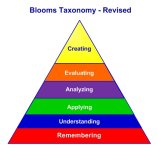
The revised taxonomy ends with categories in gerund form (e.g., Remembering, Understanding, Applying). The reason I capitalized Evaluation and the choices is that they are widely recognized terms in curriculum and pedagogy.

Please see the attached picture
 

Attachments

  • Blooms-Revised.jpg
    Blooms-Revised.jpg
    35.9 KB · Views: 0
You've made a basic mistake in test design. Since you're writing a question to test your students' knowledge of Bloom's Taxonomy, then a sentence gap-fill exercise is entirely inappropriate. Write the question like this:

In Bloom’s Revised Taxonomy, which cognitive process replaces the 'Evaluating' level from the original taxonomy?

A. Creating
B. Analyzing
C. Understanding
D. Remembering


If this is suposed to be a test of linguistic competence, which is precisely what these multiple choice gap-fill exercises are intended for, then the answer should not depend on subject knowledge. Get very clear in your mind what you're testing, and then test specifically.

Note also the benefits of consistency across the verb form of labels. Some representations of the taxonomy that you see will use basic verb forms (e.g. 'evaluate'), some will use -ing forms (e.g. 'evaluating'), and some will use noun forms (e.g. 'evaluation'). It doesn't really matter which of these you use but you should be consistent.
 
Last edited:
Status
Not open for further replies.

Ask a Teacher

If you have a question about the English language and would like to ask one of our many English teachers and language experts, please click the button below to let us know:

(Requires Registration)
Back
Top