
Could/Might

Status
Not open for further replies.

Rachel Adams

Key Member
Joined
Nov 4, 2018
Member Type
Student or Learner
Native Language
Russian
Home Country
Georgia
Current Location
Georgia
Hello.

I was completing an online test and according to its results it is wrong to use ''could'' but in Swan's book I read that ''could'' ''may'' and ''might'' express possibility. ьшпреееееееее&#107.PNG
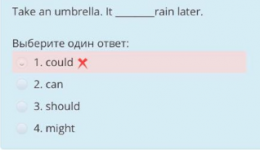
 
Between the two I would prefer "might", but "could" could work also and I would not consider it wrong.
 
"Might" is the correct answer. While "It could rain later" is not grammatically wrong, it's a non sequitur: it doesn't relate to the previous statement.
 
might is the best answer.

Whether could is wrong depends what you mean by 'wrong'. Using could is not ungrammatical, but I assume that the test instruction did not ask that you 'select all grammatical answers', so I think it's fair to say that could is wrong. The task instruction should have said something like 'select the best answer', or 'select the most appropriate answer'.
 
might is the best answer.

Whether could is wrong depends what you mean by 'wrong'. Using could is not ungrammatical, but I assume that the test instruction did not ask that you 'select all grammatical answers', so I think it's fair to say that could is wrong. The task instruction should have said something like 'select the best answer', or 'select the most appropriate answer'.

Why is it the best answer?
 
"Might" is the correct answer. While "It could rain later" is not grammatically wrong, it's a non sequitur: it doesn't relate to the previous statement.

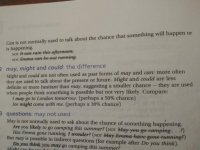
Please don't think that I argue with you or with any of the native speakers here. I said many times that I find the forum very helpful.:) I just don't undertsand one thing. In grammar books I read the rules but when I ask about them or complete tests I find out the actual use of the modal verbs is not based on the rules I read. For example, according to Swan ''May, might and could are used to talk about the present or future. I may go to London (perhaps a 50% chance. Joe might come with me. (Perhaps a 30 % chance).''
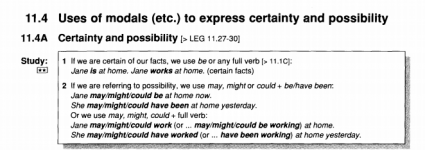
The screenshot it from Longman English Grammar. longcould.PNG
 
Last edited:
The percentage figures are not from Swan - at least not from the part you showed us.


The screenshot in post 6 is from Longman but this screen with percentage figures is from Swan.98345599_251851889387005_6332690275906879488_n.jpg It says just like Longman that ''Could'' is possible.
 
Why is it the best answer?

Because it fits the context the best.

Please don't think that I argue with you or with any of the native speakers here. I said many times that I find the forum very helpful.:) I just don't undertsand one thing. In grammar books I read the rules but when I ask about them or complete tests I find out the actual use of the modal verbs is not based on the rules I read.

Nobody thinks you're arguing, Rachel.

I can sympathise with what you're saying. Grammar books don't tend to explain very well how to use modal verbs accurately. The screenshot from Longman is a good example of this. It seems to be suggesting that those verbs are identical.

For example, according to Swan ''May, might and could are used to talk about the present or future. I may go to London (perhaps a 50% chance. Joe might come with me. (Perhaps a 30 % chance).''
That doesn't tell you about the differences between those verbs.

Swan does not mention anything about percentages, because that is a completely wrong way to understand things.
 
The screenshot in post 6 is from Longman but this screen with percentage figures is from Swan.View attachment 3511 It says just like Longman that ''Could'' is possible.

Okay, Piscean and I were wrong when we said Swan doesn't use percentages. I must say that that depresses me somewhat. That is a disastrously poor way of attempting to teach how modal verbs express possibility.
 
Okay, Piscean and I were wrong when we said Swan doesn't use percentages. I must say that that depresses me somewhat. That is a disastrously poor way of attempting to teach how modal verbs express possibility.

Thank you so much jutfrank. What book should I use? I am lost. You are right it suggests ''could/may/might'' are identical that's why I thought they can be used interchangeably in my sentence. What do I need to know about ''could''? I don't quite understand why it is wrong.
 
Put simply, it could rain at any time (unless you live somewhere where it never rains) but today, specifically, it actually might rain. It's possible that the comment is based on a weather forecast or by looking at the sky! I don't subscribe to the idea of percentages being used with such modals, but in this scenario, "might" indicates a stronger possibility than "could".
 
Put simply, it could rain at any time (unless you live somewhere where it never rains) but today, specifically, it actually might rain. It's possible that the comment is based on a weather forecast or by looking at the sky! I don't subscribe to the idea of percentages being used with such modals, but in this scenario, "might" indicates a stronger possibility than "could".

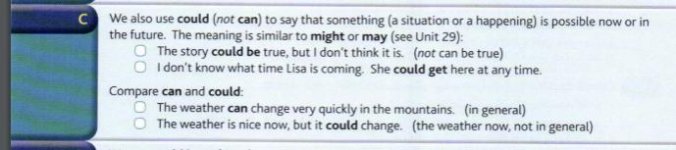
I found a similar example in Murphy's English Grammar with "Could". Just like Swan and Longman it seems to be suggesting that "could/might/may" are used interchangeably.could wrong.jpg
 
Last edited:
I found a similar example in Murphy's English Grammar with "Could". Just like Swan and Longman it seems to be suggesting that "could/might/may" are used interchangeably.
It doesn't say that. It says they're similar.
 
It doesn't say that. It says they're similar.
The example is the test and the book's example are similar too. It says ''The weather could change.'' The test's example says ''It could rain later.''
 
The problem with tests like that is that there is often no single correct answer. No one is saying that "It could rain later" is wrong. However, if you want to know what native speakers would actually say, you'll have to just take it from us that it's "It might rain later".
 
The example is the test and the book's example are similar too. It says ''The weather could change.'' The test's example says ''It could rain later.''
Both are true statements. When you're advising someone to take an umbrella, you generally express a little higher likelihood. "Could" means it's not objectively impossible; "might" means you think there's a reasonable chance it will happen.

Rather than trying to find a rule to help you choose between these similar words, you should read as much as you can. Read books and stories with lots of dialog, set in recent times. You'll gradually build a mental inventory of uses of these modals. Eventually, you'll unconsciously consult this inventory when you need to choose one. The deeper the inventory, the better the odds that your choice will match that of a native speaker.
 
Put simply, it could rain at any time (unless you live somewhere where it never rains) but today, specifically, it actually might rain. It's possible that the comment is based on a weather forecast or by looking at the sky! I don't subscribe to the idea of percentages being used with such modals, but in this scenario, "might" indicates a stronger possibility than "could".

If a native speaker used ''May'' instead would it indicate a stronger possibility than ''might''?
 
If a native speaker used ''may'' instead, would it indicate a stronger possibility than ''might''?

Not necessarily, but it will probably elicit a response from a purist pointing out that "may" is used for permission, not possibility.

Raincloud: May I rain?
Boss: Of course you may.
Raincloud: Thank you so much.
Cirrus cloud to boss: What was that raincloud talking to you about?
Boss: It wants to rain and wanted my permission.
Cirrus cloud: What did you say?
Boss: It may rain. That's my decision.

(Yes, I know that's a ridiculous conversation but ...!)
 
The problem with tests like that is that there is often no single correct answer. No one is saying that "It could rain later" is wrong. However, if you want to know what native speakers would actually say, you'll have to just take it from us that it's "It might rain later".

There was another question in that test. "May I have/can I have one of these cakes?" Well, I read in my books that "may", "might" and "can" are used in such questions. Something told me to use "can" and it was correct. Would you use it too?
 
Status
Not open for further replies.

Ask a Teacher

If you have a question about the English language and would like to ask one of our many English teachers and language experts, please click the button below to let us know:

(Requires Registration)
Back
Top