He is singing and she dancing.

Queueuey

Member
Joined
Sep 20, 2024
Member Type
Interested in Language
Native Language
Macedonian
Home Country
Macedonia
Current Location
Ukraine
Ellipting the first (shared) verb before different main verbs in coordinated structures like 'He [can/will/did/wanted to] sing and she dance".

Let me list the patterns for the auxiliaries, modals and other verbs that I have in mind:
  1. He is singing and she dancing.
  2. He will sing and she dance.
  3. Can [or any other modals] he sing and she dance?
  4. Did he sing and she dance?
  5. Has he sung and she danced?
  6. He remained seated and she standing.
  7. He wanted to sing and she (to?) dance.
Which of these are correct?
 
Last edited:
Before we continue, what is the purpose of your text? Starting with "Let me" suggests you're either answering a question or aiming to teach some other English learners.
 
Before we continue, what is the purpose of your text? Starting with "Let me" suggests you're either answering a question or aiming to teach some other English learners.
Starting with "Let me ask you a question" is certainly not a mortal sin, is it? What about failing to answer it?
 
But you did not start with "Let me ask .. ".
You started with "Let me list..." which has a different meaning.
 
So far there have been 3 responses and none contained any comments on the correctness of the listed sentences. Fantastic.
 
As @emsr2d2 asked, please tell us the purpose of your text.

I request members not to reply to this thread until the OP has complied.
 
  1. He is singing and she dancing.
  2. He will sing and she dance.
  3. Can [or any other modals] he sing and she dance?
  4. Did he sing and she dance?
  5. Has he sung and she danced?
  6. He remained seated and she standing.
  7. He wanted to sing and she (to?) dance.
Which of these are correct?
I find all seven of them to be grammatically correct, provided infinitival to is used before dance in (7): He wanted to sing and she to dance. That said, I do find (6) a bit strained. Also, sentences (3), (4), and (5) can be analyzed as not containing ellipsis at all; the auxiliary verb in each clause of the compound question simply moves together with and joins the auxiliary verb of the other clause as they both move to the front of the compound question, in a phenomenon known as "across-the-board movement." But there is indeed ellipsis in (1), (2), (6), and (7). The type of ellipsis involved is called "gapping."

P.S. I had composed this reply to your question before further replies became forbidden.
 
Last edited:
@Rover_KE How did that happen to post #8? You definitely didn't write it!
 
@Rover_KE How did that happen to post #8? You definitely didn't write it!
Obviously, I (Queueuey) wrote it.
The site may be broken (I am not a hacker) or was overloaded by the overzealous moderators, I assume.
 
Obviously, I (Queueuey) wrote it.
The site may be broken (I am not a hacker) or was overloaded by the overzealous moderators, I assume.
I know you wrote it. I saw the original. There has clearly been a glitch, perhaps while Rover was attempting to respond to your post. I'm simply trying to get to the bottom of it.

The site is not broken and we moderators are not over-zealous.
 
I know you wrote it. I saw the original. There has clearly been a glitch, perhaps while Rover was attempting to respond to your post. I'm simply trying to get to the bottom of it.

The site is not broken and we moderators are not over-zealous.
Can your sentence be ellipted to "The site is not broken and we moderators (are) not over-zealous."?
 
Can your sentence be ellipted to "The site is not broken and we moderators (are) not over-zealous."?
That does not work because of the change of form of the verb. This is possible: "The site is not broken and the moderator (is) not over-zealous."
 
Last edited by a moderator:
Sorry about that. I must have done something stupid. :oops:
 
I find 1 to be the worst of the lot. I think it's so bad that I'd consider it to strain the limits of grammaticality even if a native speaker said it. 2 is not far behind. The questions (3,4,5) are not bad at all.
 
He will sing and she dance.
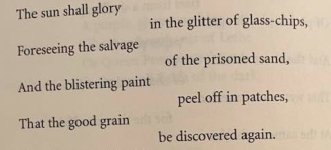
This type of ellipsis (modal gapping) tends to be found mainly in literary contexts, not in mundane sentences like that one, especially when the subject of each clause is a one-syllable pronoun and the predicate a bare, unmodified, one-syllable verb. Here's an elegant example of modal gapping. It's a sentence from Richard Wilbur's poem "Junk" (1961):
wilbur junk.jpg
Disregarding the fancy lineation, we can represent the sentence like this:
  • The sun shall glory in the glitter of glass chips, foreseeing the salvage of the prisoned sand, and the blistering paint peel off in patches, that the good grain be discovered again.
The subject of the second independent clause is blistering paint, and the elided modal is shall. Were one to assume that this type of ellipsis should be applied anywhere it can, regardless of how it sounds to people with an ear for English, then one might try to write the blunt and coarse version below and wonder why people at grammar websites dislike it:
  • This shall glory and that peel off.
 
This type of ellipsis (modal gapping) tends to be found mainly in literary contexts, not in mundane sentences like that one, especially when the subject of each clause is a one-syllable pronoun and the predicate a bare, unmodified, one-syllable verb. Here's an elegant example of modal gapping. It's a sentence from Richard Wilbur's poem "Junk" (1961):
View attachment 6289
Disregarding the fancy lineation, we can represent the sentence like this:
  • The sun shall glory in the glitter of glass chips, foreseeing the salvage of the prisoned sand, and the blistering paint peel off in patches, that the good grain be discovered again.
The subject of the second independent clause is blistering paint, and the elided modal is shall. Were one to assume that this type of ellipsis should be applied anywhere it can, regardless of how it sounds to people with an ear for English, then one might try to write the blunt and coarse version below and wonder why people at grammar websites dislike it:
  • This shall glory and that peel off.
This is certainly more coarse and less idiomatic than "I'll wash and you dry, OK?".

Now, if the ellipsis even in literary contexts is to be justified by a certain level of the complexity of the sentence, would the following sentence strike your ear as off?

The lazy schoolchildren won't do the maths homework given to them by Mrs. Black on Friday as she hasn't really explained how to do it, and their parents bother to check if they have a clue about how to do it.
 
This is certainly more coarse and less idiomatic than "I'll wash and you dry, OK?".
I don't find that example relevant to the discussion, insofar as it doesn't strike me as elliptical for I'll wash and you'll dry, OK? I interpret it as a casual, grammatically sloppy way of saying either I wash and you dry, OK? (no modal before the main verb in the first independent clause) or I'll wash if you dry, OK? (in which and is replaced with if).
Now, if the ellipsis even in literary contexts is to be justified by a certain level of the complexity of the sentence, would the following sentence strike your ear as off?

The lazy schoolchildren won't do the maths homework given to them by Mrs. Black on Friday as she hasn't really explained how to do it, and their parents bother to check if they have a clue about how to do it.
That example doesn't just strike my ear as off; it strikes me as being grammatically incapable of expressing what you probably think it expresses. I assume that you think there is an elided won't before bother in the second independent clause:

The children won't do the homework, and their parents [won't] bother to check whether they understand how to do it.

I don't think that the ellipsis you are implicitly alleging here is grammatically possible. You simply can't elide won't -- or any other auxiliary verb to which not has been contracted -- and keep the main verb unelided. Now, you could say this:

Neither will the children do the homework, nor their parents bother to check whether they understand how to do it.

This actually touches upon something I discovered recently. The condition under which it is possible for neither . . . nor to introduce independent clauses is precisely gapping of the auxiliary in the second independent clause (introduced by nor).
 
I can construe your example as

If parents don't bother to check whether their children understand how to do it, they won't do the homework.
 

Ask a Teacher

If you have a question about the English language and would like to ask one of our many English teachers and language experts, please click the button below to let us know:

(Requires Registration)
Back
Top