
He is singing and she dancing.

I can construe your example as

If parents don't bother to check whether their children understand how to do it, they won't do the homework.
No, there is no conditional meaning. My green example means the same thing as the example in blue, which is the meaning you presumably intended for your purple example in post #18.

I simply pruned off some unnecessary leaves from your purple example (such as the word "maths," which I can't stand as a native AmE speaker, and the explanatory "as"-clause) and changed the "have a clue" part to something more formal.
 
No, there is no conditional meaning. My green example means the same thing as the example in blue, which is the meaning you presumably intended for your purple example in post #18.

I simply pruned off some unnecessary leaves from your purple example (such as the word "maths," which I can't stand as a native AmE speaker, and the explanatory "as"-clause) and changed the "have a clue" part to something more formal.
OK. Your example involves inversion, just as the interrogative form.
 
OK. Your example involves inversion, just as the interrogative form.
That example does involve inversion, as do your interrogative examples. Whether the same analysis (across-the-board movement rather than ellipsis) can apply to the case of neither . . . nor . . . is a different matter. I'm inclined to think that there is genuine ellipsis of the auxiliary in the neither . . . nor . . . case.

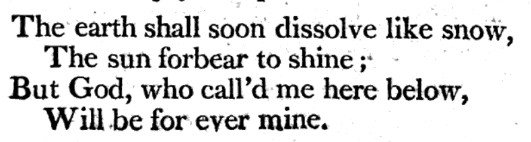
Incidentally, a very famous text that features modal gapping came to my mind today: the final stanza of the hymn "Amazing Grace" (1772), by John Newton -- perhaps the most famous hymn ever written. Many people think the last stanza is the one beginning "When we've been there ten thousand years," but that stanza was added later on, by American slaves.

Newton.jpg
In that example, "and" is missing, as well as the modal, from the second independent clause; that is, there is asyndetic coordination. Clearly, the sentence is a reduction of "The earth shall soon dissolve like snow, and the sun shall (soon) forbear to shine; but God, who called me here below, will be forever mine."

The reductions may have been done for the sake of meter. In my opinion, however, they make the sentence far more elegant.
 

Ask a Teacher

If you have a question about the English language and would like to ask one of our many English teachers and language experts, please click the button below to let us know:

(Requires Registration)
Back
Top