He was the CEO since 2004.

There seem to be a lot of exceptions to the rules.
That's English for you. For every rule you learn, there'll be a dozen exceptions to it! Fun, eh?
Could you give your feedback on my post #13?
I've been trying to understand the various instances where simple tenses are allowable in the main clause.
I think the third link is pretty clear when it says there are a few exceptions and gives examples.
 
Could you give your feedback on my post #13?

Post #13 is just a set of links to other sites, one being a dictionary. What would you like me to do with that? Be more specific, please.

If you want my opinion, we should go back to post #1 and discuss firstly whether we believe that any of those three examples you gave are considered to be grammatical.
 
Post #13 is just a set of links to other sites, one being a dictionary. What would you like me to do with that? Be more specific, please.

If you want my opinion, we should go back to post #1 and discuss firstly whether we believe that any of those three examples you gave are considered to be grammatical.
I posted the links in response to your post #12 asking if I could post the links to the references and forums I'd used to come to that understanding about my example sentences in post #1, to help things along.

And yes, I would like to discuss that.
The grammatical accuracy of those three sentences is what I've been trying to establish.
 
Is it possible to use simple past and past continuous tenses in the main clause of a sentence with temporal since?

We use perfect tenses before temporal 'since', not simple or continuous ones. The aspect of the word 'since' matches perfectly to the perfect aspect. This is perhaps simpler than you might think.

Eg.
He was the CEO since 2004.

He was going to bed early since the accident.

Those are both wrong.

1) The main clause has a time adverbial
Eg. It is ten years since I last saw her

The fact there's a time adverbial is irrelevant. Think of this as an example of the following pattern:

it + is/was + time phrase + since phrase

This is the pattern mentioned on the dictionary page you linked to. In terms of meaning and use, the simple aspect in this pattern is identical to its present perfect equivalent:

It's ten years since I rode bike.
It's been ten years since I rode a bike.


These two sentences are synonymous. You may think of this pattern as an exception that must be explained, or just accept it as a kind of non-standard expression.

2) The temporal since has a causative element to it
Eg. He is going to bed early since his accident
(could also be because he had that accident)

I disagree with all of this. First, the sentence is ungrammatical in my book. Second, I can't see how the 'since'-phrase there is causative (Do you mean ... since he had an accident?) Third, how can it be both temporal and causative?

3) The sentence itself is biographical in nature
Eg. He is the CEO since 2004

This sentence is no good.

All of the above are regarded as grammatically correct.

I think only the first is properly defensible.
 
Last edited:
You can say:

1. He has been the CEO since 2004.
2. He's been going to bed early since the accident.
3. It's been ten years since I rode a bike.
4. There's been snow on the ground all day.

All of them make sense within the proper context.
 
We use perfect tenses before temporal 'since', not simple or continuous ones. The aspect of the word 'since' matches perfectly to the perfect aspect. This is perhaps simpler than you might think.


Those are both wrong.


The fact there's a time adverbial is irrelevant. Think of this as an example of the following pattern:

it + is/was + time phrase + since phrase

This is the pattern mentioned on the dictionary page you linked to. In terms of meaning and use, the simple aspect in this pattern is identical to its present perfect equivalent:

It's ten years since I rode bike.
It's been ten years since I rode a bike.


These two sentences are synonymous. You may think of this pattern as an exception that must be explained, or just accept it as a kind of non-standard expression.


I disagree with all of this. First, the sentence is ungrammatical in my book. Second, I can't see how the 'since'-phrase there is causative (Do you mean ... since he had an accident?) Third, how can it be both temporal and causative?


This sentence is no good.


I think only the first is properly defensible.

Thank you for your response. I suppose you don't agree with the explanation offered by Raymott in the second link I shared.

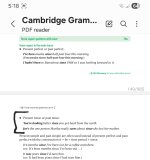
I've attached a screenshot from a Cambridge grammar book.
 

Attachments

  • Screenshot_20260103_171834_Samsung Notes.jpg
    Screenshot_20260103_171834_Samsung Notes.jpg
    186.5 KB · Views: 9
You can say:

1. He has been the CEO since 2004.
2. He's been going to bed early since the accident.
3. It's been ten years since I rode a bike.
4. There's been snow on the ground all day.

All of them make sense within the proper context.
My question is about the use of simple tenses in the main clause in particular, as exceptions to the general rules.
The use of perfect tenses is common and understandable.
 
I suppose you don't agree with the explanation offered by Raymott in the second link I shared.

Which particular bit are you asking about?
 

Attachments

  • Screenshot_20260126_212826_Chrome.jpg
    Screenshot_20260126_212826_Chrome.jpg
    506.5 KB · Views: 7
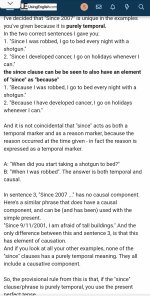
This explanation
👇🏻

Raymott is saying that when the semantics of the 'since'-phrase are purely temporal, then it must be perfective in aspect. I agree with that part. To give some concession to the strength of this 'rule', I think there may often be some dialectical factors that come into play as complicating factors, but if we're talking about standard grammar then I agree.

But I think Ray is also suggesting that the more causal the 'since'-phrase is, the more it can license non-perfective aspects, such that most 'since'-phrases, rather than being either temporal or causal, are in fact a mix of both. I'd never come across this idea explicitly before so I'd have to think about it further, but my immediate reaction is that it's an interesting and persuasive explanation.
 
Last edited:

Ask a Teacher

If you have a question about the English language and would like to ask one of our many English teachers and language experts, please click the button below to let us know:

(Requires Registration)
Back
Top