
You are using an out of date browser. It may not display this or other websites correctly.
You should upgrade or use an alternative browser.
You should upgrade or use an alternative browser.
I have a coffee
- Thread starter liliii
- Start date
- Views : 2,487
- Status
- Not open for further replies.

- Joined
- Jul 28, 2009
- Member Type
- English Teacher
- Native Language
- British English
- Home Country
- UK
- Current Location
- UK
1. In what context do you hear "everyone" saying that sentence? I can only imagine someone saying that when they actually have a coffee in their hand or on the table in front of them. I don't know why they would say it though.Everyone says "I have a coffee" even though it is incorrect grammar? At what point does common usage make it correct?
2. Why do you think "I have a coffee" is grammatically incorrect?
Tarheel
VIP Member
- Joined
- Jun 16, 2014
- Member Type
- Interested in Language
- Native Language
- American English
- Home Country
- United States
- Current Location
- United States
Q: Does everyone say "I have a coffee" even though it is incorrect grammar?
A: It's hard to imagine why anybody would say that. Nevertheless, I wouldn't say it is incorrect grammar.
There are any number of things people are unlikely to say even though they are grammatical sentences.
A: It's hard to imagine why anybody would say that. Nevertheless, I wouldn't say it is incorrect grammar.
There are any number of things people are unlikely to say even though they are grammatical sentences.
- Joined
- Dec 11, 2023
- Member Type
- English Teacher
- Native Language
- English
- Home Country
- UK
- Current Location
- UK
I am not an English teacher. I was trying to change that on my settings.
''I have a coffee.''
shouldn't it be ''I have some coffee?''
or
''I have a cup of coffee?''
''I have a coffee.''
shouldn't it be ''I have some coffee?''
or
''I have a cup of coffee?''
Piscean
Senior Member
- Joined
- Jul 12, 2015
- Member Type
- Retired English Teacher
- Native Language
- British English
- Home Country
- Europe
- Current Location
- Czech Republic
Each of them can be correct in the appropriate context, though most speakers of BrE would say I've got rather than I have these days.''I have a coffee.''
''I have some coffee?''
''I have a cup of coffee?''
- Joined
- Dec 11, 2023
- Member Type
- English Teacher
- Native Language
- English
- Home Country
- UK
- Current Location
- UK
I am asking about coffee as an uncountable noun. '' ......a coffee?'' How can this be correct? Coffee is uncountable. Yet I hear people saying ''a coffee'' in many contexts. So, does common usage make what is technically incorrect, correct?

- Joined
- Feb 18, 2015
- Member Type
- English Teacher
- Native Language
- English
- Home Country
- Iraq
- Current Location
- Iraq


- Joined
- Dec 11, 2023
- Member Type
- English Teacher
- Native Language
- English
- Home Country
- UK
- Current Location
- UK
Yes, for example I have a drink of coffee in my hand. Or I bought a cup of coffee.
But I am asking about something different. People regularly say, '' a coffee''. For example, I had a coffee this morning. Or I grabbed a coffee on the way to work. This is common usage now. Does common usage make it correct?
But I am asking about something different. People regularly say, '' a coffee''. For example, I had a coffee this morning. Or I grabbed a coffee on the way to work. This is common usage now. Does common usage make it correct?
- Joined
- Apr 17, 2009
- Member Type
- Interested in Language
- Native Language
- American English
- Home Country
- United States
- Current Location
- United States
Once again, "coffee" can be both countable and uncountable.
When you stop off at a shop and get a cup of coffee, it is entirely normal to say you got "a coffee." It's discrete. Countable.
Just like "beer" is both. I can say "I had a bunch of beer." Or I can say "I had a bunch of beers." Because they come in discrete, countable units.
When you stop off at a shop and get a cup of coffee, it is entirely normal to say you got "a coffee." It's discrete. Countable.
Just like "beer" is both. I can say "I had a bunch of beer." Or I can say "I had a bunch of beers." Because they come in discrete, countable units.
Piscean
Senior Member
- Joined
- Jul 12, 2015
- Member Type
- Retired English Teacher
- Native Language
- British English
- Home Country
- Europe
- Current Location
- Czech Republic
That is correct and natural English. I have no idea why you think it's not,But I am asking about something different. People regularly say, '' a coffee''. For example, I had a coffee this morning. Or I grabbed a coffee on the way to work.

- Joined
- Jan 7, 2011
- Member Type
- Retired English Teacher
- Native Language
- English
- Home Country
- Canada
- Current Location
- Canada
most speakers of BrE would say I've got rather than I have these days.
That goes for Canadian English too, and I believe for Americans as well, although I stand to be corrected on that point.
- Joined
- Jul 28, 2009
- Member Type
- English Teacher
- Native Language
- British English
- Home Country
- UK
- Current Location
- UK
You just need to get into your profile and change it there.I am not an English teacher. I was trying to change that on my settings.
You need to find the quotation marks key on your keyboard. We don't make quotation marks by using two apostrophes."I have a coffee."
Shouldn't it be "I have some coffee?" or "I have a cup of coffee?"
Always start a sentence with a capital letter.
Note my corrections above. It's not technically incorrect.I am asking about coffee as an uncountable noun. "... a coffee?" How can this be correct? Coffee is uncountable no full stop here yet I hear people saying "a coffee" in many contexts. So, does common usage make what is technically incorrect, correct?
It's not natural to say "I have a drink of coffee in my hand". We'd say either "I have a coffee in my hand" or "I have a cup/mug of coffee in my hand".Yes, for example "I have a drink of coffee in my hand" or "I bought a cup of coffee".
It's already correct.ButI am asking about something different. People regularly say, "a coffee". For example, "I had a coffee this morning" or "I grabbed a coffee on the way to work". This is common usage now. Does common usage make it correct?
Don't start a sentence with "or". When you write two things with "or" between them, the "or" simply comes in the middle of the longer sentence.
Don't start a sentence with "But".
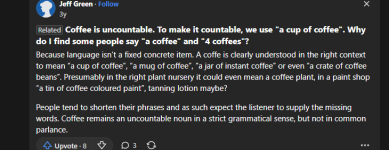
Piscean
Senior Member
- Joined
- Jul 12, 2015
- Member Type
- Retired English Teacher
- Native Language
- British English
- Home Country
- Europe
- Current Location
- Czech Republic
The noun 'coffee' is uncountable in some senses but countable in others. 'In a strict grammatical sense' means little more here than 'in my uninformed opinion'."Coffee remains an uncountable noun in a strict grammatical sense, but not in common parlance."
Last edited:
- Joined
- Jun 20, 2010
- Member Type
- Retired English Teacher
- Native Language
- British English
- Home Country
- England
- Current Location
- England
I am not an English teacher. I was trying to change that on my settings.
@liliii, click on your username at the top of the page and select ‘Account details’. Scroll down to ‘Member Type’ and tick ‘Student or Learner’.
- Status
- Not open for further replies.
Similar threads
- Replies
- 2
- Views
- 406

- Replies
- 5
- Views
- 762

- Replies
- 1
- Views
- 598
- Locked
- lxnguyen
- Ask a Teacher
- Tags waiting for source information
- Replies
- 1
- Views
- 681
- Replies
- 2
- Views
- 880
Ask a Teacher
If you have a question about the English language and would like to ask one of our many English teachers and language experts, please click the button below to let us know:
(Requires Registration)