

Grablevskij
Member
- Joined
- Aug 17, 2007
- Member Type
- Student or Learner
- Native Language
- Russian
- Home Country
- Russian Federation
- Current Location
- Russian Federation
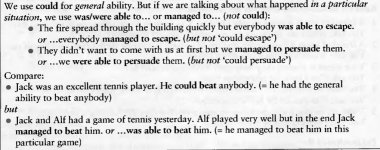
English Grammar in Use by R. Murphy, seconde edition, unit 26 (Can, could and be able to), page 52.
Please, have a look at the picture.
In the theoretical part it is said that:
1. We use "could" for general ability.
2. If we are talking about what happened in a particular situation, we use was/were able to... or managed to... (not could).
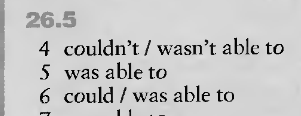
In the exercise 26.5 point 6:
I looked very carefully and I ... see a figure in the distance.
The answer in the key is could/was able to.
I suppose, that could is impossible here according to the abovementioned rules.
Am I right or wrong? If I'm wrong, could you clarify the grammar here?
Please, have a look at the picture.
In the theoretical part it is said that:
1. We use "could" for general ability.
2. If we are talking about what happened in a particular situation, we use was/were able to... or managed to... (not could).
In the exercise 26.5 point 6:
I looked very carefully and I ... see a figure in the distance.
The answer in the key is could/was able to.
I suppose, that could is impossible here according to the abovementioned rules.
Am I right or wrong? If I'm wrong, could you clarify the grammar here?
Attachments

Last edited by a moderator:
