In hand, at hand, or on hand

Status
Not open for further replies.
You didn't put them together. You put two different uses of in hand together with on our hands.

Decide which one you want to know about first. Look up its different uses in a dictionary, and then ask us about the dictionary examples, if you still have any questions.
Please explain the first two "in hand" sentences:
1. We should finish the work we have in hand before we begin something new.
2. Our officers have to concentrate 100 per cent on the task in hand.
 
Please explain the first two "in hand" sentences:
1. We should finish the work we have in hand before we begin something new.
2. Our officers have to concentrate 100 per cent on the task in hand.

1. The meaning is equivalent to 'outstanding'. The idea is that there is outstanding work that has not been finished yet.

2. The meaning is equivalent to 'present'. The officers are presently engaged in task X, so they should not focus on anything else.

 
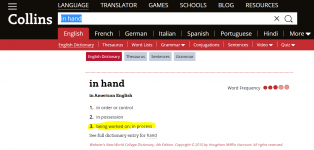
In Collins cobuild "in hand" has a sense of being worked on or in process in American English. Given that, would "if you happen not to have something in hand, help me out" work?
1. The meaning is equivalent to 'outstanding'. The idea is that there is outstanding work that has not been finished yet.

2. The meaning is equivalent to 'present'. The officers are presently engaged in task X, so they should not focus on anything else.

 
One can have one's hands full. That's a valid expression. But not having something "in hand" to mean they are busy.
 
The original would make more sense if it didn't contain that negative. It becomes illogical with 'not' - if I don't happen to have anything on hand, how can I help you? However, if I do happen to have some extra stuff readily available, then I could potentially share it with you.

If you happen to have anything on hand, could you please give me a helping hand?

Now at least it makes logical sense, although you're still dealing with the redundancy issue. I suppose you might argue that the speaker is deliberately repeating 'hand' as a play on words or intentional redundancy for effect, but that's a bit of a stretch.

Using 'on hand' also gives the impression of not inconveniencing the person - share with me only if it's convenient and not too much trouble for you. The speaker is politely giving the person they're asking a convenient excuse to say 'no'.

Even so, it still needs a bit more context for my context to work.
 
Are you saying the dictionary definition as is shown in the screenshot is imprecise or wrongheaded? My confusion mainly comes from such definitions, as I would draw from them that "having something in hand" means "having something to work on".

图像_2022-10-28_091332340.png
 
Last edited:
Is it possible to say that someone has something on hand if I want to say that he's holding it in his hand?
No. They don't mean the same thing.
 
The Collins entry 3 fits your sentence 2 in post #21.
 
The Collins entry 3 fits your sentence 2 in post #21.
Um, very subtle. With all due respect, your explanation is not being much of a help. I still can't see why "We should finish the work we have in hand before we begin something new." can't mean "we should finish the work we are presently engaged before we begin something anew" as you interpreted "in hand" in sentence 2 in post #21, or "We should finish the work we are working on before we begin something anew." as interpreted in Collins cobuild. Or why "Our officers have to concentrate 100 per cent on the task in hand." can't mean "our officers have to concentrate 100 percent on the outstanding task." as you interpreted it in sentence 1 in post #21. All I know is that they are not used that way, but I don't know how I can put the phrase in correct use for different purposes. Is there any grammatical clue? And that is what I really care about.
 
Last edited:
Is there any grammatical clue? And that is what I really care about.

Sentence 1 (from post #21) uses the construction to have [something] in hand. It's the use of this construction that allows us to interpret it in the 'outstanding' way that I described.

Sentence 2 uses the [noun] in hand. It's the use of this construction that allows us to interpret it in the 'presently engaged' way.
 
Sentence 1 (from post #21) uses the construction to have [something] in hand. It's the use of this construction that allows us to interpret it in the 'outstanding' way that I described.

Sentence 2 uses the [noun] in hand. It's the use of this construction that allows us to interpret it in the 'presently engaged' way.
Great. With this sort of constructional frame I now can see how to tell the differences and use it. Thank you.
 
Status
Not open for further replies.

Ask a Teacher

If you have a question about the English language and would like to ask one of our many English teachers and language experts, please click the button below to let us know:

(Requires Registration)
Back
Top