
[Grammar] inversion with neither

Status
Not open for further replies.

IRENGLISH

Member
Joined
May 13, 2014
Member Type
English Teacher
Native Language
Persian
Home Country
Iran
Current Location
Iran
Hey guys, a couple of questions:

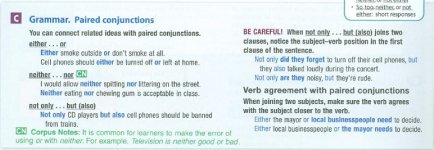
1. In my English course book, Summit 1A Page 54, I came across this statement, "Neither eating nor chewing gum is acceptable in class."

I'm wondering why inversion doesn't occur in this sentence, according to grammar books, it should've been "Neither is eating nor chewing ..."

2. there's another statement on the same page "Cell phones should either be turned off or left at home." Why isn't there a parallel structure in this sentence?
I mean the first one comes with "be" while the second doesn't. Wouldn't it be correct if we were to say "Cell phones should be either turned off or left at home."?

Your help is greatly appreciated. Untitled.jpg
 
People don't eat chewing gum in the first place. Just say:

Don't chew gum in class.

As for the other one, say:

Set your phone so it doesn't ring in class, either by turning it off, putting it on airplane mode or turning the sound off.
 
1. In my English course book, Summit 1A Page 54, I came across this statement, "Neither eating nor chewing gum is acceptable in class."

I'm wondering why inversion doesn't occur in this sentence, according to grammar books, it should've been "Neither is eating nor chewing ..."
We normally use inversion with neither only in statements that support a previous statement: Eating is not acceptable in class. Neither is chewing gum. Don't use inversion when neither ... nor frames a complete statement.

2. there's another statement on the same page "Cell phones should either be turned off or left at home." Why isn't there a parallel structure in this sentence?
I mean the first one comes with "be" while the second doesn't. Wouldn't it be correct if we were to say "Cell phones should be either turned off or left at home."?
Native speakers have a lot of trouble with these constructions, but the textbook's example is natural. You can read it as ... should either be turned off or [be] left home.
 
Thanks for your reply.

Well, I guess I still don't have a rule of thumb to apply. could we say when there's the same verb for two subjects, we don't use inversion, like, "Neither eating nor chewing gum is acceptable in class." but, when there's a different verb [there are two clauses] we need to invert. for instance " Neither is chewing gum acceptable, nor it sounds polite."


p.s. please tell me if the following sentences are correct.

1. Neither does he smoke hookah nor cigarettes.
2. Neither he smokes hookah or cigarettes.

Thanks
 
could we say when there's the same verb for two subjects, we don't use inversion, like, "Neither eating nor chewing gum is acceptable in class."

You're right that you can't use inversion here. The two things do not necessarily have to be subjects for this to be true.

but, when there's a different verb [there are two clauses] we need to invert. for instance " Neither is chewing gum acceptable, nor it sounds polite."

No, that's not right. You can say Chewing gum is neither polite nor acceptable. No inversion. Why do you think it's necessary to invert?

p.s. please tell me if the following sentences are correct.

1. Neither does he smoke hookah nor cigarettes.
2. Neither he smokes hookah or cigarettes.

No, they're not.

He smokes neither hookah nor cigarettes.
He doesn't smoke hookah and neither does he smoke cigarettes.
 
Try the rule I wrote in post #3: We normally use inversion with neither only in statements that support a previous statement. You have used inversion here in three sentences where this does not apply, and they're all wrong.
 
Thanks a lot for your replies.

What would you say about the following:

We can also invert the first clause, a type of negative inversion used for special effect, in which case we need a parallel full clause in the second part, also inverted:

  • Neither do I believe a word he says, nor do I trust him an inch.
    Neither do I believe a word he says, nor trust him an inch.

Resource
 
Try the rule I wrote in post #3: We normally use inversion with neither only in statements that support a previous statement. You have used inversion here in three sentences where this does not apply, and they're all wrong.

What would you say about the following ….

Resource
That's the exception I had in mind when I wrote normally above. The usage you quoted is largely archaic. Advanced learners should be able to recognize it, but you shouldn't try to reproduce it.
 
Status
Not open for further replies.

Ask a Teacher

If you have a question about the English language and would like to ask one of our many English teachers and language experts, please click the button below to let us know:

(Requires Registration)
Back
Top