
it/this

Status
Not open for further replies.

Maybo

Key Member
Joined
Feb 23, 2017
Member Type
Student or Learner
Native Language
Chinese
Home Country
Hong Kong
Current Location
Hong Kong
I have a problem with "it". When I did writing, sometimes my teacher told me that I wasn't clear enough when I used "it" in a sentence.
She didn't know what I was referring to. Since those writing was written by me, I knew what it meant and I didn't know which part was unclear.
So sometimes I'm not sure I'm using "it" correctly.

I saw some sentences from a book, and want to see if "this"(underlined) can be replaced by "it" and still clear.

On the 23rd the Sun will enter the 10th house and you begin a yearly career peak.
For many (it depends on your age) this is a lifetime career peak. For older Aquarians, it will be one of your lifetime peaks. This will continue well into next year.


(Your Personal Horoscope 2017 by Joseph Polansky)
 
I saw some sentences from a book, and want to see if "this"(underlined) can be replaced by "it" and still be clear.

On the 23rd the Sun will enter the 10th house and you begin a yearly career peak.
For many (it depends on your age) this is a lifetime career peak. For older Aquarians, it will be one of your lifetime peaks. This will continue well into next year.
The first can't. The second can.
 
Why can't the first?
I started to try and answer that question while I was writing the post. I couldn't think of a satisfactory way to explain it so I had to give up.
 
Why can't the first?

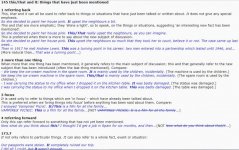
Here's the excerpt from Practical English Usage, 4th edition by Swan:

pronoun1.jpg

https://www.usingenglish.com/forum/...between-quot-this-quot-and-quot-it-quot/page2 (see #16)

As I understand it, it wouldn't be wrong in the first case. But Swan recommends using this when "an interesting new fact has been mentioned" and "there is more to say about the new subject of discussion", i.e. when the speaker elaborates the topic. I think these recommendations fit your example.
 
As I understand it, it wouldn't be wrong in the first case. But Swan recommends using this when "an interesting new fact has been mentioned" and "there is more to say about the new subject of discussion", i.e. when the speaker elaborates the topic. I think these recommendations fit your example.

#1. On the 23rd the Sun will enter the 10th house and you begin a yearly career peak.
#2. For many (it depends on your age) this is a lifetime career peak.
#3. For older Aquarians, it will be one of your lifetime peaks.
#4.
This will continue well into next year.
---------

I see. Since the sentence structure of #3 is similar to #2 but #3 use "it" and #2 use "this", I didn't know why doesn't #2 also use "it".
Now I got it. #3 use "it" because it is a bit far from the subject discussed (yearly career peak).
 
#3 use "it" because it is a bit far from the subject discussed (yearly career peak).

I don't think the distance is the main reason. You can easily say "I've read a new book by N. It's really fascinating." The first this points to the subject and brings it into focus suggesting that the author is going to elaborate on it. After that, he/she doesn't actually need to point to the subject again so that the listener can understand what the author means. He/she just mentions it by using it. I'm not sure what the author means by this in #4. Maybe he/she refers to the whole prediction.
 
I'm not sure what the author means by this in #4. Maybe he/she refers to the whole prediction.
I think it is referring to another new subject of discussion (older Aquarians' lifetime peak #3).
 
Last edited:
Status
Not open for further replies.

Ask a Teacher

If you have a question about the English language and would like to ask one of our many English teachers and language experts, please click the button below to let us know:

(Requires Registration)
Back
Top