[Grammar] make him

Status
Not open for further replies.

shibli.aftab

Member
Joined
Apr 17, 2013
Member Type
Student or Learner
Native Language
Hindi
Home Country
India
Current Location
India
Can we make him cookies?
Can we make cookies for him?

Are both sentences correct? What is the difference in meaning? If they have similar meaning, then which is common in usage?
 
They're both correct, have no perceptible difference in meaning, and are both in common use. There is perhaps a difference in register: 'make <noun> for <person>' is slightly more formal.

Here, though, we'd be more likely to make him biscuits. ;-)

b
 
With the first sentence there is a slight chance that some fatuous person will think you are going to transform him into cookies.
 
I agree with the unlikely ambiguity about you transform him into cookies. I don't agree that "biscuits" is more likely in BrE. It's perfectly possible to say "Can we make him biscuits?" and "Can we make him cookies?" In BrE, they are different foods.

To clear up any confusion, in BrE, these are biscuits:

A-blue-biscuit-tin-with-a-008.jpg


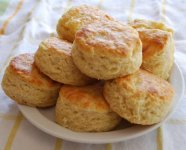
In AmE, these are biscuits:

scones.jpg


In BrE, these are scones:

scones.jpg


In BrE, these are cookies:

millies.jpg

Are you all more confused than you were before? ;-)
 
Yeah. What makes a British cookie a cookie and not a biscuit?
 
I think it's something to do with the consistency. Cookies should be sort of soft and squishy, almost bendy, and can be bought hot from stalls where they're freshly cooked - with chocolate chip ones, the chocolate chips are melted. Biscuits tend to be hard, crunchy and, most importantly, can be dipped into tea! I admit there is some crossover but it's still possible to say "I'm making biscuits" and "I'm making cookies" and end up with completely different things that aren't interchangeable. They're certainly not interchangeable with the American versions.
 
Those are all just different kinds of cookies here. Soft, warm and gooey is the best, of course.
 
I agree with the unlikely ambiguity about you transform him into cookies.
The wizards asked in unison, 'Can we make him cookies?'
Is it likely to cause ambiguity?
Not a teacher.
 
Last edited:
Matthew, I see no ambiguity in the original sentence. For it to mean "transform him into cookies", it would have to be "make him into cookies".
 
I bow to Ems' superior knowledge about confectionery, but the 'cookie' is a fairly recent innovation in my experience of Br E; in my - relatively distant but at least post-war childhood - 'cookies' were unheard of in English kitchens.;-)

b

PS Another feature of my childhood vocabulary was a much limited scope to the possible meanings of 'gay'. There was a rather surreal joke at the time:

'My mother made me a homosexual.'
'Ooh, if I gave her the wool do you think she'd make me one?'

So - re 'transformation' - though a with avoids ambiguity, it isn't always used especially when the transformation isn't instantaneous:

The wizard made him into a cookie.
but
Prison only makes people more resourceful criminals.
 
Last edited:
Matthew, I see no ambiguity in the original sentence. For it to mean "transform him into cookies", it would have to be "make him into cookies".

I don't agree.

"Can you make me a cup of tea?"
[waves hands] "Ta da! You're a cup of tea!"
 
'My mother made me a homosexual.'
'Ooh, if I gave her the wool do you think she'd make me one?'


Spooky! Just this afternoon, this thread reminded of that very joke, told for many years in my family, simply replacing the word "homosexual" with the word "lesbian" (probably because the joke-tellers in my family were mostly women).
 
With all respect, Dave, nobody would reasonably infer that.
 
Status
Not open for further replies.

Ask a Teacher

If you have a question about the English language and would like to ask one of our many English teachers and language experts, please click the button below to let us know:

(Requires Registration)
Back
Top