My control about something

Status
Not open for further replies.

Rachel Adams

Key Member
Joined
Nov 4, 2018
Member Type
Student or Learner
Native Language
Russian
Home Country
Georgia
Current Location
Georgia
This is said by an architect. Is the last sentence correct and clear? Sometimes people decide to break a wall in their flat for more space and the architect says he doesn't have to control that part of his project. (Said by my brother who is an architect)

"If you decide to change something in your flat you will have to adress the local city hall. You don't need my control about reconstruction."

Most parts of the project he's talking about are controlled by him.

 
Both sentences need work. For example:

If you decide to remove an interior wall in your flat for more space, you have to contact the local city hall. I have no control over that.

([STRIKE]adress[/STRIKE] address)
 
Both sentences need work. For example:

If you decide to remove an interior wall in your flat for more space, you have to contact the local city hall. I have no control over that.

([STRIKE]adress[/STRIKE] address)

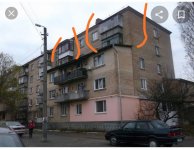
When an additional space is added what do you call it in English?

IMG_20210712_141501.jpgIMG_20210712_141613.jpg
 
The larger one is an addition. The protruding windows are too small to use that word. You might call them bay windows.

We don't use the verb "control" to mean "official legal intervention".
 
If you actually add square footage to the property, it's an extension. The oblong room with the glass roof in the first photo is a conservatory that has clearly been added on, so it's also an extension.
I'm not quite sure what the strange window in photo 2 would be called in the UK. They're not really bay windows, in my opinion.
 
I prefer to use "jurisdiction" rather the word "control" to refer to the changes to the building interior. Building legislation and control is under the local authority more than the architect.

The windows projecting a few feet straight out from the wall are designed to take advantage of the view and sunlight. They are called bay windows though 45-degree bay windows look better.
 
I'm not quite sure what the strange window in photo 2 would be called in the UK. They're not really bay windows, in my opinion.
I agree.
 
If you actually add square footage to the property, it's an extension. The oblong room with the glass roof in the first photo is a conservatory that has clearly been added on, so it's also an extension.
I'm not quite sure what the strange window in photo 2 would be called in the UK. They're not really bay windows, in my opinion.

Because in the UK such extensions are either forbidden or they are so ugly that no one would really want them. They are strange indeed. It's not a window. It's a room.
 
Because in the UK such extensions are either forbidden or they are so ugly that no one would really want them.
Where did you see/hear that?
. It's a room.
If we are talking about the protrusions on the top floor, they are the smallest rooms I have ever seen.
 
Where did you see/hear that?
If we are talking about the protrusions on the top floor, they are the smallest rooms I have ever seen.

Yes, they are. But illegal extensions are bigger.
 
I prefer to use "jurisdiction" rather the word "control" to refer to the changes to the building interior. Building legislation and control is under the local authority more than the architect.

The windows projecting a few feet straight out from the wall are designed to take advantage of the view and sunlight. They are called bay windows though 45-degree bay windows look better.

Would an architect use the word "work" to refer to his projects? "The work/project has to be done until 2 August."
 
I'd expect the "project" to refer to all the work, from start to finish, including plans, building and finishing up. The "work" might refer to each separate part of the project, or to just the building phases, without the planning etc.

However, there is a basic problem with your sentence - we wouldn't say "... has to be done until 2nd August".
 
However, there is a basic problem with your sentence - we wouldn't say "... has to be done until 2nd August".

Should it be "before"?
 
Last edited by a moderator:
Should it be "before"?

Yes, or "by". "Before" means it must be finished by midnight on 11th August. "By" means (to me) that it must be finished by midnight on 12th August.
 
Status
Not open for further replies.

Ask a Teacher

If you have a question about the English language and would like to ask one of our many English teachers and language experts, please click the button below to let us know:

(Requires Registration)
Back
Top