Sentence Diagram [2]

Zhi You

Member
Joined
Aug 6, 2025
Member Type
English Teacher
Native Language
English
Home Country
Great Britain
Current Location
Great Britain
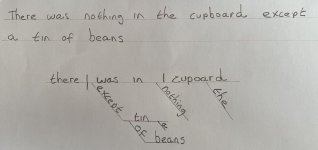
Have I Kellogg-diagramed this sentence correctly? . . Thanks.

sentence 2.jpg
 
Have I Kellogg-diagramed this sentence correctly?
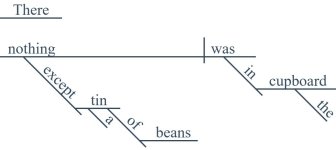
No, you haven't. "There" is an expletive subject in "There was nothing in the cupboard except a tin of beans" and should be diagrammed as an expletive, hovering above the notional subject, "nothing," which you have oddly diagrammed as an adverbial modifier. In case you have trouble understanding that "there" is an expletive, consider that it does not matter for subject-verb agreement: "There were things in the cupboard besides a tin of beans."

The biggest problem with your diagram is that you have represented "in the cupboard" not as a prepositional phrase but as severed components of the sentence, with "in" as a particle following the verb and "the cupboard" as the direct object. The sentence has no direct object.

Also, it would make more sense to put "a" before "tin" rather than after it, and the prepositional phrase "except a tin of beans" properly modifies "nothing," even though it comes at the end of the sentence. The sentence receives almost the same diagram as would "Nothing except a tin of beans was in the cupboard," the only difference being that we have "There" hovering as an expletive above "nothing".

nothing except.jpg
 
Last edited:
No, you haven't. "There" is an expletive subject in "There was nothing in the cupboard except a tin of beans" and should be diagrammed as an expletive, hovering above the notional subject, "nothing," which you have oddly diagrammed as an adverbial modifier. In case you have trouble understanding that "there" is an expletive, consider that it does not matter for subject-verb agreement: "There were things in the cupboard besides a tin of beans."

The biggest problem with your diagram is that you have represented "in the cupboard" not as a prepositional phrase but as severed components of the sentence, with "in" as a particle following the verb and "the cupboard" as the direct object. The sentence has no direct object.

Also, it would make more sense to put "a" before "tin" rather than after it, and the prepositional phrase "except a tin of beans" properly modifies "nothing," even though it comes at the end of the sentence. The sentence receives almost the same diagram as would "Nothing except a tin of beans was in the cupboard," the only difference being that we have "There" hovering as an expletive above "nothing".

View attachment 6321

Hi Annabel, what ever uses sentence diagramming may or may not havem they are a very good learning tool. Thanks for the explanation. My rationale was that 'there' was existential and also 'nothing' is often used as an adverb. Thanks.
 
My rationale was that 'there' was existential and also 'nothing' is often used as an adverb.
Existential "there" and expletive (dummy) "there" are the same thing. This type of "there" is never diagrammed as the subject in the diagramming system you are working with. It is always diagrammed as an expletive. It is the notional subject -- in this case the pronoun "nothing" -- that is diagrammed as the subject of a clause with dummy "there."

Such diagrams can help learners to see why a singular verb is needed in a sentence like "There is milk in the refrigerator," but a plural verb is needed in a sentence like "There are grapes in the refrigerator." Those sentences derive, respectively, from the sentences "Milk is in the refrigerator" and "Grapes are in the refrigerator."
 

Ask a Teacher

If you have a question about the English language and would like to ask one of our many English teachers and language experts, please click the button below to let us know:

(Requires Registration)
Back
Top