
You are using an out of date browser. It may not display this or other websites correctly.
You should upgrade or use an alternative browser.
You should upgrade or use an alternative browser.
[Vocabulary] slower wind
- Thread starter jctgf
- Start date
- Views : 3,170
- Status
- Not open for further replies.

Boris Tatarenko
Senior Member
- Joined
- May 6, 2013
- Member Type
- Student or Learner
- Native Language
- Russian
- Home Country
- Russian Federation
- Current Location
- Russian Federation
Hi,
I'm not a teacher nor a native speaker.
I'd use "weaker", though it can be wrong.
I'm not a teacher nor a native speaker.
I'd use "weaker", though it can be wrong.

- Joined
- Oct 14, 2010
- Member Type
- English Teacher
- Native Language
- British English
- Home Country
- Czech Republic
- Current Location
- Czech Republic
If you think an a response could be wrong, then please don't post it. Members come to the Ask a Teacher forum in the belief that the answers they receive will be correct.I'd use "weaker", though it can be wrong.
We don't normally speak of a weak wind. We do speak of a light wind, and it is possible to say that the wind is lighter than it was. We could also say that the wind has lessened, lightened, dropped.
Last edited by a moderator:

- Joined
- Jul 29, 2006
- Location
- Spencers Wood, near Reading, UK
- Member Type
- Retired English Teacher
- Native Language
- English
- Home Country
- UK
- Current Location
- UK
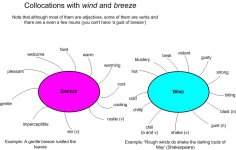
A few years ago, a student asked me what the difference was between breeze and wind and I said it was largely a matter of collocation. Following on from that, I drew this diagram. I hope it's of use to someone. ;-)
b
PS My general conclusion was that breezes on the whole were welcoming and winds could be hostile. I was happy with this view for some time, but another student (who came from Las Canarias) pointed out that 'sea breeze' was a collocation; well, maybe he didn't know the collocation, but he was familiar with the use of brisa. So I've been meaning for years to add that, although it doesn't fit in very comfortably with My Scheme!
b
PS My general conclusion was that breezes on the whole were welcoming and winds could be hostile. I was happy with this view for some time, but another student (who came from Las Canarias) pointed out that 'sea breeze' was a collocation; well, maybe he didn't know the collocation, but he was familiar with the use of brisa. So I've been meaning for years to add that, although it doesn't fit in very comfortably with My Scheme!
Attachments
- Joined
- Oct 27, 2007
- Member Type
- Student or Learner
- Native Language
- Portuguese
- Home Country
- Tuvalu
- Current Location
- Tuvalu
hi,
having been studying English for decades now, I still get stuck in some situations.
I kind of knew that "weak" wasn't proper, but just couldn't find the right word. "slower" was the best I could get to and "lighter" sounds perfect.
following the same direction, I can't say a motor is "weak", right? it can be strong, but never weak, correct? would a motor be "less powerful"?
thanks.
having been studying English for decades now, I still get stuck in some situations.
I kind of knew that "weak" wasn't proper, but just couldn't find the right word. "slower" was the best I could get to and "lighter" sounds perfect.
following the same direction, I can't say a motor is "weak", right? it can be strong, but never weak, correct? would a motor be "less powerful"?
thanks.
- Joined
- Apr 17, 2009
- Member Type
- Interested in Language
- Native Language
- American English
- Home Country
- United States
- Current Location
- United States
You'd probably say a motor was under-powered if describing how it suits its task and less powerful in comparison to another.
The new 4 cylinder engine is under-powered for hauling the 3000 pound SUV.
The engine is less powerful than the V6 it replaces.
The new 4 cylinder engine is under-powered for hauling the 3000 pound SUV.
The engine is less powerful than the V6 it replaces.

Grumpy
Senior Member
- Joined
- Aug 12, 2009
- Member Type
- Interested in Language
- Native Language
- English
- Home Country
- UK
- Current Location
- UK
A few years ago, a student asked me what the difference was between breeze and wind and I said it was largely a matter of collocation. Following on from that, I drew this diagram. I hope it's of use to someone. ;-)
b
PS My general conclusion was that breezes on the whole were welcoming and winds could be hostile. I was happy with this view for some time, but another student (who came from Las Canarias) pointed out that 'sea breeze' was a collocation; well, maybe he didn't know the collocation, but he was familiar with the use of brisa. So I've been meaning for years to add that, although it doesn't fit in very comfortably with My Scheme!
I like Bobk's diagram very much. But there's a more specific difference between breeze and wind. According to the internationally-recognised Beaufort Wind Force Scale, a breeze is a sub-set of wind. Depending on their speed, winds are classified into categories from calm [0], through light air [1-3 mph], breezes [4-31 mph] and gales [32-63 mph], to storm [64-75 mph] and, finally, hurricane [76+ mph].
- Joined
- Jun 20, 2010
- Member Type
- Retired English Teacher
- Native Language
- British English
- Home Country
- England
- Current Location
- England
What would be the antonym for "stronger" in the following sentence, please:
The wind now is stronger than it was a few minutes ago.
Colloquially, we'd say 'The wind's dropped'.

- Joined
- Jul 28, 2009
- Member Type
- English Teacher
- Native Language
- British English
- Home Country
- UK
- Current Location
- UK
Hi.
What would be the antonym for "stronger" in the following sentence, please?
The wind now is stronger than it was a few minutes ago.
Thanks a lot.
Please note the amendments I have made to your post (and those that have been made by other users). It is important to use correct capitalisation and punctuation in written English.
You could use "less strong" or "lighter" depending on what you want to say.
The wind was very strong a few minutes ago. It is less strong now. (This suggests that it is still strong, but not as strong as "very strong".)
The wind was strong a few minutes ago. It is lighter now. (This simply states that there is still a wind, but it's not as strong as it was.)
The wind was light a few minutes ago. It is [even] lighter now. (There is still a wind but now it's lighter than it was.)
- Joined
- Jul 29, 2006
- Location
- Spencers Wood, near Reading, UK
- Member Type
- Retired English Teacher
- Native Language
- English
- Home Country
- UK
- Current Location
- UK
:up: Another useful collocation is 'the wind has dropped' - that is, it was very strong, but now it's less strong; not a flat calm though.
b
b
- Joined
- Apr 17, 2009
- Member Type
- Interested in Language
- Native Language
- American English
- Home Country
- United States
- Current Location
- United States
You could say "the wind died down" as well.
- Joined
- Jul 29, 2006
- Location
- Spencers Wood, near Reading, UK
- Member Type
- Retired English Teacher
- Native Language
- English
- Home Country
- UK
- Current Location
- UK
:up: Or 'eased off'... Lots of ways ;-)
b
b
- Status
- Not open for further replies.
Similar threads


- Replies
- 9
- Views
- 16K

- Replies
- 1
- Views
- 700
Ask a Teacher
If you have a question about the English language and would like to ask one of our many English teachers and language experts, please click the button below to let us know:
(Requires Registration)