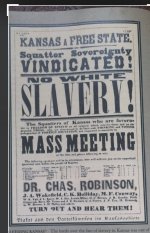
The word is "squatter". (I can see how you misread the "e" as an "o" because the typeface isn't very clear.) I don't know enough about American (or at least Kansas) history to answer but a squatter is indeed someone who occupies a building illegally. I think you need to wait for one of our American friends to wake up in order to get a fuller answer.
Hey, that's me - American and life-long resident of Kansas! And if you think the English font is bad, try deciphering the German font at the bottom. I had to ask for some help, because my limited German couldn't even guess at what some of those letters were supposed to be. As it turns out, the German at the bottom says something like "Poster from the election campaign in the Kansas area." It uses some archaic German vocabulary as well.
Now, brace yourselves for a crash course in US history just prior and up to the US Civil War...
In the page it says "
squatter sovereignty
in British English
NOUN
a derogatory term for popular sovereignty.
If being derogatory, why Americans used it formally in their notes? My guess is that it is derogatory in the eyes of British people while it was acceptable or very decent in American people.
I am not sure.
I'm not sure what you mean by Americans using it formally in their notes. It has nothing to do with British vs. American anyway. If you read the next entry under American English usage, it specifically states how it was used as a derogatory term by people who opposed the idea. However,
Webster's definition doesn't mention anything about derogatory aspects of the term 'squatter' itself, although 2A sort of implies it. 2B is merely a legal term, with no positive/negative connotation.
(Let us pause a moment to appreciate the completely unrelated yet fantastic (and previously unknown to myself) verb definition.

)
The derogatory aspect of 'squatter's sovereignty' just comes from the fact that some people take issue with the ethicality or even legality of popular sovereignty. Britain was long out of the picture in regards to American internal government by that point in history anyway. Those who disagreed with the concept (i.e. anti-slavery proponents) used the derogatory term 'squatter' instead of 'popular'. The former has negative connotations, while the latter positive.
Territories were a precursor to statehood at that time in history. Some territories later became multiple states, while other territories lost a bit of their size when state borders were finalized. Note the poster is from 1855, while Kansas didn't become a state until 1861. For other historical reference, 1865 was the final year of the US Civil War.
If you look at the map of the Kansas territory in this link, you may be able to see that roughly the western third of the territory was in what later became the state of Colorado.
Squatters doesn't have a unique meaning here, but in
this historical context it was people who staked claims on parcels of land, either for their own personal use or with the intent of later selling that land. As all the land in the territory wasn't legally owned by anyone (at least in the eyes of a court - Native American claims be damned), the only way to claim your land was living/squatting on it. Lacking a formal legal process to take possession, by default everyone was a squatter.
As you may have read from related
Collins entry on popular sovereignty , this was an old political practice of letting newly admitted states joining the United States to enter as a
"free state" or "slave state". It was loosely tied to the concept of popular sovereignty, which basically states that a central government should not be involved in matters of domestic policy. Rather the residents of individual states should decided what is best for the people of that state in matters that pertain only to that state. In theory, this referred to all domestic decisions, but in practice it became almost synonymous with the issue of slavery.
Side note: The US Constitution specifically gives certain powers to the federal government (national defense, taxation, etc.) but also says that any powers not specifically given in the Constitution to the federal government belong to the individual states. There are actually only a half-dozen or so powers specifically given to the federal government.
The idea was that the residents of the people in that state should be the ones to choose whether or not slavery was allowed, not the federal government which they were joining.
(The positive spin on it is of course the idea of self-government and power in the hands of the people vs. government, but the downside of it was that it allowed for the abhorrent practice of slavery.) It become a moot point anyway in late 1865 with the ratification of the 13th Amendment to the US Constitution, which made all forms of slavery illegal.
Also, the struggle in Kansas over whether Kansas would be admitted as a slave state or free state was a fierce one, to the extent that there were guerilla wars and vigilante mobs which resulting in the moniker "
Bleeding Kansas". This somewhat disproved the effectiveness of the concept of popular/squatters sovereignty, at least in regards to the issue of slavery. See also '
John Brown', a major figure in the Bleeding Kansas period, who took his abolitionist views to the verge of domestic terrorism. He juxtaposed his views of equality and freedom for everyone with the willingness to kill those who didn't agree with his views.
This particular poster in the image is supporting the idea of popular sovereignty - hence the "no white slaves" comment. It is however, advocating for Kansas to be a free state. If the 1855 date is accurate for the image, then Kansas wouldn't yet be a state, only a territory at that point in history. Coupled with the German translation above, it seems to be a political movement for Kansas to be admitted as a 'free state' under the auspices of popular sovereignty.
Note too, that you can just barely see a reference to 'Bleeding Kansas', presumably from Brinkley's book, just along the lower left bottom edge of the photo in post #1.
There was also a Kansas Territory newspaper of the period called the
Squatter Sovereign, which was a pro-slavery voice. See also Tarheel's comment above.
On a final note - Kansas was ultimately admitted to the Union as a free state, the 2nd to last one to be so before the formal abolishment of slavery.