The company leverages its customers' contact information

Status
Not open for further replies.

mrmvp

Senior Member
Joined
Jul 13, 2017
Member Type
Student or Learner
Native Language
Arabic
Home Country
United Arab Emirates
Current Location
United Arab Emirates
Hello.

The verb 'leverage' is used as a transitive verb in the dictionary to mean "to use" Are the following sentences correct ?


1-Experienced teachers leverage their learning and established practices to effectively teach students with special needs.

2-The company leverages its customers' contact information stored in their systems to send offers and newly arrived product updates
 
The verb 'leverage' is used as a transitive verb in the dictionary to mean "to use"
It means more than that. I suggest you take a look at:
as well as:
... and do a Google image search of "lever".
 
It means more than that. I suggest you take a look at:
as well as:
... and do a Google image search of "lever".

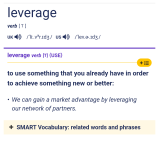
Thank you so much for your contribution. Yes, before posting the thread, I checked the dictionary for the word 'leverage.' I am familiar with the word, and it is commonly used in politics, economics, and business. However, my question is about its meaning as 'to use.' Please see the attached picture. The definition says 'to use something that you already have in order to achieve something new or better.' I believe the sentences I wrote correspond to this definition. Am I right?
 

Attachments

  • Screenshot_20250224-215952.png
    Screenshot_20250224-215952.png
    540.4 KB · Views: 8
But your own definition that you show doesn't simply mean "to use."

There has to be some sense of a force multiplication (what levers literally do), of a use of one thing to obtain greater results from another.

It's awful business jargon, so it's probably best avoided.

Of your examples, the first seems to fit. They are using their training and established practices together to generate something greater.

The second does not. Sending offers to your customers is not an example of leveraging.
 
But your own definition that you show doesn't simply mean "to use."

There has to be some sense of a force multiplication (what levers literally do), of a use of one thing to obtain greater results from another.

It's awful business jargon, so it's probably best avoided.

Of your examples, the first seems to fit. They are using their training and established practices together to generate something greater.

The second does not. Sending offers to your customers is not an example of leveraging.

Thank you for your contribution. The second one I want to say that the company makes use of the customer contacts to send offers. This can help the company gets profits and expands as well.
 
I don't really like either of your examples. To me at least it has a distinctly business use. In business, it means something like 'make use of a particular asset or financial resource in order to achieve a greater outcome, with the sense of there being minimal effort'. The metaphor, of course, is that with a lever you can get great results from doing little work. Very basically, leveraging is making money work for itself.

Your sentence 1 has nothing to do with business and your sentence 2 doesn't really fit the meaning because sending offers and product updates is not an outcome but a means. The goal is to have people accept the offers, not to send them.
 
Last edited:
Status
Not open for further replies.

Ask a Teacher

If you have a question about the English language and would like to ask one of our many English teachers and language experts, please click the button below to let us know:

(Requires Registration)
Back
Top