Nonverbis
Member
- Joined
- Jun 4, 2021
- Member Type
- Student or Learner
- Native Language
- Russian
- Home Country
- Russian Federation
- Current Location
- Russian Federation


[STRIKE]This is from Upstream Proficiency.[/STRIKE]
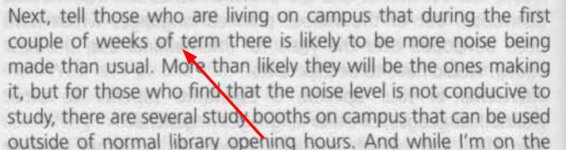
Please no comma here have a look at this screenshot. It is from Upstream Proficiency.
Could you tell me why there is no article here?
I think "The first week of term" is broken or musical. I prefer "The first week of the term"
The textbook is Upstream Profiency by Virginia Evans and Jenny Dooley.
As for your example, I think this is not [STRIKE]a[/STRIKE] correct. [STRIKE]example here.[/STRIKE]
"The summer term" doesn't have the indefinite article before 'term' because this is a noun + noun compound.
I have no idea what you're talking about. I didn't suggest that the indefinite article should be used before "term" in that phrase. That would result in "the summer a term", which is nonsense.
This phenomenon is well described in literature. [STRIKE]Like[/STRIKE] For example, "milk chocolate" or "chocolate milk".
Articles belonging to the first (modifying) noun are dropped in noun + noun combinations.
Compound nouns can be countable or uncountable. "Chocolate milk" is uncountable in "I like chocolate milk". However, in "Would you like the banana milk or the chocolate milk?" "I'd like the chocolate milk please", an article is required.
a sun hat (= a hat that protects you against the sun)
What's the relevance of that example?
Why can "the first week of term" [STRIKE]can[/STRIKE] be thought of as a set phrase? A set phrase is [STRIKE]what[/STRIKE] something that is used widely and traditionally. [STRIKE]In textbooks are listed[/STRIKE] Some textbooks list set phrases for use with the indefinite article (by day, at home, to go to town).
None of those examples use the indefinite article.
But in my opinion "the first week of term" doesn't look like a set phrase at all. And I believe that this should obey the general rule: an article precedes any countable noun save in exceptional cases.
Whatever your opinion might be, I can assure you that "the first day/week of term" is used extensively in BrE.
Otherwise, we [STRIKE]will[/STRIKE] could consider a lot of things as set phrases. [STRIKE]And[/STRIKE] Anyway, I have consulted a corpus (https://www.english-corpora.org/time/).
I inserted "the first week of term" there. Nothing can be found. So no comma here how can a phrase that nobody uses [STRIKE]can[/STRIKE] be considered [STRIKE]as[/STRIKE] a set phrase?
You're simply wrong when you say it's a phrase nobody uses. See my earlier note about BrE usage.

You might prefer it but I can assure you that the article is not necessary or used in BrE

So did I: https://www.google.com/search?q="we...:1,cd_min:2000,cd_max:2009&num=100&lr=lang_enAnd anyway, I have consulted a corpus

Could you tell me why there is no article here?
Articles belonging to the first (modifying) noun are dropped in noun + noun combinations.
I believe that this should obey the general rule: an article precedes any countable noun save in exceptional cases.


If you have a question about the English language and would like to ask one of our many English teachers and language experts, please click the button below to let us know: