
this appliance/this type of appliance/refrigerators/it

Status
Not open for further replies.
Joined
Dec 18, 2020
Member Type
Student or Learner
Native Language
Chinese
Home Country
China
Current Location
China
Hi, everyone. Please help me with the bold part please.

Almost no households were refrigerator owners in 1920. However, this appliance/this type of appliance/refrigerators/it showed the greatest increase in ownership, and by 1980 there was already a refrigerator in every household.
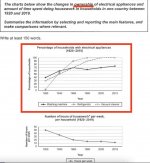
Screen Shot 2021-07-12 at 5.59.08 PM.jpg

 
In my opinion, you don't need that entire section at all.

Almost no households had a refrigerator in 1920. However, that rapidly changed and by 1980 every household had one.
 
In my opinion, you don't need that entire section at all.

Almost no households had a refrigerator in 1920. However, that rapidly changed and by 1980 every household had one.
Thanks, emsr2d2, but I'm trying to make comparisons. The question asks us to make comparisons where relevant. Besides, it didn't happen that rapidly. It took 60 years.

Almost no households had a refrigerator in 1920. However, it showed the greatest increase in ownership and by 1980 there was one in every household.

I feel the bold doesn't sound natural.
I noticed you changed my underlined part. What's wrong with it?
 
Almost no households had a refrigerator in 1920. However, it showed the greatest increase in ownership and by 1980 there was one in every household.

I feel the bold doesn't sound natural.
The problem is that "it" has no antecedent. Try Ownership increased rapidly until, by 1980, there was one in every household.
 
Almost no households had a refrigerator in 1920.

Is my version "almost no households were refrigerator owners in 1920" natural?
I want to vary my language by using the word 'owners'. I already used something like yours to describe the other two appliances.
 
You can use "refrigerator owners" but it wouldn't be what most native speakers would say. We probably wouldn't refer to households either.

In 1920, almost no one owned a refrigerator.
 
You can use "refrigerator owners" but it wouldn't be what most native speakers would say. We probably wouldn't refer to households either.

In 1920, almost no one owned a refrigerator.
Thanks, do you mean I should use the verb 'own' with people, but use the verb 'have' with 'households'?

In 1920, almost no one owned a refrigerator.
In 1920, almost no households had a refrigerator. (Also, why households not household? )
 
Thanks, do you mean I should use the verb 'own' with people, but use the verb 'have' with 'households'?.

In 1920, almost no one owned a refrigerator. In 1920, almost no households had a refrigerator.
Yes.

(Also, why households not household? )
"No households" = zero households. Zero is plural.
 
To me "... almost no household ..." is acceptable although less common than the plural.
 
Try Ownership increased rapidly until, by 1980, there was one in every household.

Almost no households had a refrigerator in 1920. However, that rapidly changed and by 1980 every household had one.

The chart is about electrical appliance ownership. What if some households had two refrigerators? Is this plural version correct?

Almost no households had refrigerators in 1920. However, ownership increased rapidly and by 1980 they were in every household.
 
It's grammatically correct but not natural. Very few people have more than one fridge, even now. In 1920, it was probably unimaginable.
 
It's grammatically correct but not natural.
Thanks.
Almost no households had refrigerators in 1920. However, ownership increased rapidly and by 1980 they were in every household.

Are both the red and green unnatural, or only the red unnatural? I understand the red is unnatural because it is a negative sentence.

Is this positive sentence natural?
40% of households had washing machine
s in 1920.
 
Thanks.
Almost no households had refrigerators in 1920. However, ownership increased rapidly and by 1980 they were in every household.

Are both the red and green unnatural, or only the red unnatural? I understand the red is unnatural because it is a negative sentence.

Is this positive sentence natural?
40% of households had washing machine
s in 1920.

I'd use "no households had a refrigerator" in the red part and "there was one in every household" in the green part.

I'd say "40% of households had a washing machine in 1920" for your final sentence. Yours suggests that each household had more than one.
 
Status
Not open for further replies.

Ask a Teacher

If you have a question about the English language and would like to ask one of our many English teachers and language experts, please click the button below to let us know:

(Requires Registration)
Back
Top