Use trailing decimals when writing whole numbers (amounts)?

Status
Not open for further replies.

Moorhen

Member
Joined
Nov 26, 2024
Member Type
Academic
Native Language
Dutch
Home Country
Netherlands
Current Location
Netherlands
I have turned the internet inside out trying to find an answer to the following question: are there any conventions on using trailing decimals when writing whole numbers (amounts)?
Here's an example:
  • My father gave me EUR 15 for my birthday
  • My father gave me EUR 15.00 for my birthday
Which one is correct?
And does it matter in which document you use this?
Or whether you're writing in American or British English?
Are there any 'authoritive sources' that I can rely on?

I write insurance reports for customers (both private and business) in which I use a lot of amounts. Whenever I come across a whole amount, I'm in doubt whether to add the trailing decimals or not. Can someone help please?
 
I'm not sure about any official conventions, but I'd expect the decimals on any kind of business transaction, especially insurance.

Any time I use my medical or dental insurance, I eventually get a follow-up summary from my insurance company detailing what it's paying and any amount I'm still responsible for. They still show the training decimals when it's even dollar amounts, even when the total is in the thousands or tens of thousands. Even when insurance covers 100%, I still see a total of "$0.00" under the 'patient responsibility' column.

I don't know of any authoritative sources, but I don't see how you could go wrong by always including it.

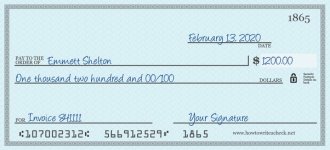
For those of us who still write checks, we include any trailing zeros, both in the decimal figure and fractional figure.

check2.jpeg
 
I'm not sure about any official conventions, but I'd expect the decimals on any kind of business transaction, especially insurance.

Any time I use my medical or dental insurance, I eventually get a follow-up summary from my insurance company detailing what it's paying and any amount I'm still responsible for. They still show the training decimals when it's even dollar amounts, even when the total is in the thousands or tens of thousands. Even when insurance covers 100%, I still see a total of "$0.00" under the 'patient responsibility' column.

I don't know of any authoritative sources, but I don't see how you could go wrong by always including it.

For those of us who still write checks, we include any trailing zeros, both in the decimal figure and fractional figure.

View attachment 6172
Thank you Skrej, that's most helpful. I'm curious to see if there are other opinions, even though I think that your reply makes perfect sense.
 
I would always use two places of decimals when listing currency amounts. Within text I would consider omitting the pence/cents when only referring to whole amounts of pounds/euros/dollars.

In the UK we write cheques differently. In the above example we would write "one thousand two hundred pounds only"
 
In your original example, I'd write "My dad gave me 15 Euros for my birthday".
In a more formal context, I'd write "I have transferred €15,00 to you by direct bank transfer". (Note that a decimal "point" in Euros is a comma, not a full stop.)
 
Yes, it absolutely matters why and where you're writing.

My father gave me €15 for my birthday.

This is obviously not something that you would ever need to write as part of your work writing insurance reports. In this context, there is no reason whatsoever to use any decimal points. In fact, it would be wrong to do so.
 
A simple general rule is this:

1) When there is a moderate or strong possibility that an amount is not a round number, then use all necessary places. For example, the bill for a meal for four people at a restaurant might be:

£157.65

But if by chance the total on the bill adds up to a round number, a waiter would still use both places following the point when writing the check to make it clear to the customer:

£157.00

2) When there is little or no possibilty of there ever being anything other than a round number, the two places after the point are not necessary and so using them would be unnecessary clutter. Imagine the price list on the menu at the restaurant:

Velouté de Champignon Noir
........ .. .....£30

Now, the figure of £30 that's written on the menu may well show up on the restaurant accounts as 30.00 but that's a very different context. Obviously, that amount is going to be added to something at a later point. Furthermore, it's likely that it will be a machine that does the totalling, and machines don't care about making things nice and easy to read—they need precision and uniformity.
 
These are all very interesting and helpful answer; thank you all. I am inclined to go with full notation (including adding the .00)
 
Then that would be unidiomatic in the contexts specified above.
 
These are all very interesting and helpful answers; thank you, all. I am inclined to go with full notation (including adding the ".00").
Note my corrections above. Giving yourself a blanket rule seems like a bad idea to me. Base your decision on the context each time. If you're writing something important and formal (or even legal) in which precision is paramount to avoid any misunderstanding, use the trailing decimals. In all other cases, I can't see any reason to do so.
 
Note my corrections above. Giving yourself a blanket rule seems like a bad idea to me. Base your decision on the context each time. If you're writing something important and formal (or even legal) in which precision is paramount to avoid any misunderstanding, use the trailing decimals. In all other cases, I can't see any reason to do so.
Well, one of the reasons I'm hearing from my clients is that some of them find it confusing when I write USD 10,000,000.00, and they would rather see it without the trailing decimals.

Personnally I find it lacking consistency if I write the following:

The insured calculated the damage to the building at USD 9,677,491.73. We believe that this amount was calculated correctly and that it is fair and reasonable.

Regarding the damage to the pipeline, we estimate the damage at USD 2,000,000. After examining the repair invoices, we will be able to provide you with a final damage amount.
 
Well, one of the reasons I'm hearing from my clients is that some of them find it confusing when I write USD 10,000,000.00, and they would rather see it without the trailing decimals.

Personnally I find it lacking consistency if I write the following:

The insured calculated the damage to the building at USD 9,677,491.73. We believe that this amount was calculated correctly and that it is fair and reasonable.

Regarding the damage to the pipeline, we estimate the damage at USD 2,000,000. After examining the repair invoices, we will be able to provide you with a final damage amount.
The first is a precise calculation. The second is an approximate estimation. There is no inconsistency.
 
Well, one of the reasons I'm hearing from my clients is that some of them find it confusing when I write USD 10,000,000.00, and they would rather see it without the trailing decimals.
This simply proves the point that you can't please all the people all the time! You said yourself that only some of your clients find it confusing. The rest are either happy with it or they simply haven't said anything about it at all. If they all said they find it confusing, you should consider changing it. However, as it stands, it's up to you how you write these figures. I would expect people who are dealing with millions of dollars to have slightly more pressing matters to worry about than trailing decimals!
 
The first is a precise calculation. The second is an approximate estimation. There is no inconsistency.
OK, I didn't express myself correctly; I meant aesthetically inconsistent
 
I would expect people who are dealing with millions of dollars to have slightly more pressing matters to worry about than trailing decimals!
Shall I be the judge of that?
 
OK, I didn't express myself correctly; I meant aesthetically inconsistent.
Consistency in correct punctuation is also important.
 
Shall I be the judge of that?
You are just as free to judge them on that score as I am. I wasn't suggesting they don't have a problem with trailing decimals. I was simply stating my opinion that I'm surprised that they do.
 
Status
Not open for further replies.

Ask a Teacher

If you have a question about the English language and would like to ask one of our many English teachers and language experts, please click the button below to let us know:

(Requires Registration)
Back
Top