Whoever comes first

Status
Not open for further replies.

Nonverbis

Member
Joined
Jun 4, 2021
Member Type
Student or Learner
Native Language
Russian
Home Country
Russian Federation
Current Location
Russian Federation
Source: Upstream Proficiency by Virginia Evans and Jenny Dooley.
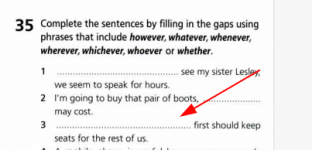
1683027667386.png

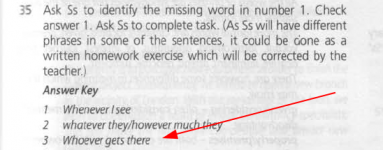
And answer key:

1683027695816.png

At first I wrote "whoever comes first", but then changed my mind and wrote "whoever will come first".

Well, in the answer key present simple is used. Something rang the bell for me, but didn't prevail.

Could you explain to me why "will + infinitive" is impossible here and why present simple is the right choice?
 
I don't think you need an explanation. There's simply no need for will in this kind of future time clause. Present simple suffices.

Think about what you already know about using present simple in real future clauses.

Come and see me before you leave.
Let me know when you arrive.
Let's see what he does.


You wouldn't use will in any of the above examples, would you? Why not?

Also, you might want to think about why come doesn't make good sense in this context.
 
View attachment 5323

Could you explain to me why "will + infinitive" is impossible here and why present simple is the right choice?
Interesting question. It's not that "will + infinitive" can never be used in "whoever"-clauses that function as the subject of the sentence. Rather, it's that when "will + infinitive" is used in such a clause, it signifies something other than mere futurity.

I'd say that it indicates willingness to do the action denoted by the infinitive. In Googling certain combinations just now, I found support of that view in a 1913 grammar textbook called An Advanced English Grammar: With Exercises, by George Lyman Kittredge and Frank Edgar Farley (here).

"305. In conditional or concessive clauses . . . will and would are proper when the subject is thought of as wishing or consenting. . . .

"12. Whoever will join us may be sure of a pleasant and profitable journey. [That is: If anyone will join us, he may be sure, etc.]"

In your sentence, mere future meaning is needed in the "whoever"-clause. The sentence is not about whoever is willing to get there first, or whoever consents to get there first. It is simply about whoever gets there first. Compare: "If you get there first, you should keep seats for the rest of us."
 
Interesting question. It's not that "will + infinitive" can never be used in "whoever"-clauses that function as the subject of the sentence. Rather, it's that when "will + infinitive" is used in such a clause, it signifies something other than mere futurity.

I'd say that it indicates willingness to do the action denoted by the infinitive. In Googling certain combinations just now, I found support of that view in a 1913 grammar textbook called An Advanced English Grammar: With Exercises, by George Lyman Kittredge and Frank Edgar Farley (here).


In your sentence, mere future meaning is needed in the "whoever"-clause. The sentence is not about whoever is willing to get there first, or whoever consents to get there first. It is simply about whoever gets there first. Compare: "If you get there first, you should keep seats for the rest of us."
Thank you. Definitely this is a case of concession. In adverbial clauses of concession present simple is used.
 

Starting with *ever.
 
Whoever gets there first should keep the seats for us.

There's no concession here.
 
  • Like
Reactions: 5jj
There's no concession here.
Ok. Let it be. But what is here? And why present simple is used.

I consulted several sources that I consider trustworthy. This is concession. Maybe you are a bit biased here. But you yourself have not explained this phenomenon. You said it is obvious and doesn't need any explanation.
 
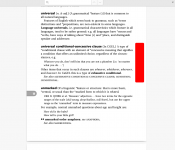
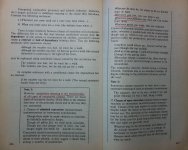
English Grammar by Kobrina and others (ISBN 5-94033-018-5)

1683385319134.jpeg

A Grammar of Present-day English (ISBN 5-98227-068-7):

1683385572764.jpeg

Oxford Guide to English Grammar by John Eastwood


1683385620626.jpeg
 
Ok. Let it be. But what is here? And why present simple is used.

I thought I'd answered that in post #2. The reason present simple is used is that the present simple suffices. You don't need to use anything else.

I consulted several sources that I consider trustworthy. This is concession.

No, it isn't. Concession is when there's a contrast in the content of clauses. The sources you show in post #10 present some nice examples of concession. However, the sentence Whoever gets there first should keep seats for the rest of us expresses no concession. What do you think is being contrasted?

Maybe you are a bit biased here.

I can't guess how or why you think I might be biased.

But you yourself have not explained this phenomenon. You said it is obvious and doesn't need any explanation.

There's nothing really to explain, as I said before. Look at it like this: You need a reason not to use a simple aspect. The simple aspect is really a lack of aspect. You need a reason to use will but you don't need a reason not to use it.

If you can tell us what further kind of explanation you're looking for, maybe we can be more helpful.
 
Last edited:
  • Like
Reactions: 5jj
It is a dialogue of a blind with a deaf.

You have not explained anything here. You said that there is nothing to explain.
 

Attachments

  • 1683402828725.png
    1683402828725.png
    160.3 KB · Views: 1
Here are the answers again to your question:

There's simply no need for will in this kind of future time clause. Present simple suffices.

In your sentence, mere future meaning is needed in the "whoever"-clause. The sentence is not about whoever is willing to get there first, or whoever consents to get there first. It is simply about whoever gets there first.

It doesn't make sense to explain why will is not used. It's simply that it's not necessary. That's what I meant when I said no explanation is required. If you want to pursue this thread, I suggest you tell us exactly what more you're looking for.

(By the way, it appears from post #13 that you haven't yet understood what concession is. Start with the dictionary entry here.)
 
It doesn't matter what I understand. In our native language we speak without understanding. Understanding is desirable, but not necessary.

This is a distinct pattern in English. Call it whatever you want, but just use it. Even without understanding.

I'm not perfect. I may not understand it, but I will remember it. At least I have tried to scrutinize this phenomenon.


I have shown you lots of textbooks that call such phrases a concession.
I understand that different scientific schools may call it somehow differently. For me "concession" is good enough for this phenomenon. And I'm not lonely in this opinion, I hope I have proven that by referring to textbooks. By the way I have consulted more textbooks on this matter.

You may think whatever you want.

This debate is useless. Let's not continue.
 
Last edited:
You have not explained anything here.
Jutfrank did explain:
Concession is when there's a contrast in the content of clauses. The sources you show in post #10 present some nice examples of concession. However, the sentence Whoever gets there first should keep seats for the rest of us expresses no concession.
You did not respond to his question:
What do you think is being contrasted?

I have shown you lots of textbooks that call such phrases a concession.
No, you haven't. They were talking about a different use of 'whoever'.
 
I've just googled 'concession in grammar'. Try this.
 
You did not respond to his question:
Because I wouldn't like to conduct religious wars here. I will not persuade you. Especially if you concentrate on personalities rather than the phenomenon itself.

As for the contrast.

20230508_083202.jpg

Not persuasive? Ok. What can I do? One can find more textbooks saying the same if they want. If the scientific school in whose traditions you were brought up doesn't classify this construction as a case of concession, let it be.

But for me these textbooks are persuasive, and explain the phenomenon and why present simple is used here. The goal is achieved for practical purposes. As for theoretical aspects, I admit that there may be other classifications of clauses.

For practical purpose wh + ever signifies present simple. But for the case of willingness, as Holmes said. That is enough to know.
 
Last edited:
Please always give the title and author of any book you quo
for me these textbooks are persuasive

You have once again misunderstood what is being discussed. The sentences in your last post are not of the same type as Whoever gets there first should keep seats for the rest of us, in which the underlined words are the subject of the sentence.
 
Status
Not open for further replies.

Ask a Teacher

If you have a question about the English language and would like to ask one of our many English teachers and language experts, please click the button below to let us know:

(Requires Registration)
Back
Top