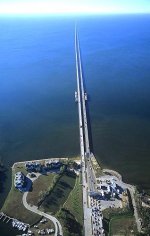
a lake on the side of the road

Status
Not open for further replies.

alpacinou

Key Member
Joined
Sep 30, 2019
Member Type
Interested in Language
Native Language
Persian
Home Country
Iran
Current Location
Iran
Hello.

If you have trees on "both" sides of the road, you can say this: The road is flanked by trees.

What if there is a lake on "one" side of the road? What can we say? The road is...
 
If you have trees on both sides of the road, you can say this: The road is flanked by trees.

What if there is a lake on one side of the road? What can we say? The road is...
"bordered by a lake."

Don't use quotation marks to emphasize words. That's what bold face and italics are for.
 
The road is next to/beside/ adjacent to/by a lake.

The road runs alongside the lake.

The road is encircles/wraps around the lake (if it goes around it).

It is also possible for a road to be flanked by lakes on both sides.
 
If you have trees on "both" sides of the road, you can say this: The road is flanked by trees.

What if there is a lake on "one" side of the road? What can we say? The road is...

. . . skirted by a lake.
 
...fringed by a lake.
 
In most cases, the lake would have been there first, so I'd say 'The road runs alongside the lake'.
 
In most cases, the lake would have been there first, so I'd say 'The road runs alongside the lake'.

If the road is winding, can I say the road snakes alongside the lake?
 
My first thought in response to the original question was that the road skirts the lake. I don't think it works in the passive (is skirted by) because that means that the lake skirts the road.

This only works though if you want to say the road winds around the lake rather than just suggesting a straight stretch of road running alongside the lake.
 
"Skirts" means avoids. It's a good choice if the road has to have curves to get around the lake, but it doesn't work if it follows a straight path that happens to lie near it.
 
But if the road is straight, my only options are run and border, right?
 
Not a teacher
------


5ecd1dff385afc8b35dd7305f950c10c.jpg


This road snakes.

Maybe it doesn't snake around the lake, but it snakes anyway.
 
It's funny. I found this example in Oxford dictionary:

They followed the road that skirted the lake.
https://www.oxfordlearnersdictionaries.com/definition/american_english/skirt_2

Can that be used when the road is flat and straight and has no curves?
My first thought in response to the original question was that the road skirts the lake. I don't think it works in the passive (is skirted by) because that means that the lake skirts the road.

This only works though if you want to say the road winds around the lake rather than just suggesting a straight stretch of road running alongside the lake.

I admit that my usage of "skirted" is a bit of a stretch, and, like you guys (heh), I prefer to speak of the road's skirting the lake.

I was aiming to please alpacinoutd, who seems usually to want exactly the type of grammatical thing he requests, and here he requested a past participle.

The applicable learner-dictionary definition is "to be or go around the edge of something."

Can't the lake be said to go around the edge of a road circling a lake?

Just as the road goes around the lake, so the lake follows the bend of the road, running alongside it like a cloth hugging a woman's hips.
 
.The applicable learner-dictionary definition is "to be or go around the edge of something."

Can't the lake be said to go around the edge of a road circling a lake?

Just as the road goes around the lake, so the lake follows the bend of the road, running alongside it like a cloth hugging a woman's hips.

Aha, so you're suggesting that the skirter be seen as the skirted?

Does that mean that the woman's hips skirt her skirt? And that the skirting board in my front room is also the skirted board? :)-D)
 
If there is something on either side of the road, can I use "cut through"?

The road cuts through an arid desert.

The road cuts through a placid lake.
 
Roads don't usually go through lakes. They go round them or, I suppose, over them (in which case, the road would be a bridge).
 
Roads don't usually go through lakes. They go round them or, I suppose, over them (in which case, the road would be a bridge).

Yes. Unless the lake is really shallow.

What about desert?

The road cuts through an arid desert.
 
Well, arid desert is redundant, but yes, you can say that.
 
Roads don't usually go through lakes. They go round them or, I suppose, over them (in which case, the road would be a bridge).
Like this one over Lake Pontchartrain, Louisiana, USA.

b106507a863b3dde2a7ba70f9df60548.jpg
 
Status
Not open for further replies.

Ask a Teacher

If you have a question about the English language and would like to ask one of our many English teachers and language experts, please click the button below to let us know:

(Requires Registration)
Back
Top