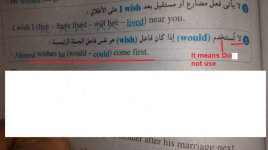
Ahmed wishes he (would-could)come first.

Status
Not open for further replies.

abo.omar

Member
Joined
Aug 27, 2015
Member Type
Interested in Language
Native Language
Arabic
Home Country
Egypt
Current Location
Egypt
Ahmed wishes he (would-could)come first.
I found this sentence in a non-native book.
The answer is (could).
The reason is that as long as the subject before 'wish' is the same as after 'wish' we should use only could.(the non-native book explanation )
I tried to find this rule in an English reference but I failed.
Is such a rule right?
 
I don't think it's a useful rule. You're better off learning what "would" and "could" mean.

Both versions of the sentence are possible, depending on context. If Ahmed is thinking of another person, either "would" or "could" is possible: "would" conveys hopefulness; "could", impossibility. If he's thinking of himself, only "could" is possible. It means that Ahmed wishes it were possible for him to come first, but it isn't.

I think "for him to come first" is used in British English to mean "to win". In American English, we say "for him to come in​ first".
 
I wish I had a brain.
;-)
 
We do not use 'I would' after 'I wish' (or 'if only') but, depending on the context, we don't have to use 'could'. For general- or present-time hypothetical situations that we wish for, we use a past tense.

.

I do not mean the subject 'I' .I mean any other subject except 'I and we'.
I do not want to speak about personal wishes ,but I call it others' wishes .
So give me sentences such as the provided example.
 
I don't think it's a useful rule. You're better off learning what "would" and "could" mean.

Both versions of the sentence are possible, depending on context. If Ahmed is thinking of another person, either "would" or "could" is possible: "would" conveys hopefulness; "could", impossibility. If he's thinking of himself, only "could" is possible. It means that Ahmed wishes it were possible for him to come first, but it isn't.

I think "for him to come first" is used in British English to mean "to win". In American English, we say "for him to come in​ first".

Ahmed wishes he could come first.(That means he has a very little chance to come first.)
Ahmed wishes he would come first.(That means he has a very good chance to come first.)
 
Ahmed wishes he could come first.(That means he has a very little chance to come first.)
Ahmed wishes he would come first.(That means he has a very good chance to come first.)

That second one makes sense if it applies to somebody else (somebody other than Ahmad). Examples:

I wish he would get here on time more often.
I wish he would work harder.
I wish he would complain less.
I wish he would do his chores without complaining.
I wish he would help with the housework more often.
I wish he would be nicer.
I wish he would stop yelling at the kids.
I wish he would study harder.
 
Ahmed wishes he could come first.(That means he has a very little chance to come first.)
Ahmed wishes he would come first.(That means he has a very good chance to come first.)

That second one makes sense if it applies to somebody else (somebody other than Ahmad).
And as I said above, it doesn't work if Ahmed is thinking about himself. "He" has to apply to someone else.
 
You haven't responded to ems's post yet, abo.omar.

Let me tell you that it is not an academic book .It is not a high education book.It is a book written by an ordinary teacher as notes on the educational official book here in Egypt.
The book writer put such a piece of information in his book .I did my best to find it in an English grammar book,but in vain I found nothing.
I wish you (could ) understood me.:lol:
 
That second one makes sense if it applies to somebody else (somebody other than Ahmad). Examples:

I wish he would get here on time more often.
I wish he would work harder.
I wish he would complain less.
I wish he would do his chores without complaining.
I wish he would help with the housework more often.
I wish he would be nicer.
I wish he would stop yelling at the kids.
I wish he would study harder.

Thank you for all these wishes.But my problem is to use a different subject not 'I'.
 
I found this sentence in a non-native book.

That is not sufficient. Please provide the title and author of the book.

You haven't responded to ems's post yet, abo.omar.

Let me tell you that it is not an academic book. It is not a high education book. It is a book written by an ordinary teacher as notes on the educational official book here in Egypt.
The [STRIKE]book[/STRIKE] writer/author put [STRIKE]such a[/STRIKE] this piece of information in his book. I did my best to find it in an English grammar book, but [STRIKE]in vain[/STRIKE] I found nothing.
I [STRIKE]wish[/STRIKE] hope you [STRIKE](could)[/STRIKE] [can] [STRIKE]understood[/STRIKE] understand me.:lol:

This is like pulling teeth, abo.omar. It doesn't matter what else you would like to tell us about the book. We asked you for the title of the book and the name of the author. Please do us the courtesy of doing what we asked, and do the author of the book the courtesy of crediting him for his work.

Remember: We don't put a space before a comma or a full stop. We always put a space after a comma or a full stop.
 
This is like pulling teeth, abo.omar. It doesn't matter what else you would like to tell us about the book. We asked you for the title of the book and the name of the author. Please do us the courtesy of doing what we asked, and do the author of the book the courtesy of crediting him for his work.

Remember: We don't put a space before a comma or a full stop. We always put a space after a comma or a full stop.
indexd.jpgThe name of the book is Almoasser. The author is 'A group of specialists'. There in not any name. The book is famous here and sold to all students for about 70 pounds ( about 3.5 dollars)
 
Last edited:
Well, that's better than nothing.

However, in post #14, I told you that we always put a space after a full stop. Please click on Edit Post and add those missing spaces.
 
Thank you for all these wishes.But my problem is to use a different subject not 'I'.

It's easy enough to change I to He. Examples:

He wishes Ahmed would work harder.
He wishes Ahmed was a nicer person.
He wishes Ahmed would learn how to cook.
He wishes Ahmed would not interrupt so much
He wishes Ahmed would go away.
 
It's easy enough to change I to He. Examples:

He wishes Ahmed would work harder.
He wishes Ahmed was a nicer person.
He wishes Ahmed would learn how to cook.
He wishes Ahmed would not interrupt so much
He wishes Ahmed would go away.

I want 'Ahmed' as a first subject, and 'he' as a second subjects but refers to Ahmed as follows;
Ahmed wishes he would work harder.
Ahmed wishes he would learn how to cook.
Here was my question .Can we use 'would 'or use 'could' only?
 
Here was my question .Can we use 'would 'or use 'could' only?
Yet again: We don't put a space before a comma or a full stop. We always put a space after a comma or a full stop.
 
Yet again: We don't put a space before a comma or a full stop. We always put a space after a comma or a full stop.

Thanks for reminding me. But I am not clever at using my keyboard as using my pen.
 
Last edited:
You were told in earlier posts that if 'he' refers to the same person as the initial subject, we cannot use would.

I said, " Here was my question .Can we use 'would 'or use 'could' only?"
I used was not is.
 
You were told in earlier posts that if 'he' refers to the same person as the initial subject, we cannot use would.
That is why I wrote my post.
That means the non-native author is right.
My problem was that I did not find it in any English reference.
Ahmed wishes he would work harder. (wrong)
Ahmed wishes he could work harder. ( right )
I want to add that it is better to use hope or want to speak about others' wishes.
 
Last edited:
Status
Not open for further replies.

Ask a Teacher

If you have a question about the English language and would like to ask one of our many English teachers and language experts, please click the button below to let us know:

(Requires Registration)
Back
Top