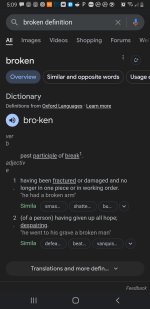
Broken: having been fractured or damaged and no longer in working order.

Status
Not open for further replies.

craipenn

Member
Joined
Oct 9, 2024
Member Type
Other
Native Language
English
Home Country
United States
Current Location
United States
Can someone break down this sentence professionally for me?

BROKEN:
having been fractured or damaged and no longer in one piece or in working order.

My question is whether or not the words after damaged also apply to the word fracture in this sentence. My understanding is that because of the word or between fractured and damaged that the words that follow damaged are just conditional descriptions of what kind of damage would qualify something thats only damaged to be broken and that they follow and only apply to the word damaged since fractured means to break or cause to break
 
Last edited by a moderator:
Welcome to the forum, craipenn, :)

It's not a sentence--it's a definition, so typically does not have a finite verb. Where did you find it?

Let's hope somebody else understands your question. :confused:
 
Last edited:
First of all, it isn't a grammatical sentence, just a phrase.

Second, I say it doesn't make sense logically. For something to be broken, it must be either fractured (in many pieces where it normally isn't) or damaged (but still in one piece) or neither of these but not in working order. In other words, there are two sufficient conditions of brokenness (fractured/damaged) and one necessary condition (not in working order). To say that again, it may be fractured, and it may be damaged, but it must be not in working order.

To say that something is fractured is to say that it is no longer in one piece, which is why it doesn't make sense.

Having said all this, I'll add that I don't agree that you can define brokenness so simply. Something may be damaged but still not considered broken, so strictly speaking, I wouldn't class damaged as a sufficient condition. It's the degree of damage that counts.

Where did you see this? In a dictionary? Which?
 
Last edited:
First of all, it isn't a grammatical sentence, just a phrase.

Second, I say it doesn't make sense logically. For something to be broken, it must be either fractured (in many pieces where it normally isn't) or damaged (but still in one piece) or neither of these but not in working order. In other words, there are two sufficient conditions of brokenness (fractured/damaged) and one necessary condition (not in working order). To say that again, it may be fractured, and it may be damaged, but it must be not in working order.

To say that something is fractured is to say that it is no longer in one piece, which is why it doesn't make sense.

Having said all this, I'll add that I don't agree that you can define brokenness so simply. Something may be damaged but still not considered broken, so strictly speaking, I wouldn't class damaged as a sufficient condition. It's the degree of damage that counts.

Where did you see this? In a dictionary? Which?
Thank you for you response! This is the definition of Broken on Oxford Languages use by Google. I agree with all you said. This definition was part of an argument I had with a coworker about that specific definition or phrase. The way it reads to me is that it is either fractured or damaged with those following conditions. My coworker was trying to argue that the word after damaged applied to the word fractured and damaged in that specific definition, the way it is written. My argument was that because it said or then damaged, the words that followed applied to damaged grammatical. My question is specifically about that phrase. It seems to be a very poor written definition, in my opinion.
 

Attachments

  • Screenshot_20241009-170924_Chrome.jpg
    Screenshot_20241009-170924_Chrome.jpg
    371.7 KB · Views: 3
I agree it's poorly written. I don't think it makes sense in either way, so it isn't worth analysing.
 
Welcome to the forum, craipenn, :)

It's not a sentence--it's a definition, so typically does not have a finite verb. Where did you find it?

Let's hope somebody else understands your question. :confused:
Thanks for your response! If I wasn't very clear with my question, in that specific phrase, do those conditions that follow damaged apply only to that word, the way it is written? I understand it is not a well written definition and it leaves confusion. My question is solely to the logic of the phrase structure and how it applies within the general rules of English. Thanks for your time!
 
I agree it's poorly written. I don't think it makes sense in either way, so it isn't worth analysing.
Thanks for your time!
 
BROKEN:
having been fractured or damaged and no longer in one piece or in working order.
It's broken. It's no longer in working order.

I'm sure that any other definition you see will be similar. However, don't take my word for it. Look at a few.
 
It's broken. It's no longer in working order.

Yes, that's right. The logic here is simple:

If something is in working order, then it isn't broken.
If something is no longer in working order, then it is broken.

This is where any definition should start. Any conditions of brokenness, such as whether it's fractured or damaged, are secondary.
 
Yes, that's right. The logic here is simple:

If something is in working order, then it isn't broken.
If something is no longer in working order, then it is broken.

This is where any definition should start. Any conditions of brokenness, such as whether it's fractured or damaged, are secondary.
Do you think something can be fractured, still be in working order but also be considered broken because fracture means to break or cause to break? Fractured sidewalk, Fractured bone, Fractured Car windshield? Where as Damaged needs unique conditions to be considered "broken". My understanding of the word fracture aways means broken were as damaged doesn't specifically mean broken. Just curious.
 
Last edited:
Do you think something can be fractured, still be in working order but also be considered broken

Logically, no. As I said, if it's in working order, or 'proper' working order, then it isn't broken, by the definition I gave above. It's hard though to imagine something to be simultaneously fractured and unbroken.

because fracture means to break or cause to break?

It means 'having split into parts'. Logically at least, it's possible for something to be fractured and unbroken. That's what I've been saying throughout the thread.

My understanding of the word fracture aways means broken

Well, no. On the most basic level, 'fractured' means 'having split into parts'. Although it is highly likely that if something is fractured it is also no longer in working condition, it's not logically necessary.

were as damaged doesn't specifically mean broken.

Right.

This conversation is really getting at one of the serious problems of trying to define the meaning of words, which I think is generally speaking a silly thing to do. The meaning of words should be described, not defined. It's a better approach to try to generalise what people mean when they use words. This is what Wittgenstein taught us over 70 years ago.
 
Status
Not open for further replies.

Ask a Teacher

If you have a question about the English language and would like to ask one of our many English teachers and language experts, please click the button below to let us know:

(Requires Registration)
Back
Top