Can we use( too) before positive adjectives?

Status
Not open for further replies.

abo.omar

Member
Joined
Aug 27, 2015
Member Type
Interested in Language
Native Language
Arabic
Home Country
Egypt
Current Location
Egypt
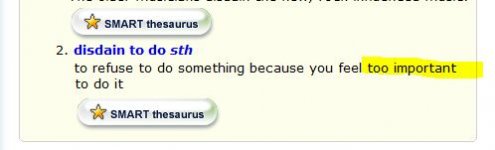
too.JPGCan we use too before positive adjectives?
 
Sure. Use quotation marks to highlight quoted words in titles. Never use parentheses ("brackets" in British English), square brackets, or any other punctuation marks for this purpose. It's always wrong.
 
View attachment 3953Can we use too before positive adjectives?
The highlighted phrase is grammatical and makes sense.

You can use too before any adjective, not just positive ones. Something can be too important, too trivial, too light, too dark, too heavy, too light, too low, too high, too beautiful, too ugly, too early, or too late.
 
Sure. Use quotation marks to highlight quoted words in titles. Never use parentheses ("brackets" in British English), square brackets, or any other punctuation marks for this purpose. It's always wrong.

He is too clever to pass the test. Is this sentence correct?
 
You've misunderstood (or been badly taught) the rule.

The adjective important is not positive in your sentence, but negative in the sense of 'problematic'. The idea is that your level of importance poses a problem. That's the sense in which adjectives after too are seen as 'negative'.

If you say My shoes are too small, you're not saying that smallness in general is a bad thing, but that in this particular situation, smallness poses a problem.

 
Last edited:
He is too clever to pass the test. Is this sentence correct?

It's very difficult to understand how that could be so but it is possible that it could make sense, yes. The idea would be that his high level of cleverness poses a problem in that in some way it serves as an obstacle.
 
You've misunderstood (or been badly taught) the rule.

The adjective important is not positive in your sentence, but negative in the sense of 'problematic'. The idea is that your level of importance poses a problem. That's the sense in which adjectives after too are seen as 'negative'.

If you say My shoes are too small, you're not saying that smallness in general is a bad thing, but that in this particular situation, smallness poses a problem.

It is too important to read slowly. Is this sentence correct?
 
It is too important to read slowly. Is this sentence correct?
It's grammatically correct. I can think of one context in which it would be reasonably natural.
 
He is too clever to pass the test. Is this sentence correct?
It's grammatical. It tells us he has a good reason for wanting to flunk the test. He does not want to pass.

Is that what you mean?

Maybe you mean:

- He is too dumb to pass the test. (He is dumb, so he will fail.)

- He is not clever enough to pass the test. (He is not clever, so he will fail.)

- He is too clever to flunk the test. (He is smart, so he will pass.)​
 
Last edited:
It is too important to read slowly. Is this sentence correct?
It's grammatical, but it's highly unlikely. It depends on what the pronoun It refers to.

Most things that are important should be read slowly and carefully. For instance, a nurse should read a patient's chart slowly. It is too important to read fast.

So You context would have to be very unusual. For example:

You: Our airplane is going to crash! What does the manual say we should do?

Me: I'll read it slowly.

You: No! Read it fast! This situation is too important to read slowly!​

Maybe you mean: It is very important to read slowly. That can make sense in more situations — reading prescription, for example.

Use too this way: [noun] is too [adjective]. It means that something is overly, excessively, unreasonably [adjective].

- The socks are too big for my feet.

- Her job is too important for a dope.

- I'd like to go out today, but the weather will be too rainy.

- He tried to pass the test, but it was too hard.​
 
Last edited:
Status
Not open for further replies.

Ask a Teacher

If you have a question about the English language and would like to ask one of our many English teachers and language experts, please click the button below to let us know:

(Requires Registration)
Back
Top