
You are using an out of date browser. It may not display this or other websites correctly.
You should upgrade or use an alternative browser.
You should upgrade or use an alternative browser.
Coloquial and standard sentences
- Thread starter Kharkhun
- Start date
- Views : 3,402
- Status
- Not open for further replies.

tzfujimino
Key Member
- Joined
- Dec 8, 2007
- Member Type
- English Teacher
- Native Language
- Japanese
- Home Country
- Japan
- Current Location
- Japan
Hello, kharkhun.:-D
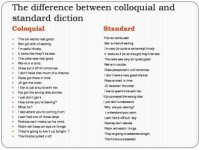
It's illegible, I'm afraid.
(And it's 'colloquial', by the way.)
It's illegible, I'm afraid.
(And it's 'colloquial', by the way.)
tzfujimino
Key Member
- Joined
- Dec 8, 2007
- Member Type
- English Teacher
- Native Language
- Japanese
- Home Country
- Japan
- Current Location
- Japan
I have no idea. I'm sorry.
(Should I try a magnifying glass? No, I don't think it will work.)
(Should I try a magnifying glass? No, I don't think it will work.)
- Joined
- Jun 20, 2010
- Member Type
- Retired English Teacher
- Native Language
- British English
- Home Country
- England
- Current Location
- England
How can I make it larger for you?
Type out one or two examples for a start.
There seems to be too much material there to consider all at once.

- Joined
- Jul 28, 2009
- Member Type
- English Teacher
- Native Language
- British English
- Home Country
- UK
- Current Location
- UK
I've managed to make out a few:
Colloquial: The car works real good.
Standard: The car works well.
Colloquial: What for?
Standard: Why are you leaving?
Colloquial: We're in a bind.
Standard: We're in trouble.
Colloquial: The car works real good.
Standard: The car works well.
Colloquial: What for?
Standard: Why are you leaving?
Colloquial: We're in a bind.
Standard: We're in trouble.

- Joined
- Oct 14, 2010
- Member Type
- English Teacher
- Native Language
- British English
- Home Country
- Czech Republic
- Current Location
- Czech Republic
Based on that very small sample, my opinion is that this colloquial/standard list is not very helpful. I'd say:
The car works real good. Unnatural and/or substandard in BrE.
The car works well. Not very natural in BrE. Cars tend to 'run' rather than 'work'.
What for? It's 'colloquial' in that it's not a complete sentence, It's also possible only if somebody has stated their intention of doing something before. It does not, on its own, mean 'Why are you leaving?'.
Why are you leaving? That's standard enough.
We're in a bind. That's one informal thing that could be said.
We're in trouble. OK
The car works real good. Unnatural and/or substandard in BrE.
The car works well. Not very natural in BrE. Cars tend to 'run' rather than 'work'.
What for? It's 'colloquial' in that it's not a complete sentence, It's also possible only if somebody has stated their intention of doing something before. It does not, on its own, mean 'Why are you leaving?'.
Why are you leaving? That's standard enough.
We're in a bind. That's one informal thing that could be said.
We're in trouble. OK

Roman55
Key Member
- Joined
- Feb 5, 2014
- Member Type
- Interested in Language
- Native Language
- British English
- Home Country
- Italy
- Current Location
- France
I am not a teacher.
The thumbnail directs us to a very difficult-to-read list of dubious quality.
The word colloquial is spelt in two different ways within the space of 5 words.
The "coloquial" list contains 21 phrases and the standard list contains only 20. It's the supposed equivalent of "What for?" that's missing, which might explain the problem 5jj pointed out.
Numerous clues indicate that the expressions are AmE. "in a bind", "that much of a…", "pal around", "The Knicks" etc…
Plus there is the use of adjectives as adverbs e.g. "real good" (twice) and "awful thirsty".
The thumbnail directs us to a very difficult-to-read list of dubious quality.
The word colloquial is spelt in two different ways within the space of 5 words.
The "coloquial" list contains 21 phrases and the standard list contains only 20. It's the supposed equivalent of "What for?" that's missing, which might explain the problem 5jj pointed out.
Numerous clues indicate that the expressions are AmE. "in a bind", "that much of a…", "pal around", "The Knicks" etc…
Plus there is the use of adjectives as adverbs e.g. "real good" (twice) and "awful thirsty".

Barb_D
VIP Member
- Joined
- Mar 12, 2007
- Member Type
- Other
- Native Language
- American English
- Home Country
- United States
- Current Location
- United States
"The car runs good" is not colloquial, it's wrong.
Do people use incorrect English? All the time.
But that doesn't make it an "informal" or "colloquial" way of saying it. Just sub-standard and indicative of someone who doesn't know better or who doesn't care.
If you type out more of these so we can see them (I blew it up (colloquially) or enlarged it (formally) and the words were too fuzzy to read.)
Do people use incorrect English? All the time.
But that doesn't make it an "informal" or "colloquial" way of saying it. Just sub-standard and indicative of someone who doesn't know better or who doesn't care.
If you type out more of these so we can see them (I blew it up (colloquially) or enlarged it (formally) and the words were too fuzzy to read.)

anhnha
Senior Member
- Joined
- May 5, 2012
- Member Type
- Student or Learner
- Native Language
- Vietnamese
- Home Country
- Vietnam
- Current Location
- Vietnam
***NOT A TEACHER***
If I am not mistaken, that is an excerpt from Grammar Essentials: Learn to Express Yourself Clearly & Correctly.
If I am not mistaken, that is an excerpt from Grammar Essentials: Learn to Express Yourself Clearly & Correctly.
| Colloquial | Standard |
| The car works real good. | The car works well. |
| Ben got sick of waiting. | Ben tired of waiting. |
| I’m awful thirsty | I’m very (or quite or extremely) thirsty. |
| It looks like they’ll be late. | It looks as if (or as though) they’ll be late. |
| The cake was real good. | The cake was very (or quite) good. |
| We’re in a bind. | We’re in trouble. |
| Drew put it off till tomorrow. | Drew postponed it until tomorrow. |
| I don’t have that much of a chance. | I don’t have a very good chance. |
| Rosa got there in time. | Rosa arrived in time. |
| Jill got the order. | Jill received the order. |
| I like to pal around with her. | I like to spend time with her. |
| Kip got the wrong idea across. | Kip conveyed the wrong idea. |
| I just don’t get it. | I just don’t understand. |
| How come you’re leaving? | Why are you leaving? |
| What for? | Why? |
| I see where you’re coming from. | I understand your point. |
| Leah had one of those days. | Leah had a difficult day. |
| Rodney can’t make up his mind. | Rodney can’t decide. |
| Robin will keep an eye on things. | Robin will watch things. |
| They’re going to live it up tonight. | They’re going to celebrate tonight. |
| The Knicks pulled it off. | The Knicks succeeded. |
- Joined
- Oct 14, 2010
- Member Type
- English Teacher
- Native Language
- British English
- Home Country
- Czech Republic
- Current Location
- Czech Republic
It seems to me to be a very misleading page. The so-called 'colloquial' expressions range from sub-standard/wrong to slightly informal. The 'standard' ones range from quite natural to slightly pompous.
queeniech
Member
- Joined
- May 17, 2012
- Member Type
- Student or Learner
- Native Language
- Chinese
- Home Country
- Hong Kong
- Current Location
- Hong Kong
Colloquial: Rosa got there in time.
Standard: Rosa arrived there in time.
I saw some people use 'got there' in place of 'arrived there' in some English books. I wonder if it is recommended to use 'got there" in examinations?
Standard: Rosa arrived there in time.
I saw some people use 'got there' in place of 'arrived there' in some English books. I wonder if it is recommended to use 'got there" in examinations?
Barb_D
VIP Member
- Joined
- Mar 12, 2007
- Member Type
- Other
- Native Language
- American English
- Home Country
- United States
- Current Location
- United States
Colloquial: Rosa got there in time.
Standard: Rosa arrived [STRIKE]there [/STRIKE]in time.
I saw some people use 'got there' in place of 'arrived there' in some English books. I wonder if it is recommended to use 'got there" in examinations?
Personally, I would not use "arrived there" but rather "arrived."
I agree that "got there" is less formal than "arrived." I don't know that standards your teachers apply in exams. If I were grading a paper and someone wrote "There was so much traffic that I feared we wouldn't get there in time" I would say that was 100% okay.
- Joined
- Oct 14, 2010
- Member Type
- English Teacher
- Native Language
- British English
- Home Country
- Czech Republic
- Current Location
- Czech Republic
All of the individual sentences are possible in the appropriate context, even those that are grammatically incorrect. It's just that the whole table as it stands is unhelpful/misleading.
Tdol
No Longer With Us (RIP)
- Joined
- Nov 13, 2002
- Member Type
- English Teacher
- Native Language
- British English
- Home Country
- UK
- Current Location
- Japan
I wonder if it is recommended to use 'got there" in examinations?
Most exams would accept this as it's correct.
- Status
- Not open for further replies.
Similar threads
- Replies
- 15
- Views
- 1K


- Replies
- 3
- Views
- 919
- Locked
- Replies
- 5
- Views
- 1K

Ask a Teacher
If you have a question about the English language and would like to ask one of our many English teachers and language experts, please click the button below to let us know:
(Requires Registration)