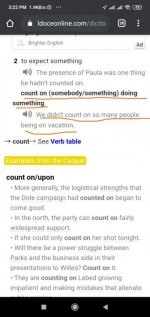
Don't count on me seeing anywhere

Status
Not open for further replies.

Ador

Junior Member
Joined
Apr 8, 2020
Member Type
Student or Learner
Native Language
Bengali; Bangla
Home Country
Bangladesh
Current Location
Bangladesh
Are there any mistakes in these sentences? I think the last sentence should be : Don't count on me seeing anywhere. What's your opinion about this?IMG_20200512_140848.jpg

 
The original, "Don't count on seeing me anywhere", is correct. The writer will be too busy with his/her work, presumably at home, to go anywhere.
 
The original is correct. It means "You should not expect to see me anywhere".
 
That only works when you mean that you are relying on them doing something. The original is a negative imperative.

DO NOT rely on ... seeing me anywhere.
You won't see me anywhere (because I'll be at home).
 
That only works when you mean that you are relying on them doing something. The original is a negative imperative.

DO NOT rely on ... seeing me anywhere.
You won't see me anywhere (because I'll be at home).

Does it also mean you shouldn't expect to see her anywhere : Don't count on me being anywhere? Because it followed the Longman's structure.
 
No, "Don't count on me being anywhere" doesn't mean the same thing at all. "I" will be somewhere - I'll be at home!

I don't know if this dialogue will help you:

Helen: John's having a party on Saturday night. Did you know that?
Sue: Yes, he sent me an invitation.
Helen: I think it'll be great. It will be lovely to see everyone.
Sue: Well, don't count on seeing me at the party. I've got too much to do.
Helen: Oh, that's a shame.
 
No, "Don't count on me being anywhere" doesn't mean the same thing at all. "I" will be somewhere - I'll be at home!

I don't know if this dialogue will help you:

Helen: John's having a party on Saturday night. Did you know that?
Sue: Yes, he sent me an invitation.
Helen: I think it'll be great. It will be lovely to see everyone.
Sue: Well, don't count on seeing me at the party. I've got too much to do.
Helen: Oh, that's a shame.

Could you please check if I used it correctly:

Karim: Do you know the answer of this question?

Rahim: Please, don't count on me answeing all your questions. You should search them on Google also.
 
Could you please check if I used it correctly:

Karim: Do you know the answer of this question?

Rahim: Please, don't count on me [STRIKE]answering[/STRIKE] being able to answer all your questions. You should search them on Google also.
It works better as I've edited it above. "Don't count on" means don't depend on; be prepared to do it a different way. I made the change above because Rahim would say this if he thought Karim was too confident that Rahim would always be capable of answering. As you wrote it, there's a suggestion that Rahim might refuse​ to answer.
 
Do you know the answer to this question?
 
It works better as I've edited it above. "Don't count on" means don't depend on; be prepared to do it a different way. I made the change above because Rahim would say this if he thought Karim was too confident that Rahim would always be capable of answering. As you wrote it, there's a suggestion that Rahim might refuse​ to answer.


It looks like you have used 2nd conditional in this sentence: Rahim would say this if he thought Karim was too confident that Rahim would always be capable of answering. Am I right? If not, please explain it to me.
 
It looks like you have used 2nd conditional in this sentence: Rahim would say this if he thought Karim was too confident that Rahim would always be capable of answering. Am I right? If not, please explain it to me.
I just speak English. I'd never heard of first, second, or third conditionals before I came to this forum. Hopefully a teacher who knows what they are will jump in to answer your question. :)
 
Rahim: Please, don't count on me answering all your questions.

If you want your sentence to use the same construction as the one in post 1, you need to say "Please don't count on asking me all your questions".
 
Status
Not open for further replies.

Ask a Teacher

If you have a question about the English language and would like to ask one of our many English teachers and language experts, please click the button below to let us know:

(Requires Registration)
Back
Top