English word for bakra and its meat

Tait-ka

Member
Joined
Sep 21, 2024
Member Type
Student or Learner
Native Language
Urdu
Home Country
Pakistan
Current Location
Pakistan
Screenshot_20260528-104236_1.jpgScreenshot_20260528-104643_1.jpg
Screenshot_20260528-104246_1.jpg

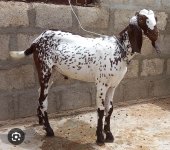
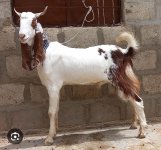
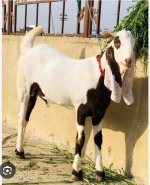
Please look at the pictures above. We call the animal shown "bakra" in Urdu. (Plural "bakray")
What do you call it in English?

Also, what do you call its meat? Do you call its meat "mutton"?
 
@Tait-ka Do you really not have a basic Urdu-English dictionary you could have used to find out that "bakra" in Urdu is "goat" in English?
 
NOT A TEACHER
------------

My brief research suggests that goats are very important in Pakistani culture and in the Urdu language, and that there are distinct words for male, female, and young goats, as well as for their meat.

We don't really do that in English. A goat is a goat. We do something somewhat similar with sheep, though. A young sheep, and its meat, is called lamb, whereas mutton is the meat of an adult sheep.

Another brief research suggests English actually does have distinct words for goat and goat meat categories, but to be honest, I've never heard any of those words. It might be because I'm not a native speaker and I didn't grow up on a farm, which is why I'd like to verify whether/how often the following words are used:

male goat = buck or billy
female goat = doe or nanny
young goat = kid
adult goat meat = chevon
young goat meat = cabrito
 
Last edited:
It's a goat.
Is either the male one and the female one called "goat"? And what do you call the meat of male and female one?
 
Is either the male one and the female one called "goat"? And what do you call the meat of male and female one?
As you can see from the two previous response, technically a male adult is a billy, a female adult is a nanny and a baby goat is a kid. Like 5jj, those are the only terms from Glizdka's list that I've ever heard.

The majority of Brits don't really need a word for all those separate things in everyday English because we don't see many goats. There are farms producing goat's milk/cheese but goat meat isn't really eaten in the UK outside of very specific religious/cultural groups. I'd put money on the fact that if you showed a picture of a goat of any gender or age to most Brits, they'd just say it's a goat.
As far as the meat goes, I've only ever heard it called "goat [meat]". I've certainly never heard of "chevon" or "cabrito".
 
I know those, but not the others.
Chevon and cabrito sound Spanish to me. Perhaps they are loanwords from Spanish that have become somewhat prevalent in English, particularly in the southern US.

I know Mexicans “respect” their goats, so it would make sense that they made the distinction especially prominent when they immigrated and started their food businesses in the US, after which the terms were adopted into English to at least some extent.

I still remember how odd it was to see queso, which literally means cheese in Spanish, listed as an ingredient in a dish at a Mexican restaurant in Nevada. I learned the hard way that this was done to assure customers that it was real cheese, not government cheese or some other cheese-like artificial abomination that doesn’t even remotely resemble actual cheese.

Perhaps chevon and cabrito are similar.

In any case, this is just a linguistic curiosity. I don't think Tai-ka, or anyone browsing this forum for that matter, should expect most people to understand what chevon and cabrito mean. For the most part, English simply calls it goat.
 
Last edited:
Is either the male one and the female one called "goat"? And what do you call the meat of male and female one?
As far as I'm concerned, it's just goat all the way.
 
"Cabrito" is the Spanish word for a kid (baby goat) but according to Google Translate, "chevon" doesn't exist in Spanish. It sounds French to me but I've checked and "chèvre" is French for a female goat, and "bouc" for a male but no "chevon" is listed.
 
male goat = buck or billy
female goat = doe or nanny
young goat = kid

'Billy' goat is commonly known across registers, due to the fairy tale about The Three Billy Goats Gruff. The others are commonly used within the sphere of rural life, agriculture, or animal husbandry. They might not be familiar or common knowledge to urban dwellers. There's also a 'wether', which is a castrated male goat.

Note that 'doe' is also used for a female deer.

adult goat meat = chevon
young goat meat = cabrito

I've never heard of these. The first sounds French, the second Spanish.

"chèvre" is French for a female goat, and "bouc" for a male but no "chevon" is listed.

'Chèvre' is also used for the French-style soft goat cheese. The hard Italian-style cheese is 'caprino' (from the Itaalian 'capra', or 'goat'). Although I personally eat a fair amount of the latter, I still just call it 'goat cheese'.

We do use 'mutton' for sheep meat, but I'm not aware of any separate term for goat meat. 'Mutton' is used for goat meat in the Carribean, but rarely outside the Caribbean.

The reason English uses a different name for the animal versus the meat boils down to social class differences after the Norman conquest of England. The Old English (Anglo-Saxon) speaking peasant class who raised the animals, and the Norman French speaking ruling class who simply ate the animals used their own terms for the animals. Since certain high-value animals were resevered primarlly for the Norman-French speaking aristocracy, those Norman terms for the animals gradually worked their way into English. Other animals were commonly eaten across all social classes, so they didn't develop seperate terms, or else were seen as peasant food and thus unworth of inclusion in Norman vocabulary.

Some Googling suggests that the term 'chevron' for goat meat wasn't introduced until 1922, as a marketing attempt by the National Sheep and Goat Raisers Association in Texas to make the meat sound more appealing and marketable. It never caught on, primarily because goat just isn't eaten that much by most Americans. The primary consumers of goats are immigrants from Latin America the Middle-East, and the Carribean where goat is more commonly consumed. Mutton isn't widely consumed either in the US, aside from being traditional on Easter. Its consumption is again relegated to certain ethnic groups, althoug it is fairly common in the southwestern US with certain Native America tribes of that region

So, due to the term 'chevron' being relatively new (linguistically speaking) in an uncommon market, it just hasn't entered the general vocabulary of most English speakers. Since it's so uncommon, it of course hasn't make the international jump to other English-speaking countries.

/novella

 
So, due to the term 'chevron' being relatively new ...
I might have found that if I'd looked up "chevron" but unfortunately Glizdka's post gave it as "chevon" so that's what I put into Google Translate.
 
I ate goat meat exactly once, in Trinidad. It was sold as goat. No special name.
 
My wife and I regularly ate mutton (goat meat) when we worked in Oman. Guests from the UK always called it goat (meat).
 
In India goat meat is very popular, as Hindus abhor beef and Muslims pork. Sheep are rare, so goat meat is eaten, and they call it mutton. In North America mutton means the meat of mature sheep and is very hard to find nowadays.
 
I've heard people from the Muslim world, mostly in the Middle East, call goat meat 'mutton' several times before, though it doesn't sound right to me.
 
But it's sheep meat, as has been told above.
Mutton is sheepmeat in the UK. In many countries it is goatmeat.
(i feel another touch of tetchiness coming on.)
 
But it's sheep meat, as has been we were told above.
Note that "as has been told" doesn't work. You could also say:
... as was said above.
... as [name] already said.
... as [name] already told us.

I'd probably have quoted 5jj's response (as you did) and said "But Glizdka said mutton is sheep meat. Do you disagree?"
 
I might have found that if I'd looked up "chevron" but unfortunately Glizdka's post gave it as "chevon" so that's what I put into Google Translate.
It wasn't a typo. My brief research pointed to chevon, no r.

The culinary name chevon, a blend of the French words chèvre 'goat' and mouton 'sheep', was coined in 1922 and selected by a trade association

My wife and I regularly ate mutton (goat meat) when we worked in Oman. Guests from the UK always called it goat (meat).
I've heard people from the Muslim world, mostly in the Middle East, call goat meat 'mutton' several times before, though it doesn't sound right to me.
I would find it really confusing. I was already confused to see beef bacon, beef ham, and beef sausage in Egypt. To see goat mutton would be perplexing.
 

Ask a Teacher

If you have a question about the English language and would like to ask one of our many English teachers and language experts, please click the button below to let us know:

(Requires Registration)
Back
Top