Essay: Do you prefer essay exams or multiple choice exams?

Essay exams always felt more fair to me. Multiple choice rewards guessing and tricks, while essays show how well someone actually understands a topic. I like having space to explain ideas in my own words, even if it takes more time. I’ve done badly on tests where I knew the material but picked one wrong option. Essays at least let reasoning count.
 
Essay exams always felt more fair to me. Multiple choice rewards guessing and tricks, while essays show how well someone actually understands a topic. I like having space to explain ideas in my own words, even if it takes more time. I’ve done badly on tests where I knew the material but picked one wrong option. Essays at least let reasoning count
Do not use the personal pronoun in an IELTS essay.
Isn't it wrong to omit your idea in the introduction of the opinion essay and write only "I will state my point of view about this issue and support it with some arguments below." Like it is shown in these samples. Should't this be used after "In personally think that" or "in my opinion," "I agree that," or a similar phrase?
 
I really don't know what the requirements are for the exam you have in mind. In IELTS, you are expected to avoid using the personal pronouns I and my in order to keep your writing objective.

Yes, I would imagine that, in any kind of exam, a generic statement like:
I will state my point of view about this issue and support it with some arguments below.
.. should be considered meaningless.
 
I really don't know what the requirements are for the exam you have in mind. In IELTS, you are expected to avoid using the personal pronouns I and my in order to keep your writing objective.

Yes, I would imagine that, in any kind of exam, a generic statement like:

.. should be considered meaningless.
No, I don't mean IELTS. I mean in general opinion essays not the ones I showed you , aren't such phrases as " I personally think that" or "in my opinion," "I agree that," "I support the idea," or a similar phrase generally used?
 
I really don't know what the requirements are for the exam you have in mind. In IELTS, you are expected to avoid using the personal pronouns I and my in order to keep your writing objective.

Yes, I would imagine that, in any kind of exam, a generic statement like:

.. should be considered meaningless.
I saved the structure you suggested using and I always used it. But what is not clear to me whether or not I should include both my opinion and a thesis or only one of them or both of them. I am asking about general opinion essays.
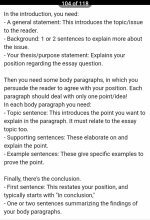
Some teachers suggest using 1. A broad background statement. 2. Rewrite the question prompt. 3. Write your thesis statement. A personal opinion wasn't mentioned here.
Another structure I came across was 1. State your topic. Give opinion. 2. Paragraph 1. Paragraph 2. 3. Summary. A thesis wasn't mentioned. I am confused.
 

Attachments

  • Screenshot_20251229_150040_Telegram.jpg
    Screenshot_20251229_150040_Telegram.jpg
    487.2 KB · Views: 2
Note that "I personally think/believe etc..." is tautologous. If you use "I", you're clearly stating your personal opinion.
 
Note that "I personally think/believe etc..." is tautologous. If you use "I", you're clearly stating your personal opinion.
Thank you. But I am really confused about the structure I wrote about in post #25. 😥
 
No, I don't mean IELTS. I mean in general opinion essays not the ones I showed you , aren't such phrases as " I personally think that" or "in my opinion," "I agree that," "I support the idea," or a similar phrase generally used?
If you were explicitly asked to provide a personal opinion, with the word "you" in there, then it's okay to use a phrase like one of those above, but even then you can actually avoid the personal pronoun.

For example:
Prompt: Some people say that there should be mandatory prison sentences for the use of illicit drugs. To what extent do you agree?

Thesis statement:
Although some may argue that a prison sentence should always be the penalty for using illegal drugs, I believe rehabilitation can often be a better approach. [ with personal pronoun]

While some people think drug abusers must go to jail, others argue that alternative penalties might be more effective. [ without personal pronoun].
 
If you were explicitly asked to provide a personal opinion, with the word "you" in there, then it's okay to use a phrase like one of those above, but even then you can actually avoid the personal pronoun.

For example:
Prompt: Some people say that there should be mandatory prison sentences for the use of illicit drugs. To what extent do you agree?

Thesis statement:
Although some may argue that a prison sentence should always be the penalty for using illegal drugs, I believe rehabilitation can often be a better approach. [ with personal pronoun]

While some people think drug abusers must go to jail, others argue that alternative penalties might be more effective. [ without personal pronoun].
Do you mean it is still better not to use personal pronouns in general opinion essays as well and should I include both my opinion and a thesis or only one of them or both of them?
 
I saved the structure you suggested using and I always used it. But what is not clear to me whether or not I should include both my opinion and a thesis or only one of them or both of them. I am asking about general opinion essays.
Thank you. But I am really confused about the structure I wrote about in post #25. 😥
There is not one set structure that every teacher/examiner follows. What's important is that the essay is cohesive. That means the individual paragraphs should each have a purpose and the sentences should flow logically in each one. Moreover, the paragraphs should link logically together.
Some teachers suggest using 1. A broad background statement. 2. Rewrite the question prompt. 3. Write your thesis statement.
I am aware of that but as I've said before, I think regurgitating the prompt is not very useful.
Another structure I came across was 1. State your topic. Give opinion. 2. Paragraph 1. Paragraph 2. 3. Summary. A thesis wasn't mentioned. I am confused.
It's generally accepted that the examiner (in IELTS and similar formal contexts) will look for some kind of statement at the end of your introduction in which you outline the direction of the essay.
 
Do you mean it is still better not to use personal pronouns in general opinion essays as well
It's up to you. Please read my answer above.
and should I include both my opinion and a thesis or only one of them or both of them?
No. You only need one sentence at the end of the introduction which outlines what you will argue in your essay.
 
There is not one set structure that every teacher/examiner follows. What's important is that the essay is cohesive. That means the individual paragraphs should each have a purpose and the sentences should flow logically in each one. Moreover, the paragraphs should link logically together.

I am aware of that but as I've said before, I think regurgitating the prompt is not very useful.

It's generally accepted that the examiner (in IELTS and similar formal contexts) will look for some kind of statement at the end of your introduction in which you outline the direction of the essay.
I wanted to make sure I understand. So I can use one of these structures too. I have to write about my opinion or a thesis not both of them. As you said "You only need one sentence at the end of the introduction which outlines what you will argue in your essay."
Just to make it clear why I was asking about writing both. There are lots of samples where "I agree that..." an opinion is followed by a thesis: I am going to state my opinion in details and support it with some arguments."
You used it in a different way "
Although some may argue that a prison sentence should always be the penalty for using illegal drugs, I believe rehabilitation can often be a better approach." This is understood to be an opinion which should be followed by a thesis. I mean according to the book I have.
 
No! This is the thesis. :oops:
I am sorry for the extended discussion. I just wanted to explain why I was so confused in the first place. The essay samples given in that book are very confusing. It illustrates an opinion and then there are those statements that you advised against using and I believe they are given as thesis statements.
 
No! This is the thesis. :oops:
According to some of those samples "Although some may argue that a prison sentence should always be the penalty for using illegal drugs, I believe rehabilitation can often be a better approach" should be followed by "this essay outlines the reason behind my position" or "I will support arguments to support my view" or something similar.
 
I meant that those samples you posted have lines such as "I am going to state my opinion ..." or "I will state my point of view ..". Don't do that!
Sorry, I have to ask once again are such statements purpose statements which you explained earlier should better be used at the end of the introduction?
 

Ask a Teacher

If you have a question about the English language and would like to ask one of our many English teachers and language experts, please click the button below to let us know:

(Requires Registration)
Back
Top