Is making or makes

Status
Not open for further replies.

Rachel Adams

Key Member
Joined
Nov 4, 2018
Member Type
Student or Learner
Native Language
Russian
Home Country
Georgia
Current Location
Georgia
This example is from "A Practical English Grammar Exercises" by A. J. Thomson and A. V. Martinet.
Should I use "it is always making a noise like that" or "it always makes a noise like that?"

"The car is making a very strange noise. Do you think it's all right?-

"Oh, that noise does not matter. It always makes a noise like that."
 
Both forms are possible.
 
Both forms are possible.

Can either be used in this example too, or is it different?

"Do you dream at night?"
-"Yes, I always dream and if I have too much supper I have nightmares."

Can I use "Yes, I am always dreaming..." would it sound unnatural or can it be used to express an irritation?
 
Can I use "Yes, I am always dreaming...". Would it sound unnatural or can it be used to express [STRIKE]an[/STRIKE] irritation?

Yes.
Not in the right context.
Yes.
 
I would use/expect to hear "always dream" versus "always dreaming" which to me would sound unnatural or, at least, uncommon.
 
Yes.
Not in the right context.
Yes.

Do both examples express irritation? "The car is always making a noise like that" and "I am always dreaming".
 

Do you mean only "I am always dreaming" expresses irritation, or none of them? Is irritation expressed only when I am talking about somebody else but, not about to myself, a car, a washing machine, etc?
 
Do you mean only "I am always dreaming" expresses irritation, or neither of them?
The written words alone can't express irritation—only the tone of voice and/or facial expression can do that.
 
Last edited:
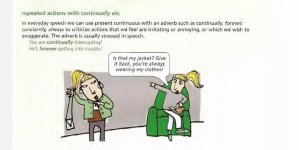
I was judging by this explanation: IMG_20210720_110338.jpg
If in everday speech native speakers can use present continuous and the construction will express irritation, can't present simple express the same feeling? If with present continuous expresses it by its construction, can't present simple express the same by the tone of voice?
"English Grammar in Context" by Michael Vince.
 
Last edited by a moderator:
Tenses/aspects do not express irritation. People do.
 
[FONT=&quot]From https://www.usingenglish.com/articles/english-tenses-aspects-4-durative-aspect.html
[/FONT]
[FONT=&quot]
[/FONT][FONT=&quot]4. [/FONT][FONT=&quot]Andrea[/FONT][FONT=&quot]'s [/FONT][FONT=&quot]always [/FONT][FONT=&quot]losing[/FONT][FONT=&quot] her keys.
[/FONT]
[FONT=&quot]
In [4], the use of
[/FONT][FONT=&quot]always[/FONT][FONT=&quot], normally associated by virtue of its meaning with the unmarked tense seems at first illogical. However, as we have seen [...] the use of the durative aspect with short actions can stress the repetition of that action. The combination of [/FONT][FONT=&quot]always[/FONT][FONT=&quot] and the durative action tells us that this is a situation that actualises repeatedly but, because the duration of the whole series of[/FONT][FONT=&quot] losing [/FONT][FONT=&quot]is limited, it is not presented as a permanent state of affairs.

This combination is associated by some writers with some idea of the speaker's emotional attitude, but this will be made explicit not just by the aspect, but by the whole context of situation. It is not true to suggest, as some do, that it always expresses the speaker's irritation. It can just as easily express pleasure:

[/FONT][FONT=&quot]……[/FONT][FONT=&quot]4a. [/FONT][FONT=&quot]William is so sweet. He'[/FONT][FONT=&quot]s[/FONT][FONT=&quot] always[/FONT][FONT=&quot] buying[/FONT][FONT=&quot] me flowers and chocolates.[/FONT]
[FONT=&quot][/FONT]
 
Then the book isn't quite right. Perhaps I misunderstand, but I understand it to mean that the purpose of the present continuous, of its construction is to expresses irritation. Do you agree?

If I sum up and say that both present simple and present continuous can express either irritation or pleasure but not by the aspect, but by context. The only thing that the continuous form itself expresses is duration which is limited. Is that right?
 
Last edited by a moderator:
Then the book isn't quite right. Perhaps I misunderstand, but I understand it to mean that the purpose of the present continuous, of its construction is to expresses irritation.
Thomson and Martinet do not say that.
If I sum up and say that both present simple and present continuous can express either irritation or pleasure but not by the aspect, but by context.
People can express pleasure or irritation using any tense or aspect.
The only thing that the continuous form itself expresses is duration which is limited. Is that right?
I wouldn't say that it 'expresses' that, but it is used with situations that have some form of duration, and the duration is limited,
 
Last edited by a moderator:
Thomson and Martinet do not say that.

People can express pleasure or irritation using any tense or aspect.
I wouldn't say that it 'expresses' that, but it is used with situations that have some form of duration, and the duration is limited,

No, I was talking about Michael Vince's "English Grammar in Context", about the screenshot I uploaded.

You said "People can express pleasure or irritation using any tense or aspect". I don't understand the purpose of the rule Michael Vince mentions and it's mentioned in Raymond Murphy's book too. Unlike Michael Vince, in Raymond Murphy's book I read "You can also say "I am always doing something", but this has a different meaning. For example, "I've lost my key again. I'm always losing things." It doesn't mean that I lose things every time. It means that I lose things too often, more often than usual."
He doesn't mention irritation, though. What should I do as a learner? Isn't it better to remember that any aspect can express irritation or pleasure instead of thinking that when using present continuous I am giving my sentence a special tone?
 
What should I do as a learner?
Not misinterpret what writers say.

Your sources do not say that the present continuous with always always suggests irritation (or anything else). They do not say that the present simple cannot be used in this way.
 
Not misinterpret what writers say.

Your sources do not say that the present continuous with always always suggests irritation (or anything else). They do not say that the present simple cannot be used in this way.

Thus, I can use either present simple or continuous to express that something happens more often than usual, to express irritation, pleasure, annoyance, almost anything, but that is expressed not by aspect, but by intonation/context. Is that right?

In these examples I can use either tense to express irritation, annoyance, or anything else. That's not expressed just by present continuous but by intonation and context and by present simple as well.
1. "These workmen are never satisfied, they always complain. Or "Are always complaining."

2. "He always says he will mend the window but he never does it." Or "He is always saying."

3. "I always buy lottery tickets but I never win anything." Or "I am always buying."

4. "His dog always bites me." Or "Is always biting me."

5. "Do you dream at night?" Yes, I am always dreaming." Or "I always dream."

6. "He always wears black." Or "Is always wearing black."
 
Not misinterpret what writers say.

Your sources do not say that the present continuous with always always suggests irritation (or anything else). They do not say that the present simple cannot be used in this way.

If I don't have "always" in my sentence can I still use either tense?

For example, "These dogs fight whenever they meet." Is "are fighting whenever they meet" also correct?
 
If I don't have "always" in my sentence can I still use either tense?

For example, "These dogs fight whenever they meet." Is "are fighting whenever they meet" also correct?
The first is fine.
The second is not. ... are fighting suggests that the fighting is in progress. This not possible if they have just met.
 
With your dogs example, I think I can see where at least some of the confusion is coming from. The following sentences mean just about the same thing:

1. Our dogs fight whenever they meet.
2. Our dogs are always fighting!

If you add "whenever they meet" to the end of sentence 2, it stops sounding natural. The use of "always" with the continuous negates the need for "whenever they meet".
 
Status
Not open for further replies.

Ask a Teacher

If you have a question about the English language and would like to ask one of our many English teachers and language experts, please click the button below to let us know:

(Requires Registration)
Back
Top