Measuring Student Progress

oliviateaches

New member
Joined
Jun 26, 2025
Member Type
English Teacher
Native Language
English
Home Country
United States
Current Location
United States
Ok so I am a fairly new teacher and I have SO MUCH trouble noticing when or how a student has made progress. There are so many things I feel I need to pay attention to as a teacher that I just can't get my brain to notice their progress. What are some ideas for suggestions about how to measure or observe progress?

Thank you!
 
The obvious and main way is periodic progress tests.
 
You can keep a list of goals or objectives each student should acquire according to what you're teaching them. Mark them off as they demonstrate mastery.

I don't keep a formal list, but one example I take mental note of is when for example my Spanish speaking students finally start starting using the 'be' verb instead of 'have' when talking about people's age. Since Spanish uses the 'have' verb to express people's age, using the English construction of 'be' shows they're no longer translating from Spanish but thinking in English. Especially when you notice them self-correcting.
 
I’ve been in a similar spot before — when I first started helping friends with English I found it hard to tell if they were actually progressing week to week. What helped me was mixing small informal checks (like asking the same question in different ways) with simple goals I set for them. For example, one friend struggled with past tense at the start, so I paid attention to how often they used it correctly over time. Sometimes progress is subtle — they might still make mistakes but start self-correcting, or they start using different expressions more naturally. It doesn’t have to be a formal test every time, even quick observation in real use can give you a good sense of growth.
 
Recording student interactions over time works really well too - even just audio notes after class about what each student struggled with or improved on. The language interference examples are gold - noticing when students stop making their native language errors shows real internalization. Simple checklists of can-do statements help track functional progress beyond just grammar accuracy. Sometimes the biggest breakthroughs happen when students start taking risks with new structures rather than playing it safe.
 
Speaking and listening are my concerns, so I need accurate measures of my pupils abilities year by year.
Being as lazy as I am handsome, I downloaded past and sample papers from the Cambridge ESL site.
I have a couple of every test from Pre-A1 to C2 - The listening comp sections give me very accurate results so I can give every kid an unofficial but accurate CEFR rating for listening.

If your concern is the written word, use those sections of the test. You could train a monkey to score the reading comp as Cambridge supply the answer key.
The writing section is more difficult, as is the speaking, because much of the score is subjective. As we are not trained Cambridge examiners, we can't guarantee accuracy.
However, we can get a really good idea.

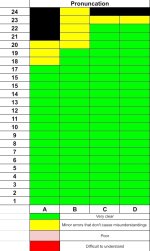
I keep scores for every pupil and every class. This one is for pronunciation. I'm especially fussy so I give a 4 when Cambridge would give a 5. One trilled R or a couple of examples of poor inflection will lose them the mark. I also record fluency/vocabulary and grammar. Upper grades have discourse management and interactive communication as well.

Screenshot_20260519_130653_Sheets.jpg
 

Ask a Teacher

If you have a question about the English language and would like to ask one of our many English teachers and language experts, please click the button below to let us know:

(Requires Registration)
Back
Top