
[Grammar] Must not A or B

Status
Not open for further replies.

KMA8622

Member
Joined
Oct 11, 2021
Member Type
Student or Learner
Native Language
Japanese
Home Country
Japan
Current Location
Australia
Hello,

I was looking at a government official home page for immigration and found the sentence below as a part of conditions to apply for a certain visa.

You must not marry or enter into a de facto relationship before entering Australia.

Does this mean;
1) You "must not marry" + "must not enter into a de facto relationship"
or
2) You "must not marry" + "must enter into a de facto relationship"

I know the answer should be (1) from the context but just wanted to make sure from the grammar perspective because I sometimes get confused for these expressions.

Are those negative sentences always like that?
Anything exceptions?
What if it was You must not marry and enter into--------. ?
 
I presume the conditions are for those who have obtained their permanent residency.
It would be preposterous if they require you to enter into a de facto relationship.
 
Hello,

I was looking at a government official home page for immigration and found the sentence below as a part of conditions to apply for a certain visa.

You must not marry or enter into a de facto relationship before entering Australia.

Does this mean;
1) You "must not marry" + "must not enter into a de facto relationship" :tick:
or
2) You "must not marry" + "must enter into a de facto relationship" :cross:

I know the answer should be (1) from the context but just wanted to make sure from the grammar perspective because I sometimes get confused by these expressions.

Are those negative sentences always like that?
Any exceptions?
What if it was You must not marry and enter into--------. ?

Thankfully, it isn't.
 
I know the answer should be (1) from the context but just wanted to make sure from the grammar perspective because I sometimes get confused for these expressions.

Context is the greatest determiner of meaning.
 
I think you're asking about logic. This is how it works:

You must X and Y.

Here, X and Y are two things you must do. By contrast:

You must not X or Y.

Here, X and Y are both things you must not do.
 
And you can add +/− to the list.
 
Hello,

I was looking at a government official home page for immigration and found the sentence below as a part of conditions to apply for a certain visa.

You must not marry or enter into a de facto relationship before entering Australia.

Does this mean;
1) You "must not marry" + "must not enter into a de facto relationship"
or
2) You "must not marry" + "must enter into a de facto relationship"

I know the answer should be (1) from the context but just wanted to make sure from the grammar perspective because I sometimes get confused for these expressions.

The additive negative meaning arises because the verb phrases coordinated by "or" fall under the scope of negation. Whether we consider the one action or the other, we must not do either of them. What that implies is that you must not do the one action and you must not do the other. In the sentence diagram below, you can see how negation ("not") dominates the coordinate structure in the syntactic hierarchy.

tree_must not.jpg

Are those negative sentences always like that? Any[strike]thing[/strike] exceptions?

I can't think of any exceptions off the top of my head.

What if it was You must not marry and enter into--------. ?
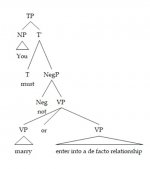
In that case, the coordinate structure would still be under the syntactic scope of negation, but the meaning would be different. The meaning would be "not both": you must not do both actions. You can do either action, or you can do neither, but you must not do both. If you do one, you must not do the other. In formal logic, DeMorgan's Theorem lays everything out with the following formulas:

Not (X or Y) means not X and not Y.
Not (X and Y) implies not X or not Y.
 
How likely would a government be to recommend a de facto relationship over a marriage?
 
I've been patiently waiting for somebody to explain what a "de facto relationship" is.
:-?
 
I've been patiently waiting for somebody to explain what a "de facto relationship" is.
:-?

In family law, it essentially means two people are living together as a married couple, even though they're not legally married.
 
Common law spouse has no real legal effect in English law, so I suppose this is a way of describing the situation of people living like a married couple without being married.
 
Status
Not open for further replies.

Ask a Teacher

If you have a question about the English language and would like to ask one of our many English teachers and language experts, please click the button below to let us know:

(Requires Registration)
Back
Top