Sentence Diagrams

Zhi You

Member
Joined
Aug 6, 2025
Member Type
English Teacher
Native Language
English
Home Country
Great Britain
Current Location
Great Britain
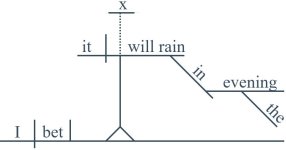
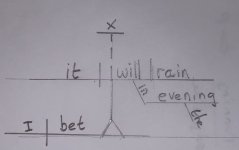
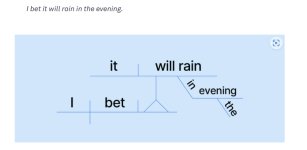
Hi Guys, I found this on a 'popular' website. I am learning about sentence diagrams. I was doing ok until I came up against this example. The explanation needed to be more thorough in order for to follow. Well anyway those of you in the know have a look at this Kellogg diagramed sentence and comment on its correctness please. . Thanks a bunch.
it will rain.jpg
 
Well anyway those of you in the know have a look at this Kellogg diagramed sentence and comment on its correctness please.
The diagram is mostly correct but does have a minor flaw. Although it is correct for the subordinate clause to be diagrammed as the direct object of "bet" (the stilts holding up that clause come after the vertical direct-object line following "bet"), the subordinate clause is itself diagrammed incorrectly in one respect: the subject and predicate are separated by a direct-object line rather than a line bisecting the clausal line (the same type of line that separates "I" and "bet it will rain in the evening"). There should be another bisecting line between "it" (the subject of the subordinate clause) and "will rain in the evening" (the predicate of the subordinate clause). In addition, it is common to diagram the omitted "that" in such "that"-less "that"-clauses ("I bet [that] it will rain in the evening") by placing "x" on a hovering expletive line (see below):

I bet it will rain.jpg
 
The diagram is mostly correct but does have a minor flaw. Although it is correct for the subordinate clause to be diagrammed as the direct object of "bet" (the stilts holding up that clause come after the vertical direct-object line following "bet"), the subordinate clause is itself diagrammed incorrectly in one respect: the subject and predicate are separated by a direct-object line rather than a line bisecting the clausal line (the same type of line that separates "I" and "bet it will rain in the evening"). There should be another bisecting line between "it" (the subject of the subordinate clause) and "will rain in the evening" (the predicate of the subordinate clause). In addition, it is common to diagram the omitted "that" in such "that"-less "that"-clauses ("I bet [that] it will rain in the evening") by placing "x" on a hovering expletive line (see below):

View attachment 6317
Thanks Annabel this is what was confusing me, why the subject 'it' was not split off from its predicate with the correct interesdting line. I did not know about the use of the 'x' to indicate a missing hypothesised 'that'. But one thing that still confuses me is why the predicate 'will rain' is not itself treated as a verb and direct object as I have suggested in my diagram below. Can you also answer this please . . Thanks again.


sentence.jpg
 
There is no object in it will rain.
 
There is no object in it will rain.
Thanks 5jj. . What is the thinking / the rule here; when modal verbs operate as finite verbs then they are not considered to have objects, is that it please? . . Thanks.
 
Thanks Annabel this is what was confusing me, why the subject 'it' was not split off from its predicate with the correct interesdting line. I did not know about the use of the 'x' to indicate a missing hypothesised 'that'. But one thing that still confuses me is why the predicate 'will rain' is not itself treated as a verb and direct object as I have suggested in my diagram below. Can you also answer this please . . Thanks again.


View attachment 6318
Thanks 5jj. . What is the thinking / the rule here; when modal verbs operate as finite verbs then they are not considered to have objects, is that it please? . . Thanks.
Ok, I am getting myself in knots . . ‘rain’ here is also a verb. .
 
Thanks 5jj. . What is the thinking / the rule here; when modal verbs operate as finite verbs then they are not considered to have objects, is that it please? . . Thanks.
Modal verbs are always finite.
 
But one thing that still confuses me is why the predicate 'will rain' is not itself treated as a verb and direct object as I have suggested in my diagram below.
In "will rain," "will" is a helping verb, as teachers like to say; "rain" is the main verb, and it is intransitive (it does not have a direct object, at least in a sentence like that; "rain" is transitive in sentences like "It is raining cats and dogs," "It shall rain fire and brimstone," etc.). Linguistically, "will" is a modal auxiliary verb, in the same class as "should," "may," "could," etc.: "It may rain in the evening," "It should rain in the evening," "It could rain in the evening."

"Rain" can also be a noun, and, when a noun, can function as a direct object: "We will have rain in the evening."

Regarding your new diagram, why did you delete the direct-object line betwen "bet" and the stilts holding up the subclause?
 
In "will rain," "will" is a helping verb, as teachers like to say; "rain" is the main verb, and it is intransitive (it does not have a direct object, at least in a sentence like that; "rain" is transitive in sentences like "It is raining cats and dogs," "It shall rain fire and brimstone," etc.). Linguistically, "will" is a modal auxiliary verb, in the same class as "should," "may," "could," etc.: "It may rain in the evening," "It should rain in the evening," "It could rain in the evening."

"Rain" can also be a noun, and, when a noun, can function as a direct object: "We will have rain in the evening."

Regarding your new diagram, why did you delete the direct-object line betwen "bet" and the stilts holding up the subclause?
Ok, thanks. I had not noticed the need to put in a direct object line there. Thanks a bunch.
 

Ask a Teacher

If you have a question about the English language and would like to ask one of our many English teachers and language experts, please click the button below to let us know:

(Requires Registration)
Back
Top