She started the meeting with the monthly sales report

fenglish

Member
Joined
Jun 14, 2009
Member Type
Other
Native Language
Chinese
Home Country
China
Current Location
China
Here is the definition of "start" in Cambridge dictionary:

start

BEGIN:
1. intransitive or transitive to begin doing something
...


Here is the original sentence from the Cambridge dictionary:
She started off the meeting with the monthly sales report.

Here is the modified sentence:
She started the meeting with the monthly sales report.

Is it the same when using "start" and "start off" in the above two sentences? What's the difference between them with the above example context?
 
Here is the definition of "start" in Cambridge dictionary:

start
BEGIN:
1. intransitive or transitive to begin doing something
...

Here is the original sentence from the Cambridge dictionary:
She started off the meeting with the monthly sales report.

Here is the modified sentence:
She started the meeting with the monthly sales report.

Is it the meaning the same when using "start" and or "start off"? in the above two sentences? If not, what's the difference between them with in the above example context?
Who wrote the "modified sentence"?
There's no real difference in meaning. I'm slightly surprised that the Cambridge dictionary chose to use a phrasal verb in their example sentence when they could have just used the verb they were exemplifying.
 
Here is the original sentence from the Cambridge dictionary:

Here is the modified sentence:

Please show us exactly where on the page you can see these two sentences.
 
Please show us exactly where on the page you can see these two sentences.

I found the original sentence from the Cambridge Advanced Learner's Dictionary 3th Edition from My mobile phone. Here is the wikipedia link here about the dictionary: https://en.wikipedia.org/wiki/Cambridge_Advanced_Learner's_Dictionary

After searching from Google, I found the same original sentence in here: https://dictionary.cambridge.org/fr/dictionnaire/anglais/start-off

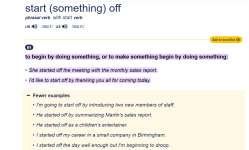
start (something) off
phrasal verb with start verb

to begin by doing something, or to make something begin by doing something:
She started off the meeting with the monthly sales report.
I'd like to start off by thanking you all for coming today.

And here: https://dictionary.cambridge.org/fr/dictionnaire/anglais/start

start
verb

start verb (BEGIN)
to begin doing something:

I wrote the modified sentence.
 
Let's sort this out. The example sentence She started off the meeting with the monthly sales report from the Cambridge Dictionary is provided under the phrasal verb start (something) off, not the verb start. Here's a screenshot:

Screenshot 2025-09-16 141844.png
 

Ask a Teacher

If you have a question about the English language and would like to ask one of our many English teachers and language experts, please click the button below to let us know:

(Requires Registration)
Back
Top