that have a higher baseline

Status
Not open for further replies.

diamondcutter

Senior Member
Joined
Oct 21, 2014
Member Type
English Teacher
Native Language
Chinese
Home Country
China
Current Location
China
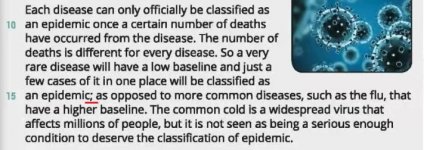
Each disease can only officially be classified as an epidemic once a certain number of deaths have occurred from the disease. The number of deaths is different for every disease. So a very rare disease will have a low baseline and just a few cases of it in one place will be classified as an epidemic, as opposed to more common diseases, such as the flu, that have a higher baseline. The common cold is a widespread virus that affects millions of people. But it is not seen as being a serious enough condition. to deserve the classification of epidemic.

Source: A textbook for senior high school students in China, Pearson Education and Beijing Normal University Press

I think the clause “that have a higher baseline” is a non-defining relative clause. What do you say?
 
5b635507f01d51b1c7c22f195cb99fc.jpg
This is the cover of the book.:)

The first line of Chinese on the cover means "A textbook for senior high school students in China".

Its title is just “英语”, which means “English”.

The small Chinese characters beside the title means "compulsory" and "Book 3".
 
Last edited:
I have two more questions about the passage in the OP.

1. I wonder if the use of the semicolon before "as opposed to" is incorrect because "as opposed to more common diseases, such as the flu, that have a higher baseline" is a phrase, not a sentence.

2. The common cold is a widespread virus that affects millions of people.
For this sentence, I’d like to know if it’s more appropriate to say “The common cold is caused by a widespread virus...”
 
Last edited:
I wonder if the use of the semicolon before "as opposed to" is incorrect
There's no semicolon there. Are you asking if the use of a semicolon would be incorrect? Yes, it would.
For this sentence, I’d like to know if it’s more appropriate to say “The common cold is caused by a widespread virus...”
Technically, yes. But it's implied, and the sentence works. There's a technical term for that sort of thing--synecdoche maybe?
 
Last edited:
Sorry, Barque. In my quotation in the OP, I changed the semicolon to a comma unconsciously. But in the original passage, there is. Here’s the page from the book.
65151503e39f10b0a150eb3f5be10a8.jpg
 
Yes, it's incorrect.
 
My question in #6:
The common cold is a widespread virus that affects millions of people.
For this sentence, I’d like to know if it’s more appropriate to say “The common cold is caused by a widespread virus...”
Barque’s reply in #7:
Technically, yes. But it's implied, and the sentence works. There's a technical term for that sort of thing--synecdoche maybe?
Could you give some new examples about synecdoche?
 
Status
Not open for further replies.

Ask a Teacher

If you have a question about the English language and would like to ask one of our many English teachers and language experts, please click the button below to let us know:

(Requires Registration)
Back
Top