[Grammar] The game is about to start.

Status
Not open for further replies.

BDX777

Junior Member
Joined
Mar 3, 2018
Member Type
Student or Learner
Native Language
Polish
Home Country
Poland
Current Location
England
The game is about to start = seems easy
The game is on the point of - here should be gerund or infinitve?
and in these patterns
just about to gerund and just to infinitive
are above examples correct?


My book tells: "present perfect can also be used instead of present simple when the completion of the event is emphasised"
Does "When we have had a rest, We will go out" mean exactly what " when we finish a rest, We will go out"
if yes which is more common and why?

Conditionals, what is the difference between: "If you should se Kris, will you ask him..." and "If you saw Kris, would you ask him...?
Why we do "If you should", when we can simply use second conditional?
 
Last edited by a moderator:
The game is about to start = seems easy (I don't know what this means.)

"The game is on the point of ..." [STRIKE]here[/STRIKE] Should the next word be a gerund or an infinitive?

[STRIKE]and[/STRIKE] In these patterns ...

"just about to" + gerund [STRIKE]and[/STRIKE]
"just to" + infinitive

Are the above examples correct?

Please see my corrections and comments above.

The game is on the point of starting.

The game is just about to start.

I can't make a sentence with "just to" for the same context. Can you explain what you mean?
 
BDX777, please ask unrelated questions in their own threads, with a title specific to each.
 
I can't make a sentence with "just to" for the same context. Can you explain what you mean?

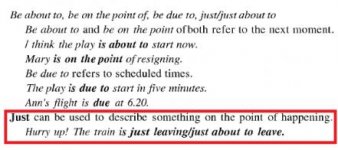
the book shows "just can be used to describe something on the point of happening"
e.g
The train is just leaving.
The traing is just about to leave.
I would like to ask, are these sentences correct?
 
You do know that "The train is just leaving" and "The train is just about to leave" mean two different things, don't you?
 
The book [STRIKE]shows[/STRIKE] says "just can be used to describe something on the point of happening"
e.g
The train is just leaving.
The traing is just about to leave.
I would like to ask, are these sentences correct?
Yes, they are (except for a typo). Can you see how the one with an infinitive doesn't match the pattern in your post?
 
No, I don't
see a piece of grammar book which I am using
grammar.jpg
 
Similar.

The game is just starting.
The game is about to start.
 
I meant that just about to leave doesn't match this pattern:

"just to" + infinitive

Is that what you were asking about?
I just want to know if, The game is just starting and The game is about to start mean the same?
And if The train is just leaving and The traing is just about to leave mean the same?
 
I just want to know if [no comma] "The game is just starting" and "The game is about to start" mean the same. [no question mark]
And if "The train is just leaving" and "The train is just about to leave" mean the same.
They don't. Just leaving means it's leaving at the moment the phrase is uttered; just about to leave means it's going to leave very soon.

Always mark text you're writing about with quotation marks.
 
They don't. Just leaving means it's leaving at the moment the phrase is uttered; just about to leave means it's going to leave very soon.

Always mark text you're writing about with quotation marks.
Thank you for your help
any idea why the book gives that information? I am using Vince - Advanced Language Practice
 
I just want to know if, The game is just starting and The game is about to start mean the same?
And if The train is just leaving and The traing is just about to leave mean the same?

As isolated sentences like this, they don't. But in context, they definitely could. That means that both forms may be used in exactly the same situations. If so, the use of present continuous is to talk about what is going to happen in the imminent future.
 
Status
Not open for further replies.

Ask a Teacher

If you have a question about the English language and would like to ask one of our many English teachers and language experts, please click the button below to let us know:

(Requires Registration)
Back
Top