[Grammar] through/into the mountainside

Status
Not open for further replies.
Joined
Dec 14, 2015
Member Type
Student or Learner
Native Language
Chinese
Home Country
China
Current Location
China
BkmeiAuCQAAPCi7.jpgoriginal.jpg

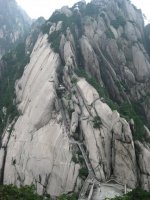
I have uploaded two pictures. How would I describe these two pictures?

1) A road is carved through/into the mountainside.

2) Steps are carved through/into the mountainside.

I don't know when to use "through" and when to use "into".

Could you please help?
 
In the first photo, the road is carved intermittently through the side of the mountain. (I wouldn't use "mountainside"; that makes the description more difficult, I think). If the road was fully visible over its length, I'd say that the road was carved into the mountainside (or into the side of the mountain).

In the second, I can't see any carving at all. The steps seem to be affixed in some way to the rock - neither through, nor into, the mountain.

A way you could distinguish these words is by how far into a part of the mountain something goes. If it goes in one place, and comes out at another, it's "through". If it just makes a long indentation, like a scratch, it's "into".

If you hammer a nail through a piece of wood, it comes out the other side.
If you hammer a nail into a piece of wood, it doesn't.
 
Last edited:
In 1) I'd use into.
In 2) it doesn't appear that the steps are actually carved at all.
 
In the first photo, the road is carved intermittently through the side of the mountain. If the road was fully visible over its length, I'd say that the road was carved into the mountainside (or into the side of the mountain).

A way you could distinguish these words is by how far into a part of the mountain something goes. If it goes in one place, and comes out at another, it's "through". If it just makes a long indentation, like a scratch, it's "into"..

I got when to use "into". I still have trouble understanding "through". Please allow me to explain. If it is a wall, I can easily understand that "through" means going into and then out of on the other side because a wall has thickness. However, the side of a mountain is a slope. It has only two-dimensions. How can a road go through the side of the mountain? To me, if it can, it actually goes through the whole mountain, not the slope . Please correct me.

" If the road was fully visible over its length, I'd say that the road was carved into the mountainside (or into the side of the mountain)". I want some clarification. Does Raymott mean if from a certain perspective, I can see the beginning and end of the road into the side of the mountain, use into? If not, use through?

 
Last edited:
However, the side of a mountain is a slope. It has only two-dimensions. How can a road go through the side of the mountain? To me, if it can, it actually goes through the whole mountain, not the slope . Please correct me.
No, a slope can have three dimensions, and usually does in nature. A two dimensional plane can have a slope. If you bend it down at both sides, it develops a third dimension. If it's made of paper, you can poke a pencil through it from one side, and it can go into and out of the paper twice (through the paper twice).

Assume the "mountain" is a cylinder. If a road goes through the mountain at a right angle to the surface, it will go through the whole mountain. If the road enters at 45 degrees to the cone surface, it will still go through the mountain, but not through as much. If you keep decreasing this angle, it keep going through the mountain for smaller distances before coming out again. If the road approaches at 0 degrees, it will touch the mountain at one point.


" If the road was fully visible over its length, I'd say that the road was carved into the mountainside (or into the side of the mountain)". I want some clarification. Does Raymott mean if from a certain angle, I can see the beginning and end of the road into the side of the mountain, use into? If not, use through?
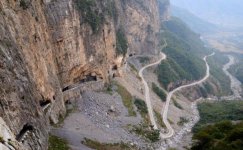
Not exactly. It depends on other situational factors. If a road goes through a mountain, it goes into the mountain and comes out again. You first photo shows this happening multiple times. So there is no natural choice between through and into if the road goes through the side of a mountain.

The difficulty of explaining this is that A can go both through B and into B. There is no absolute need to make a choice between these two terms because they're not mutually exclusive.
 
A road carved through a mountain is a tunnel.

As for into, I'd say the road is carved into the side of the mountain. (Or something like that.)

Wow. Raymott!

:-D
 
I have used a piece of paper to demonstrate what Raymott said. Great explanations. I agree. The side of the mountain indeed has 3 dimensions.

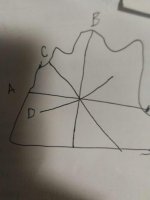
I have uploaded my awkward drawing. Would you mind taking a final look? Let's say that this is a mountainside. For road A, B,C, I think I should use "through". For road D, I think I should use "in". Do you agree? Thanks for your patience.
1273877626.jpg
 
I wouldn't say any road goes in (or into) a mountain. Instead, the road either goes through the mountain or around the mountain.
 
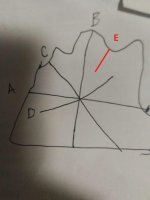
You've missed the opportunity of drawing a road going into, but not out of, and therefore not through, a mountain. I've added one - E.

road.jpg

Yes, road D is 'in' the mountain. This would be rare though. How would you get to it?
 
Road D is not a road. It is where Buddhist statutes are carved into. :lol:
 
Status
Not open for further replies.

Ask a Teacher

If you have a question about the English language and would like to ask one of our many English teachers and language experts, please click the button below to let us know:

(Requires Registration)
Back
Top