
typewriter keys sticking together?

Status
Not open for further replies.

keannu

VIP Member
Joined
Dec 27, 2010
Member Type
Student or Learner
Native Language
Korean
Home Country
South Korea
Current Location
South Korea
Is "sticking together" several keys sticking to each other or keys sticking to the bottom of the keyboard? How can keys stick to each other? I can't get it.

ex)Back in the 1870’s, Sholes & Co., a leading manufacturer of typewriters at the time, received many complaints from users about typewriter keys sticking together if the operator went too fast. In response, management asked its engineers to figure out a way to prevent this from happening. The engineers discussed the problem and then one of them said, “What if we slowed the operator down? If we did that, the keys would not jam together nearly as much.” The result was to have an inefficient keyboard configuration. For example, the letters ‘O’ and ‘I’ are the third and sixth most frequently used letters in the English language,and yet the engineers positioned them on the keyboard so that the relatively weaker fingers had to depress them. This ‘inefficient logic’ pervaded the keyboard, and solved the problem of keyboard jam-up.
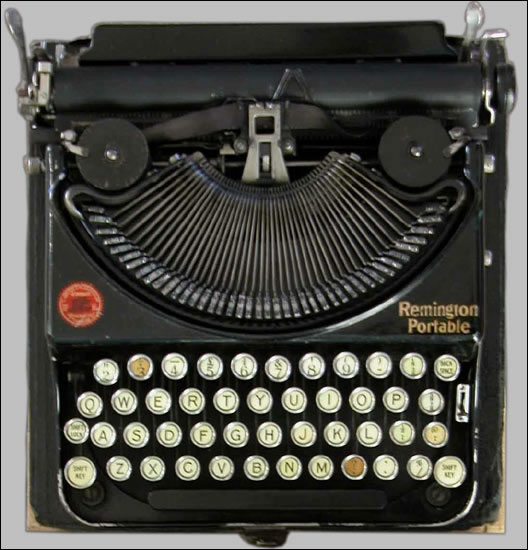
 
typewriter.jpg


See the metal pieces arranged in a semicircle?

When you strike a key, the corresponding piece moves out from its "home" and strikes the ribbon, leaving the impression on the paper of the letter inscribed on it.

If you press two keys that are close together too quickly, they will get stuck together, because they are both trying to occupy the same space as they travel from their homes to the center of the ribbon.
 
typewriter.jpg


See the metal pieces arranged in a semicircle?

When you strike a key, the corresponding piece moves out from its "home" and strikes the ribbon, leaving the impression on the paper of the letter inscribed on it.

If you press two keys that are close together too quickly, they will get stuck together, because they are both trying to occupy the same space as they travel from their homes to the center of the ribbon.

I thought the keys on the below part will stick together that doesn't make sense as they are separated, but it turns out they not the keys but the above metal pieces trying to hit the paper, but even though the metal pieces are separated by a hair's interval, they seem to stick together in fast typing, right? Thank you so much for your great endeavor!
 
They are separated, but they are all "aimed" at the same spot. So their paths will cause them to intersect if you do not ensure that one key returns to home before the next is struck. The closer the keys are, the more risk of having them stick.
 
The problem seems to be in the word 'key'. People rased in the digital age see keys as something that the fingers press; in SD's diagram they are white.

When the engineer talked about 'keys sticking together', he was talking about he radially-fixed metal arms. They stick together because they are slightly flexible and wedge theselves together. They are physically separate, but try to occupy the same space if you press two at (or nearly at) the same time.

Using 'key' to refer to this 'arm' (I don't know if it has a proper name) is a common metonym, usually understood (by people born long enough ago to have got inky fingers from such crashes ;-))

b
 
As, dare I say, a previous user of mechanical typewriters, the problem with the letters "I" and "O" was compounded by the fact that many English words end in "-ion".

Unfortunately, for two-fingered typists like myself, the shorter index finger was used for the "I" and the longer middle finger for the "O". This meant that, because of the different finger lengths, when typing quickly, the "O" print-lever was actually activated at the same time as the "I".

On my laptop, the problem merely surfaces as a typo, with the words being typed as ending in "-oin".

If they hadn't been placed next to each other on the "qwerty" keyboard, the problem may never have arisen!

Regards
R21

PS I see we also have Sholes & Co to thank for the invention of the "qwerty" keyboard!
http://en.wikipedia.org/wiki/QWERTY
 
Last edited:
Status
Not open for further replies.

Ask a Teacher

If you have a question about the English language and would like to ask one of our many English teachers and language experts, please click the button below to let us know:

(Requires Registration)
Back
Top