
... was slowly putting a silver plate ...

Anna232

Senior Member
Joined
Mar 17, 2024
Member Type
Teacher (Other)
Native Language
Georgian
Home Country
Georgia
Current Location
Georgia
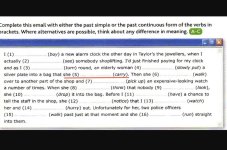
This exercise is from Advanced Grammar in Use by Martin Hewings. The correct option is "was carrying" but why can't I use "had been carrying" "had carried" and "carried?" If she was still carrying it then "had been carrying" and "carried" are correct, aren't they? Why are "had carried" and "had been carrying" wrong?
"I'd just finished paying for my clock and as I turned round, an elderly woman was slowly putting a silver plate into a bag that she was carrying.
 

Attachments

  • Screenshot_20251111_211611_Samsung Internet.jpg
    Screenshot_20251111_211611_Samsung Internet.jpg
    363.7 KB · Views: 3
'Had carried' and 'had been carrying' suggest that the action of carrying the bag is over and/or no longer relevant to the present.

However, she's still carrying the bag and it's relevant since she's concealing the shoplifted goods in it.
 
'Had carried' and 'had been carrying' suggest that the action of carrying the bag is over and/or no longer relevant to the present.

However, she's still carrying the bag and it's relevant since she's concealing the shoplifted goods in it.
Isn't "carried" also correct?
 
Isn't "carried" also correct?
It's grammatically possible but it sounds old-fashioned to me. I can't put my finger on why but I can imagine my late grandfather (born 1921) saying "She was putting it into a bag [that] she carried" but, these days, the majority of native speakers would use the simple past continuous at the end.
 
If the past perfect continuous were used in the relative clause:

She was putting a silver plate into a bag that she had been carrying.

it would suggest, I think, that she had just set the bag down to put the silver plate into it, whereas the past continuous:

She was putting a silver plate into a bag that she was carrying.
indicates she was carrying the bag while she was putting the silver plate into it. The simple would indicate habit to me:

She was putting a silver plate into a bag that she carried.

We don't know if she was carrying the bag at that moment, but we know she was in the habit of carrying it. Compare:

She was putting a grocery bag into a car that she drove.
 
If the past perfect continuous were used in the relative clause:

She was putting a silver plate into a bag that she had been carrying.

it would suggest, I think, that she had just set the bag down to put the silver plate into it, whereas the past continuous:

She was putting a silver plate into a bag that she was carrying.
indicates she was carrying the bag while she was putting the silver plate into it. The simple would indicate habit to me:

She was putting a silver plate into a bag that she carried.

We don't know if she was carrying the bag at that moment, but we know she was in the habit of carrying it. Compare:

She was putting a grocery bag into a car that she drove.
Because the book says "The past perfect continuous can be used to talk about a situation or activity that went on before a particular past time and finished at that time , continued beyond it , or finished shortly before it" I thought I could use past perfect continuous to imply that she stopped carrying it and that action finished before another action. But it doesn't work because she was still carrying it.
But because the book says "continued beyond" I don't understand why I can't use past perfect continuous in the original example to mean that she was still carrying it.
 
I don't understand why I can't use past perfect continuous in the original example to mean that she was still carrying it.
You can, but there is less potential ambiguity with the past continuous. Read Annabel Lee's post again.
 
You can, but there is less potential ambiguity with the past continuous. Read Annabel Lee's post again.
Then past perfect would be also possible if the carrying was over. Right?
 
Annabel Lee and Skrej have already told you that.
 

Ask a Teacher

If you have a question about the English language and would like to ask one of our many English teachers and language experts, please click the button below to let us know:

(Requires Registration)
Back
Top