"What's the funny point?" sounds smug and obnoxious?

Apparently, according to a thread on Reddit, some youngsters eschew full stops because they feel using a full stop indicates aggression or hostility. Needless to say I find that astonishing and baffling.
Back in post #8, which seems like a million years ago now, I recalled the day my colleague told me that using full stops in texts/WhatsApps is seen as "passive-aggressive". I'm glad I'm not the only person who is completely flummoxed by this (despite Glizdka's explanation).
 
Excuse me. Why did you use "I find..."? I thought it was "I found...".
Using the present tense makes it clear that probus still finds it astonishing and baffling. It's true that they found it astonishing and baffling when they read it, but the fact is that those feelings remained up to the point of writing, so are still valid.
 
Using the present tense makes it clear that probus still finds it astonishing and baffling. It's true that they found it astonishing and baffling when they read it, but the fact is that those feelings remained up to the point of writing, so are still valid.
My grammar lessons didn't teach that. I used to think one should say I found... Now I have learned one more lesson.
 
Last edited:
My grammar lessons didn't teach that. I used to think one should say I found...
There are a lot of things that aren’t taught at school but that you’ll find used in real life. Just because something hasn’t been mentioned in your English class doesn’t mean it’s not a thing.

A wise man once said that teachers are not so much interested in being precise about what is or isn't absolutely true. They're there to give you the most useful information that will help you use the language better than you already do.
 
My grammar lessons didn't teach that. I used to think one should say "I found". Now I have learned one more lesson.
"I found" is the simple past of "find". Don't get confused and think that you should always use "I find" instead. In the context of probus's original sentence, you can think of "I find" as meaning the same as "I consider".
 
I've been thinking about "What's the funny point?", and apart from being ungrammatical/unnatural, it does sound very close. To my non-native-speaker ear, it sounds like an amalgamation of "What's the point?" and "What's so funny?"

Now, because of what I've already said, "What's so funny?" can be interpeted as "Don't laught at it!"

Would combining it with the overinterpreted meaning of "What's the point?" as "It's pointless!" help explain why the person deemed the OP's sentence offensive?
 
@Lissle Something no one has pointed out yet is the error in your title. Take care with the word order in questions. It should read "Does "What's the funny point?" sound smug and obnoxious?"
 
I've been thinking about "What's the funny point?", and apart from being ungrammatical/unnatural, it does sound very close. To my non-native-speaker ear, it sounds like an amalgamation of "What's the point?" and "What's so funny?"
I don't agree that it involves any idea of "What's the point?" (ie "pointless"). It could be reworded as "What's the point you're trying to make that I'm supposed to find funny?"
Now, because of what I've already said, "What's so funny?" can be interpreted as "Don't laught laugh at it!"
Not in this context. When attached as a comment to a cartoon, it can really only be taken literally.
Would combining it with the overinterpreted meaning of "What's the point?" as "It's pointless!" help explain why the person deemed the OP's sentence offensive?
I don't think so, no. I still think the reader simply thought the OP was saying "It's not funny" (which is closer to "What's so funny?") and took umbrage at it. The reader might have been a little less harsh if they'd realised the OP was not a native English speaker but there are always people on the internet who are just out to start an argument!
 
I've been thinking about "What's the funny point?", and apart from being ungrammatical/unnatural, it does sound very close. To my non-native-speaker ear, it sounds like an amalgamation of "What's the point?" and "What's so funny?"

Now, because of what I've already said, "What's so funny?" can be interpeted as "Don't laught at it!"

Would combining it with the overinterpreted meaning of "What's the point?" as "It's pointless!" help explain why the person deemed the OP's sentence offensive?
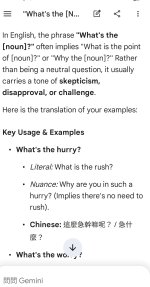
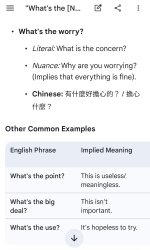
One Taiwanese told me that my question sentence's pattern is the same as "What's the hurry?" or "What's the worry?", which implies the speaker doesn't approve of the listener's behaviour and sounds aggressive.
 
Last edited:
One A Taiwanese person told me that my question sentence's pattern is the same as "What's the hurry?" or "What's the worry?", which implies the speaker doesn't approve of the listener's behaviour and sounds aggressive.
We don't use "What's the worry?" in the UK so I can't comment on that.
"What's the hurry?" generally is a straightforward question if you want to ask someone why they feel it's necessary to do something quickly. I can't see it sounding aggressive.

I'm curious - did the person who told you this base it on the fact that those two questions sound disapproving and aggressive in Taiwanese? If not, what's their basis for telling you they sound that way in English?
 
We don't use "What's the worry?" in the UK so I can't comment on that.
"What's the hurry?" generally is a straightforward question if you want to ask someone why they feel it's necessary to do something quickly. I can't see it sounding aggressive.

I'm curious - did the person who told you this base it on the fact that those two questions sound disapproving and aggressive in Taiwanese? If not, what's their basis for telling you they sound that way in English?
The person should be an English learner like me, so his viewpoint may be not correct. That is, your teaching is the right one.
His original comment is below, and I have added an AI translation:

"What's the XXX?" 在英文中常帶有"XXX 是在幹嘛/有甚麼用?"的含意,所以不是單純的問句,而帶有"質疑、不認同"的語意。
What's the hurry? 這麼急幹嘛呢?
What's the worry? 有什麼好擔心的?
--------------
AI translation:
1000003149.jpg
 

Attachments

  • 1000003150.jpg
    1000003150.jpg
    174 KB · Views: 3
Last edited:
@Lissle As a general rule, I would discourage you from taking advice on what does and doesn't sound natural etc in English from someone who isn't a native speaker or doesn't at least speak the language fluently.
 
@Lissle As a general rule, I would discourage you from taking advice on what does and doesn't sound natural etc in English from someone who isn't a native speaker or doesn't at least speak the language fluently.
One of the reasons that Taiwanese people can't learn English well is that our school English teachers are Taiwanese and their English is not as good as native speakers'. That is, we have learned some wrong English in school, and now spend more time to correct it.
About 26 years ago, the Department of Education planned to introduce native English speaking teachers into high schools in Taiwan. However, the policy was aborted due to severe opposition from local teachers.
 
One of the reasons that Taiwanese people can't learn English well is that our school English teachers are Taiwanese and their English is not as good as native speakers'. That is, we have learned some wrong English in school, and now spend more time to correct it.
About 26 years ago, the Department of Education planned to introduce native English speaking teachers into high schools in Taiwan. However, the policy was aborted due to severe opposition from local teachers.
Even more reason for you to make full use of this forum and its native/fluent English speakers. It's a shame that you can't count on the teachers there to teach you correctly but it is what it is!
 
One of the reasons that Taiwanese people can't learn English well is that our school English teachers are Taiwanese and their English is not as good as native speakers'. That is, we have learned some wrong English in school, and now spend more time to correct it.
About 26 years ago, the Department of Education planned to introduce native English speaking teachers into high schools in Taiwan. However, the policy was aborted due to severe opposition from local teachers.
I could see another probable reason for this. The disparity between how popular learning English is and how few native-speaker teachers would be available to hire means that demand couldn't be met by the supply, so it would cost the government a fortune.

Out of curiosity, what does foreign language education in public schools look like in Taiwan? Here, it's treated almost entirely as a school subject rather than a practical skill, so there’s lots of theory, tests, and focus on written English, while practice, drills, and spoken English are almost entirely ignored.

 
I could see another probable reason for this. The disparity between how popular learning English is and how few native-speaker teachers would be available to hire means that demand couldn't be met by the supply, so it would cost the government a fortune.

Out of curiosity, what does foreign language education in public schools look like in Taiwan? Here, it's treated almost entirely as a school subject rather than a practical skill, so there’s lots of theory, tests, and focus on written English, while practice, drills, and spoken English are almost entirely ignored.
That year the government was planning to spend a lot of money to employ native English teachers to strengthen Taiwanese English education, but the government aborted the policy due to local teachers' severe opposition.
English is a major subject in Taiwan. We used to learn it after we went to high school. Then in 2005, we started to learn it in elementary school. Our listening and speaking abilities are not good, but reading and writing are ok. Compared to old generations, the young generation's English is much better since they live in a well-to-do time and have rather much better resources than their parents'.
 

Ask a Teacher

If you have a question about the English language and would like to ask one of our many English teachers and language experts, please click the button below to let us know:

(Requires Registration)
Back
Top