Wow. I'm clearly one of those "older internet users" in that case.
Would you mind if I asked your age, then?

To me,

still means "crying with laughter/That's very funny".
Yes. That's the original meaning. Even the reaction menu on this very forum uses
as a "funny/laughing" reaction. But if you try to look at it through a different lens, it looks like a person towering over you with a smug smile, mocking you and showing superiority.

means "I'm crying very hard with sadness/I'm distraught".
Yeah, I don't really get this one either. My guess is that it's the tears that connect it to the original
while still being different enough to work as a valid alternative.
This particular emoji (
) was what originally made me research the topic. I’d been seeing it a lot in short videos recommended to me by the
AI-overlord algorithm. At some point, I looked up why people were using
to express laughter, and that’s what opened this whole can of worms.

would either be a threat ("I want to kill you!) or "Someone's died" (but not someone either I or the recipient cares about).
The message is "dying of laughter". It's also used to express that the person is giving off
giga chad energy, though more commonly that meaning is associated with the variant that has two bones (

).
I'm not talking about the pre-flood lake in the middle of Africa. I'm talking about an
alpha male with a very pronounced jaw line who doesn't give a firetruck.
This is even more of a surprise. I'm still using
to mean "Yes" or "Good" and
to mean "I'm happy". They would mean those things whether used as a standalone emoji or at the end of a sentence.
Yeah, they've been replaced with

, which communicates that no harm is intended.
This is reminding me of the day a work colleague (who was 23 at the time) told me that using full stops (periods) in texts/WhatsApps was now deemed "passive-aggressive". I genuinely thought she was joking and had to Google it to find out it was true. Ridiculous. I text/WhatsApp/email the same way I write on this forum - with full capitalisation and punctuation. Nothing she said or any information from the net explained to me how on earth a full stop could be considered passive-aggressive.
This one’s pretty easy to explain, I believe. One of the main rules of language is that people are lazy. If there’s a way to do the same thing with less effort, they’ll choose that way. The medium reflects this.
Many people use
[send] as the final period. Younger people also tend to send shorter messages, usually ending them where a period would otherwise be used. This results in shorter, more frequent messages, as opposed to the longer, more drawn-out ones sent by older folks.
Now, if a person takes the effort to put a period at the end of an especially short message, it can seem intentional. Usually, it’s meant to accentuate that the message should be seen as
final and that they are through with the conversation. Why else would someone bother pressing an unnecessary button?
This brings me to one of my weirdest discoveries in punctuation, the
friendly period. There are already obscure punctuation marks, like the
irony mark or the
interrobang, but it’s still odd to see the need for a period that communicates nothing beyond its standard grammatical function.
Well, anyway, as much as I’d love punctuation and emojis to stay the way they were when I was introduced to them, nobody can stop the evolution of language. And because the internet is now one of the predominant media through which language expresses itself, we’re bound to see the meanings and usage of these things change over time.
There’s a short series on Netflix called
Adolescence, which touches on how young people use emojis differently, and how millennials and boomers remain oblivious to it. I can also see it as a kind of code: you don’t belong here if you use emojis differently from us, and the way we use them marks us as part of a group whose communication you’re not meant to fully understand.
I should also point out that being 35 years old and autistic probably doesn’t help me understand the less obvious ways younger people communicate, and that I’ve always treated what I’ve learned about it as a linguistic curiosity. I could very well be wrong about everything I’ve said.


 " in the comment. Sometimes I received good explanations, yet yesterday someone offensively scolded me as smug and obnoxious with a few sentences.
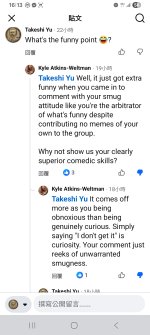
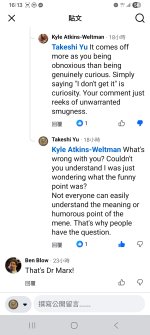



 (←That's an oops!)

