"What's the funny point?" sounds smug and obnoxious?

Lissle

Member
Joined
May 8, 2026
Member Type
Student or Learner
Native Language
Chinese
Home Country
Taiwan
Current Location
Taiwan
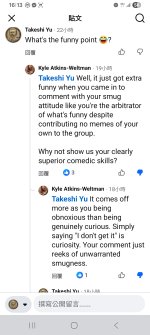
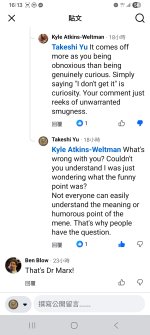
FB always gives me funny cartoons, such as the Far Side. However, not being a native American, I often didn't get the funny point. When I didn't get it, I typed "I don't get it" or "What's the funny point?🤣" in the comment. Sometimes I received good explanations, yet yesterday someone offensively scolded me as smug and obnoxious with a few sentences.
Does "What's the funny point?🤣" sound smug and rude for native speakers?

p.s I used 😂 in the question "What's the funny point? 😂" to make it look a bit more polite. That's why I don't understand why the guy got angry at my question. After, it is just a simple question even it's not correct in grammar.

The fb dialogue is below:

1000003122.jpg
1000003123.jpg

1000003124.jpg
 
Last edited by a moderator:
FB always gives shows me funny cartoons, such as the Far Side. However, not being a native American English speaker, I often didn't don't get the funny point humour. When I didn't don't get it, I typed type "I don't get it" or "What's the funny point?🤣" in the comments. Sometimes I received receive good explanations, yet but yesterday someone offensively scolded me, as saying I was smug and obnoxious. with a few sentences.
(I don't understand the underlined point. Did they write a few sentences scolding you, or did they say that a few sentences you had written were smug and obnoxious?)
Note my corrections and comments above.
Does "What's the funny point?🤣" sound smug and rude for to native speakers?
It's neither of those things but it is ungrammatical. We don't say it like that. Try:

I don't get it.
I don't get why it's funny.
I don't see the point. Why is it funny?
How is that meant to be funny?
What's the joke?

I'd ignore the person who said you were "smug and obnoxious". Just remember that a sense of humour is personal. What you find funny might not be what the person sitting next to you sounds funny. You're perfectly entitled to ask someone to explain the joke, especially since you're not a native English speaker.
 
@Lissle Please don't edit post 1 of any thread after it's received responses. I happened to notice that there were suddenly some images in the first post that hadn't been there when I replied. You should have added the images in a new post. Also, please reduce the size of images before posting. They were huge! I have resized them for you this time.

The person clearly thought you meant "It's not funny" by saying "What's the funny point?" and went off on you unfairly. They accused you of being the arbiter of what's funny and what's not so it's clear that they didn't understand that you were genuinely asking someone to explain it to you.
 
@Lissle Please don't edit post 1 of any thread after it's received responses. I happened to notice that there were suddenly some images in the first post that hadn't been there when I replied. You should have added the images in a new post. Also, please reduce the size of images before posting. They were huge! I have resized them for you this time.

The person clearly thought you meant "It's not funny" by saying "What's the funny point?" and went off on you unfairly. They accused you of being the arbiter of what's funny and what's not so it's clear that they didn't understand that you were genuinely asking someone to explain it to you.
Thank you for your kind advice. I intended to inform you that I had edited the post after I finished editing it. However, some delay happened and I was unable to inform you immediately. I am sorry about that.

Does "What's the funny point? 😂"(in spite of the error in grammar) connotate or imply "It's not funny!" ? In Chinese, it's simply a common question to ask someone to explain why the joke is funny. To make the question more polite, I even used 😂, which means the asker tries to ask politely in my mother language.
 
Thank you for your kind advice. I intended to inform you that I had edited the post after I finished editing it. However, some delay happened and I was unable to inform you immediately. I am sorry about that.
OK, but my advice stands. Don't edit any post after it's received responses. Telling us you've done it after doing it doesn't help. Just add a new post.
Does "What's the funny point? 😂" space before an opening bracket (in spite of the error in grammar) connotate or imply "It's not funny!"?
It can imply that.
I crossed out "connotate or" for two reasons - it's not a commonly used verb and it's a synonym for imply so using both is tautologous. Take care with the spacing around punctuation.
In Chinese, it's simply a common question to ask someone to explain why the joke is funny.
It's perfectly common in most languages. That's not the point. The point is that the reader did not think you were genuinely asking for an explanation. They thought you were saying you didn't think the joke was funny. That's not the same as not understanding the joke.
To make the question more polite, I even used 😂, which, in my native language, means the asker tries is trying to ask politely. in my mother language.
That's a big difference in meaning then. That emoji depicts someone crying with laughter (ie they're laughing very hard). It has nothing at all to do with politeness. If anything, it made your original question worse for the reader. They not only thought you didn't find the joke funny, but also that you thought it was funny that you didn't find it funny! In the UK at least, we put that emoji at the end of a statement or question to make it clear that we're joking so what we said isn't to be taken seriously.
 
NOT A TEACHER
------------

I'll preface what I have to say by pointing out that what you said did not give the person the right to attack you, and you probably shouldn't dig too deeply into whether what you said was or wasn't offensive. Though I'd say there's most likely a cultural difference at play here. What you thought would be a benign inquiry about the joke's nature was overinterpreted by the person as a passive-aggressive comment meant to criticize the original post.

I'll try to break it down so you can hopefully better understand how politeness can work, how touchy certain people can be, and why they might completely mistake your intentions.
Does "What's the funny point? 😂"(in spite of the error in grammar) connotate or imply "It's not funny!" ?
Yes, it can be interpreted that way. Or even worse: "What the **** are you laughing at?!" or "Don't you dare laugh at it!" How is that possible?

We tend to be very careful with words, you see, and sometimes go to great lengths to make sure that what we say sounds as mild as possible. That's why people prefer to say "I don't think you're right" instead of "You're wrong", "I'll think about it" instead of "I won't do it", "Would you mind if I asked your age?" instead of "How old are you?", and "What's so funny?" instead of "Don't laught at it!"

This "politeness game" can spiral out of control and take unexpected turns. Because people are used to hearing the polite form all the time, they tend to look past the literal meaning of your words and search for the intended meaning instead. This leads to what I would call "the inflation of the severity of expressions", for lack of my knowledge of a proper linguistic term for this phenomenon.

When someone hears "What's so funny?", for example, they don't interpret it literally as a question asked by someone who doesn't understand the joke. Instead, they assume you really meant “Don't laugh at it!”, but wrapped it in politeness.

What makes this “politeness game” even more confusing and difficult to navigate is the fact that some people have weaponized politeness as a way to hurt others through passive-aggressive comments and sarcasm. They deliberately use overly polite phrasing, accompanied by an exaggerated smile and an unnaturally sweet tone. I assume the other person thought you were one of those people.
To make the question more polite, I even used 😂, which means the asker tries to ask politely in my mother language.
I think using the 😂 emoji actually made it worse! There's been a recent shift in how people use and interpret emojis, especially among younger people, which often confuses older internet users. The emoji you used is now often associated with sarcasm or mockery. To show that something is genuinely funny, many people instead use 😭, or 💀 if they find it especially hilarious.

Two more emojis that are used for sarcasm and mockery are (y) and :). A sentence like "No problem! :)" may be interpreted as "It is a problem!", while "Thank you for your help! (y)" may come across as "You're useless!"

What I find especially confusing in all of this is the use of a period at the end of an especially short sentence to signal disrespect or dismissiveness. Some people use "OK." to mean "Whatever, I don't care what you're saying!"

There's a lot more to the “politeness game” that I could explain, but in general, people on the internet can become pretty paranoid and hypervigilant about tone, and it's almost impossible to avoid having your intentions misconstrued at some point. I wouldn't worry about it too much. Just block the person and move on.
 
Last edited:
I think using the 😂 emoji actually made it worse! There's been a recent shift in how people use and interpret emojis, especially among younger people, which often confuses older internet users. The emoji you used is now often associated with sarcasm or mockery. To show that something is genuinely funny, many people instead use 😭, or 💀 if they find it especially hilarious.
Wow. I'm clearly one of those "older internet users" in that case. To me, 😂 still means "crying with laughter/That's very funny", 😭 means "I'm crying very hard with sadness/I'm distraught", 💀would either be a threat ("I want to kill you!) or "Someone's died" (but not someone either I or the recipient cares about).
Two more emojis that are used for sarcasm and mockery are (y) and :). A sentence like "No problem! :)" may be interpreted as "It is a problem!", while "Thank you for your help! (y)" may come across as "You're useless!"
This is even more of a surprise. I'm still using (y) to mean "Yes" or "Good" and :) to mean "I'm happy". They would mean those things whether used as a standalone emoji or at the end of a sentence.

This is reminding me of the day a work colleague (who was 23 at the time) told me that using full stops (periods) in texts/WhatsApps was now deemed "passive-aggressive". I genuinely thought she was joking and had to Google it to find out it was true. Ridiculous. I text/WhatsApp/email the same way I write on this forum - with full capitalisation and punctuation. Nothing she said or any information from the net explained to me how on earth a full stop could be considered passive-aggressive. I'll continue to use them regardless of the age of the person I'm communicating with. If they're upset, fine. I'll simply tell them that I'm equally upset by the lack of punctuation in their messages, which is making them hard for me to decipher (and that upsetting me in this way is itself "passive-aggressive"!)
 
@Lissle Please don't edit post 1 of any thread after it's received responses. I happened to notice that there were suddenly some images in the first post that hadn't been there when I replied. You should have added the images in a new post. Also, please reduce the size of images before posting. They were huge! I have resized them for you this time.

The person clearly thought you meant "It's not funny" by saying "What's the funny point?" and went off on you unfairly. They accused you of being the arbiter of what's funny and what's not so it's clear that they didn't understand that you were genuinely asking someone to explain it to you.

Wow. I'm clearly one of those "older internet users" in that case. To me, 😂 still means "crying with laughter/That's very funny", 😭 means "I'm crying very hard with sadness/I'm distraught", 💀would either be a threat ("I want to kill you!) or "Someone's died" (but not someone either I or the recipient cares about).

This is even more of a surprise. I'm still using (y) to mean "Yes" or "Good" and :) to mean "I'm happy". They would mean those things whether used as a standalone emoji or at the end of a sentence.

This is reminding me of the day a work colleague (who was 23 at the time) told me that using full stops (periods) in texts/WhatsApps was now deemed "passive-aggressive". I genuinely thought she was joking and had to Google it to find out it was true. Ridiculous. I text/WhatsApp/email the same way I write on this forum - with full capitalisation and punctuation. Nothing she said or any information from the net explained to me how on earth a full stop could be considered passive-aggressive. I'll continue to use them regardless of the age of the person I'm communicating with. If they're upset, fine. I'll simply tell them that I'm equally upset by the lack of punctuation in their messages, which is making them hard for me to decipher (and that upsetting me in this way is itself "passive-aggressive"!)
It seems that we are the same age. Speaking of punctuation, I am upset by people's ending sentences with "..." , which means they are not willing to tell you their full thoughts and seems to be somewhat looking down on you, especially when you need complete information.
 
Last edited:
Don't worry, emsr2d2. The kids know you're an oldie and don't expect you to follow their rules.
 
Wow. I'm clearly one of those "older internet users" in that case.
Would you mind if I asked your age, then? ;)
To me, 😂 still means "crying with laughter/That's very funny".
Yes. That's the original meaning. Even the reaction menu on this very forum uses 😂 as a "funny/laughing" reaction. But if you try to look at it through a different lens, it looks like a person towering over you with a smug smile, mocking you and showing superiority.
😭 means "I'm crying very hard with sadness/I'm distraught".
Yeah, I don't really get this one either. My guess is that it's the tears that connect it to the original 😂 while still being different enough to work as a valid alternative.

This particular emoji (😭) was what originally made me research the topic. I’d been seeing it a lot in short videos recommended to me by the AI-overlord algorithm. At some point, I looked up why people were using 😭 to express laughter, and that’s what opened this whole can of worms.
💀would either be a threat ("I want to kill you!) or "Someone's died" (but not someone either I or the recipient cares about).
The message is "dying of laughter". It's also used to express that the person is giving off giga chad energy, though more commonly that meaning is associated with the variant that has two bones (☠️).

I'm not talking about the pre-flood lake in the middle of Africa. I'm talking about an alpha male with a very pronounced jaw line who doesn't give a firetruck.
This is even more of a surprise. I'm still using (y) to mean "Yes" or "Good" and :) to mean "I'm happy". They would mean those things whether used as a standalone emoji or at the end of a sentence.
Yeah, they've been replaced with 🙃, which communicates that no harm is intended.
This is reminding me of the day a work colleague (who was 23 at the time) told me that using full stops (periods) in texts/WhatsApps was now deemed "passive-aggressive". I genuinely thought she was joking and had to Google it to find out it was true. Ridiculous. I text/WhatsApp/email the same way I write on this forum - with full capitalisation and punctuation. Nothing she said or any information from the net explained to me how on earth a full stop could be considered passive-aggressive.
This one’s pretty easy to explain, I believe. One of the main rules of language is that people are lazy. If there’s a way to do the same thing with less effort, they’ll choose that way. The medium reflects this.

Many people use [send] as the final period. Younger people also tend to send shorter messages, usually ending them where a period would otherwise be used. This results in shorter, more frequent messages, as opposed to the longer, more drawn-out ones sent by older folks.

Now, if a person takes the effort to put a period at the end of an especially short message, it can seem intentional. Usually, it’s meant to accentuate that the message should be seen as final and that they are through with the conversation. Why else would someone bother pressing an unnecessary button?

This brings me to one of my weirdest discoveries in punctuation, the friendly period. There are already obscure punctuation marks, like the irony mark or the interrobang, but it’s still odd to see the need for a period that communicates nothing beyond its standard grammatical function.

Well, anyway, as much as I’d love punctuation and emojis to stay the way they were when I was introduced to them, nobody can stop the evolution of language. And because the internet is now one of the predominant media through which language expresses itself, we’re bound to see the meanings and usage of these things change over time.

There’s a short series on Netflix called Adolescence, which touches on how young people use emojis differently, and how millennials and boomers remain oblivious to it. I can also see it as a kind of code: you don’t belong here if you use emojis differently from us, and the way we use them marks us as part of a group whose communication you’re not meant to fully understand.

I should also point out that being 35 years old and autistic probably doesn’t help me understand the less obvious ways younger people communicate, and that I’ve always treated what I’ve learned about it as a linguistic curiosity. I could very well be wrong about everything I’ve said.

 
Last edited:
For the record, I don't get the original joke either. Maybe I don't know enough about paleontology. Maybe it's trying to suggest Marxist views are ancient history and such views are of a bygone era like the dinosaurs? I'd have to ask someone to explain it to me as well.

I've been seeing the use of "I'm dead" for humor as well. It's frequently (purposely, I assume) misspelled as 'ded'.
 
Last edited:
Would you mind if I asked your age, then? ;)
Let's just say I won't be seeing 50 again!
Yes. That's the original meaning. Even the reaction menu on this very forum uses 😂 as a "funny/laughing" reaction. But if you try to look at it through a different lens, it looks like a person towering over you with a smug smile, mocking you and showing superiority.
I can't see how it looks like someone towering over you. In fact, the eyes kind of look like they're looking up, not down.
Yeah, I don't really get this one either. My guess is that it's the tears that connect it to the original 😂 while still being different enough to work as a valid alternative.

This particular emoji (😭) was what originally made me research the topic. I’d been seeing it a lot in short videos recommended to me by the AI-overlord algorithm. At some point, I looked up why people were using 😭 to express laughter, and that’s what opened this whole can of worms.
I can see the connection between tears and laughter but the look on the face of the 😭 emoji could not, in my opinion, be confused with happiness or laughter.
The message is "dying of laughter".
I get that, even if I wouldn't use the skull to indicate that.
It's also used to express that the person is giving off giga chad energy, though more commonly that meaning is associated with the variant that has two bones (☠️).
I'm very happy in the knowledge that I don't have the faintest idea what "giga chad" means. I can guess that "giga" means "very" but when I was a kid a "chad" was a funny little cartoon character with just its nose and fingertips showing over the top of a brick wall.
I'm not talking about the pre-flood lake in the middle of Africa. I'm talking about an alpha male with a very pronounced jaw line who doesn't give a firetruck.
I'm guessing you just told me what a "giga chad" is! All I know about alpha males (outside of the animal kingdom - and I don't mean humans as animals) comes from a recent Louis Theroux documentary about the "Manosphere" (another term I'd never heard until I watched the show). There were certainly a lot of weird blokes with chiseled jawlines (and some horribly misogynistic views) in it.
Yeah, they've been replaced with 🙃, which communicates that no harm is intended.
I use that to show that the words that precede it are perhaps a bit silly.
This one’s pretty easy to explain, I believe. One of the main rules of language is that people are lazy. If there’s a way to do the same thing with less effort, they’ll choose that way. The medium reflects this.

Many people use [send] as the final period. Younger people also tend to send shorter messages, usually ending them where a period would otherwise be used. This results in shorter, more frequent messages, as opposed to the longer, more drawn-out ones sent by older folks.
After a bit of discussion, my colleague and I did eventually come up with the explanation that younger people seem to write single sentences then hit Send, rather than writing whole paragraphs. On that basis, I can see why they might not bother with a full stop. Do they, though, bother with a question mark at the end of a question?
Now, if a person takes the effort to put a period at the end of an especially short message, it can seem intentional. Usually, it’s meant to accentuate that the message should be seen as final and that they are through with the conversation. Why else would someone bother pressing an unnecessary button?
I can see the connection between that and people saying "full stop" (BrE) or "period" (AmE) at the end of a statement to make it clear that the conversation is over as far as they're concerned.
This brings me to one of my weirdest discoveries in punctuation, the friendly period. There are already obscure punctuation marks, like the irony mark or the interrobang, but it’s still odd to see the need for a period that communicates nothing beyond its standard grammatical function.
I've never seen the "friendly period" before and would have no idea how I'm supposed to make it on my keyboard. The same goes for the "irony mark". I do, however, love interrobangs and use them a lot!
Well, anyway, as much as I’d love punctuation and emojis to stay the way they were when I was introduced to them, nobody can stop the evolution of language. And because the internet is now one of the predominant media through which language expresses itself, we’re bound to see the meanings and usage of these things change over time.
I agree entirely. It doesn't mean that I'm going to change how I write, regardless of the method of communication.
There’s a short series on Netflix called Adolescence, which touches on how young people use emojis differently, and how millennials and boomers remain oblivious to it. I can also see it as a kind of code: you don’t belong here if you use emojis differently from us, and the way we use them marks us as part of a group whose communication you’re not meant to fully understand.
Yes, and this has been the case for generations. I'm sure there were things my friends and I said when we were kids that were specifically designed to make sure our parents didn't know what we were talking about. I have no idea what they were and I'm pretty sure they haven't survived the intervening decades.
I should also point out that being 35 years old and autistic probably doesn’t help me understand the less obvious ways younger people communicate, and that I’ve always treated what I’ve learned about it as a linguistic curiosity. I could very well be wrong about everything I’ve said.
I don't think you're wrong about any of it and you've clearly researched it pretty thoroughly, as is the wont of many autistic people!
 
I'm very happy in the knowledge that I don't have the faintest idea what "giga chad" means. I can guess that "giga" means "very" but when I was a kid a "chad" was a funny little cartoon character with just its nose and fingertips showing over the top of a brick wall.
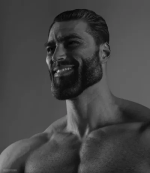
Chad is slang for an attractive and confident, masculine man who's very succesful with women, sort of like what we used to refer to as a jock, but pushed to the extreme. A giga chad (or gigachad) is an even more extreme and exaggerated version of your usual chad. The main component is the giga chad's unattainable physique and being sexually hyperactive with multiple different women.

Here's the image that usually shows up when you look up what a gigachad is.
1778363085763.png

It's a similar phenomenon to how a karen is an obnoxiously entitled customer who wants to speak with your manager, or how a joe is an average, simple guy. Heck, even the word guy started as the given name Guy.

Even though these words come from given names, I see them commonly used as regular, countable nouns, so I refuse to capitalize them to distinguish them from actual given names. Some may disagree with that choice.
I'm guessing you just told me what a "giga chad" is! All I know about alpha males (outside of the animal kingdom - and I don't mean humans as animals) comes from a recent Louis Theroux documentary about the "Manosphere" (another term I'd never heard until I watched the show). There were certainly a lot of weird blokes with chiseled jawlines (and some horribly misogynistic views) in it.
Using Greek letters to describe male personalities is a whole nother can of worms you definitely don't want to open.
After a bit of discussion, my colleague and I did eventually come up with the explanation that younger people seem to write single sentences then hit Send, rather than writing whole paragraphs. On that basis, I can see why they might not bother with a full stop. Do they, though, bother with a question mark at the end of a question?
I can't say I've seen the question mark being omitted very often, but I might just not have noticed it. What I think is more common is the omission of auxilaries, or just using the main verb. Then, the question mark usually is used.

"Want to come over tonight?"
"Wanna come over tonight?"
"Come over tonight?"
I've never seen the "friendly period" before and would have no idea how I'm supposed to make it on my keyboard. The same goes for the "irony mark". I do, however, love interrobangs and use them a lot!
I don't use the irony mark because of its obscurity, but I do use the tilde (~) to signify either irony or a peculiar, melodic tone, accompanied with a proper punctuation mark afterward. With a period, it does kind of look like a horizontal version of the irony mark.

"Oh, really~?"
"Why hello there~!"
"I don't know what you're talking about~."

I find it's usually understood as intended.

I don't use the friendly period because of how obscure it is, and because I totally agree with you that the whole aforementioned practice is ridiculous.
Yes, and this has been the case for generations. I'm sure there were things my friends and I said when we were kids that were specifically designed to make sure our parents didn't know what we were talking about. I have no idea what they were and I'm pretty sure they haven't survived the intervening decades.
What used to be cool to say when we were kids is cringy to today's kids, but not nearly as cringy as an older person trying to use today's slang, which is precisely why I purposely misuse slang when I talk to kids. A well misused six seven or skibidi can really ruin their entire career.
I don't think you're wrong about any of it and you've clearly researched it pretty thoroughly, as is the wont of many autistic people!
I research what emotions and social norms are to battle my inability to naturally process them, but it's more mechanical and calculated than intuitive.

I still often come across as awkward, coy, judgy, condescending, or whatever else, when it was not my intention at all. It has helped me reduce how often it happens, though!
 
Last edited:
Chad is slang for an attractive and confident, masculine man who's very succesful with women, sort of like what we used to refer to as a jock, but pushed to the extreme. A giga chad (or gigachad) is an even more extreme and exaggerated version of your usual chad. The main component is the giga chad's unattainable physique and being sexually hyperactive with multiple different women.
I'm from the UK so we didn't use "jock" when I was a kid. I learnt its meaning from American TV and film.
It's a similar phenomenon to how a karen is an obnoxiously entitled customer who wants to speak with your manager, or how a joe is an average, simple guy. Heck, even the word guy started as the given name Guy.
Even though these words come from given names, I see them commonly used as regular, countable nouns, so I refuse to capitalize them to distinguish them from actual given names. Some may disagree with that choice.
I'm well aware of Karen being used as a derogatory term for such a woman but I don't think I've ever seen it uncapitalised. Context makes it clear whether you're talking about a person with that given name or the generic term.
Using Greek letters to describe male personalities is a whole nother can of worms you definitely don't want to open.
I'm sure there are a lot of cans of worms I have no interest in opening.
I can't say I've seen the question mark being omitted very often, but I might just not have noticed it. What I think is more common is the omission of auxilaries, or just using the main verb. Then, the question mark usually is used.

"Want to come over tonight?"
"Wanna come over tonight?"
"Come over tonight?"
I'm sure that's very common in all variants of English. I do it and most of the people I know do. Those sentences would still be correctly capitalised and punctuated when I write them though.
I don't use the irony mark because of its obscurity, but I do use the tilde (~) to signify either irony or a peculiar, melodic tone, accompanied with a proper punctuation mark afterward. With a period, it does kind of look like a horizontal version of the irony mark.

"Oh, really~?"
"Why hello there~!"
"I don't know what you're talking about~."

I find it's usually understood as intended.
I have never used or seen used a tilde in that way. If someone sent me one of those messages above, I would assume the tilde was a typo.
I don't use the friendly period because of how obscure it is, and because I totally agree with you that the whole aforementioned practice is ridiculous.
:) (and I'm using that with its standard happy meaning!)
What used to be cool to say when we were kids is cringy to today's kids, but not nearly as cringy as an older person trying to use today's slang, which is precisely why I purposely misuse slang when I talk to kids. A well misused six seven or skibidi can really ruin their entire career.
I totally get that. I'm fully conversant with the use of the first two italicised phrases above but I've no idea what the third would mean outside of its obvious literal meaning.
I research what emotions and social norms are to battle my inability to naturally process them, but it's more mechanical and calculated than intuitive.
I still often come across as awkward, coy, judgy, condescending, or whatever else, when it was not my intention at all. It has helped me reduce how often it happens, though!
It's admirable that you've taken it upon yourself to do all this research and you've clearly succeeded in your aim most of the time.

I should add that I suspect the reason I'm unaware of a lot of youth slang etc is simply that I don't associate with anyone of that age, nor do I watch TV or film aimed at that demographic. Most of my friends are roughly my age, there are no kids in my extended family (ie I have no nieces/nephews etc). My best friend has a 20-year-old but when I see him, he's with his parents and I can only assume he doesn't talk the same way with them/me as he does with his mates.
 
I'm well aware of Karen being used as a derogatory term for such a woman but I don't think I've ever seen it uncapitalised. Context makes it clear whether you're talking about a person with that given name or the generic term.
It was a pretty difficult stylistic decision. On the one hand, I know that these words come from given names and that almost everyone capitalizes them. On the other hand, it doesn't feel right to capitalize a common noun, and that's what they usually seem to be used as, especially with the indefinite article before them.

What tipped the scale for me was when I learned that the common noun guy comes from the given name Guy (like Guy Fawkes). I've never seen guy capitalized. Because I see it as the exact same phenomenon, it feels right not to capitalize karen, joe, or other names that have turned into common nouns, like chad.
I'm sure there are a lot of cans of worms I have no interest in opening.
I'm sorry to have opened one of them for you, then! 😬 (←That's an oops!)
I'm sure that's very common in all variants of English. I do it and most of the people I know do. Those sentences would still be correctly capitalised and punctuated when I write them though.
I agree that not using correct capitalization, punctuation, and spacing makes anything one says incorrect. I try to follow that maxim in your signature regardless of the medium.

At the same time, I'm pretty sure it's the text processor in the app that auto-capitalizes the first word for them. In fact, when I get messages from people who are using, say, WhatsApp from a browser on a desktop computer, I rarely see the first word capitalized because browsers rarely include auto-capitalization of the first word.

I have slightly revised my writing style, though. When I use messenger apps such as WhatsApp, I conform to the no-period-at-the-end-of-a-short-sentence rule. Whenever that period would be the only period in a message, I don't use it. Whenever there would be multiple periods, as in a longer, more drawn-out message, I do use all of them. It's the safe middle ground between minimalism and proper punctuation that I'm willing to settle for.
I have never used or seen used a tilde in that way. If someone sent me one of those messages above, I would assume the tilde was a typo.
I have seen it a few times in fiction writing. That's what made me comfortable adopting this use of the tilde. I have also seen it used to signal omission or trailing off, though I much prefer the ellipsis (...) for that.
I totally get that. I'm fully conversant with the use of the first two italicised phrases above but I've no idea what the third would mean outside of its obvious literal meaning.
To ruin someone's entire career can mean a few things, from literally what the phrase says to merely causing mild discomfort.
I should add that I suspect the reason I'm unaware of a lot of youth slang etc is simply that I don't associate with anyone of that age, nor do I watch TV or film aimed at that demographic. Most of my friends are roughly my age, there are no kids in my extended family (ie I have no nieces/nephews etc).
As it is with language, exposure is the best teacher, especially with particular registers.

Having worked with kids as young as single digits, and being a tad younger than you, I get much more exposure to their linguistic practices.
My best friend has a 20-year-old but when I see him, he's with his parents and I can only assume he doesn't talk the same way with them/me as he does with his mates.
I bet he doesn't.

Anyhow, thank you very much for this conversation! (Genuinely!)

I'm afraid I'm beginning to feel like I've been hogging this topic and causing a major topic drift. For the OP's sake, I'll be crawling back to the hole in the ground I call home now, only to come out again in a different topic!
 
Last edited:
Let's remember what full stops are actually for, which is to show where one sentence ends and another begins. Obviously, a text without full stops would be very hard to read, but equally obviously, if a text consists of only one sentence, there is no need for a full stop, since nothing follows.

This sentence doesn't need a full stop
 
Apparently, according to a thread on Reddit, some youngsters eschew full stops because they feel using a full stop indicates aggression or hostility. Needless to say I find that astonishing and baffling.
 
Apparently, according to a thread on Reddit, some youngsters eschew full stops because they feel using a full stop indicates aggression or hostility. Needless to say I find that astonishing and baffling.
Excuse me. Why "I find..."? I thoght it was "I found..."
 

Ask a Teacher

If you have a question about the English language and would like to ask one of our many English teachers and language experts, please click the button below to let us know:

(Requires Registration)
Back
Top