How to Write a Formal Letter in English
Last updated: April 2026
A formal letter follows a fixed structure: sender's address, recipient's address, date, salutation, a body of three to four paragraphs, and a formal sign-off. Use "Yours sincerely" if you know the recipient's name; use "Yours faithfully" if you do not. This guide explains each element in detail, with a complete worked example and a free downloadable template.
How to Write a Formal Letter
Sometimes you need a letter to convey your message in a professional way - whether you are applying for a position, making an important request, or resigning from a role. Getting the format right is key to appearing credible and ensuring your letter achieves its purpose.
Presentation matters. A tidy, structured layout sets a professional tone and shows your attention to detail.
Below are the typical sections of a formal letter. Each section, from greeting to signature, serves a purpose in helping your letter look polished and be easily read. Further details follow the illustration:
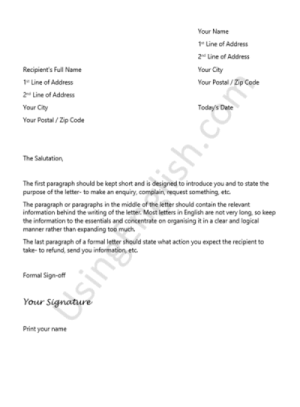
Structuring Your Letter
To respect your reader's time, present your points in a logical order and keep the text concise. Each sentence should have a clear purpose.
Avoid contractions and informal words (e.g. use "will not" rather than "won't").
How to start a professional letter
Put your address in the top-right corner. This could be your personal address or another address for replies.
Place the recipient's address on the left, usually below your own. If you are using a windowed envelope, align their address with the envelope window.
Write the date below the recipient's address. You can place it on either side of the page, but ensure the month is written in words.
If you do not know their name, use "Dear Sir" or "Dear Madam" (or both). If you do know their name, use their title (Mr, Mrs, Ms, Dr, etc.) and their surname. Keep a formal tone.
Pro Tip: Finding out the person's name wherever possible makes your letter more personal and professional.
a) If you do not know the recipient's name, use:
Dear Madam,
Dear Sir,
Dear Sir or Madam,
b) If you do know the recipient's name, use their title (Mr, Mrs, Ms, Dr, etc.) and their surname:
Dear Mr Jenkins,
Dear Ms Hamers,
Dear Mrs Hutchins,
Dear Miss Davis,
Dear Dr Green,
Etc.
In the past, formal letters sometimes included elaborate salutations based on the recipient's social status, such as 'Reverend Sir' or 'Most Worthy Sir' for clergymen.
Visit our discussion forum, where our teachers and experts are ready to help.
VISIT OUR LETTER WRITING FORUMHow to write the letter body
Now that you know how to address your recipient, let us focus on structuring your main message for maximum clarity:
- Be concise, and relevant: Stick to the core purpose.
- Avoid informal language: Maintain a formal, respectful tone.
- Aim for three or four paragraphs: Each paragraph should have a clear aim.
First paragraph: Introduce yourself and explain why you are writing (for example, to enquire, request, or complain).
Middle paragraph(s): Provide the essential background or key points. Keep it short, structured, and focused.
Last paragraph: Explain what you expect from the recipient (for example, a reply, a refund, or more information).
How to end your letter
Close the letter based on the greeting:
- Use "Yours sincerely" if you know the recipient's name.
- Use "Yours faithfully" if you do not.
Sign your name, then print it underneath your signature using capital letters (or type it). If gender might be unclear, add your title in brackets after your name. Optionally, include your telephone number and email.
Reading your finished letter from top to bottom helps catch spelling or grammatical errors. Make sure your recipient can easily understand the main points.
Proofreading is Key! - Before sending, always check for errors. A well-edited letter reflects professionalism and care.
Free formal letter template
To ensure you include all key elements, download our sample template:
MICROSOFT WORD TEMPLATE (DOCX)Types of Formal Letter
The rules above apply to all formal letters, but each type has its own conventions and expectations. Once you are confident with the basics, use these guides to tackle specific letter types:
- Cover Letter - sent with your CV when applying for an advertised job vacancy
- Letter of Enquiry - a speculative approach to an organisation that has not advertised a vacancy
- Complaint Letter - a formal complaint to a company or organisation
- Resignation Letter - a formal notice of your intention to leave a role
- Reference Letter - written on behalf of someone to support a job or academic application
- Business Letter Format - conventions for professional B2B and B2C correspondence
Full Example of a Formal Letter
The letter below shows all the elements described above working together. Read the annotations carefully - they explain why each section is written as it is.
Sender's address - top right
14 Fernwood Avenue
Bristol
BS6 7PJRecipient's name and address - top left, below the sender's address
The Customer Services Manager
Hartfield Electronics Ltd
Unit 4, Redcliffe Business Park
Bristol
BS1 6NXDate - written in full, month in words
14 April 2026Reference line - optional, but useful for complaints and business letters
Re: Faulty Laptop - Order Reference HE-294811Salutation - recipient's name is unknown, so "Dear Sir or Madam" is correct
Dear Sir or Madam,First paragraph - states the purpose clearly and immediately
I am writing to complain about a laptop I purchased from your online store on 28 March 2026. The item, a Hartfield ProBook 14 (model HPB-14X), developed a fault within one week of delivery.Middle paragraph - provides factual background with specific dates and references
When I opened the laptop on 29 March 2026, the screen displayed a persistent flicker that made it unusable. I contacted your technical support team by telephone on 1 April 2026 and followed their troubleshooting instructions, but the fault persisted. I returned the item by tracked post on 4 April 2026 (tracking reference: RM7743829GB) and have received no acknowledgement or replacement.Closing paragraph - states exactly what action is expected and by when
I would be grateful if you would arrange a full replacement or, if that is not possible, a complete refund of the purchase price of £649.99. I expect to hear from you within 14 days. If I do not receive a satisfactory response, I will have no alternative but to escalate my complaint to the relevant consumer authority.Sign-off - "Yours faithfully" because the salutation used "Dear Sir or Madam"
Yours faithfully,Printed name - in capitals, with title in brackets to clarify gender
SARAH WHITMORE (MS)
sarah.whitmore@email.com
01234 567890
Notice how the letter is factual throughout. It states dates, references, and amounts precisely, and makes a specific request in the final paragraph. Emotional language is avoided entirely.
What do common letter-writing abbreviations mean?
Here are abbreviations often used in professional letters. Understanding these will help keep your message clear:
- AKA
- Also Known As - Used to introduce an alternative name or alias for a person or thing.
- ASAP
- As Soon As Possible - Used to indicate the urgency of a request or action needed.
- Attn:
- Attention - Indicates that the letter is intended for a specific person or department.
- BCC
- Blind Carbon Copy - Similar to CC, but the recipients' names are not visible to other recipients.
- CC
- Carbon Copy - When you send a copy of a letter to more than one person, you use this abbreviation to let them know.
- CEO
- Chief Executive Officer - Refers to the highest-ranking executive in a company or organization.
- COB
- Close of Business - Specifies that a task or response is expected by the end of the business day.
- Enc.
- Enclosure - Used to indicate that additional documents or materials are included with the letter.
- EOD
- End of Day - Specifies that a task or response is expected by the end of the workday.
- EOM
- End of Month - Specifies that a task or response is expected by the end of the current month.
- ETA
- Estimated Time of Arrival - Indicates the expected time of arrival for a package, person, or event.
- FAO
- For the Attention Of - Similar to 'Attn', FAO is used to show that you intend the letter for a particular person or department.
- FAQ
- Frequently Asked Questions - Refers to a list of commonly asked questions and their answers.
- FYI
- For Your Information - Used to provide information or share something without expecting a specific response.
- N/A
- Not Applicable - Indicates that something does not apply to the given context or situation.
- PP
- Per Procurationem - A Latin phrase meaning that you are signing the letter on somebody else's behalf; if they are not there to sign it themselves, etc.
- PS
- Postscript - (also written as 'P.S.') Used when you want to include an additional thought or message at the end of a letter after the signature.
- PTO (informal)
- Please Turn Over - Used to make sure that the other person knows the letter continues on the other side of the page.
- Re:
- Regarding - Indicates that the letter is in reference to a particular subject or previous correspondence.
- RSVP
- Répondez s'il vous plaît - (also written as 'R.S.V.P.') French abbreviation meaning "Please respond." Used to request a response to an invitation or inquiry.
- TBD
- To Be Determined - Indicates that a decision or information is yet to be finalised or confirmed.
Formal Letter Writing: Frequently Asked Questions
What is the correct format for a formal letter?
A formal letter should include the sender's address (top right), the recipient's name and address (top left), the date, a formal salutation, a body of three to four paragraphs, a formal sign-off ("Yours sincerely" or "Yours faithfully"), and the sender's printed name and signature. This structure is standard in the UK and is widely understood internationally.
How do I start a formal letter if I don't know the recipient's name?
Use "Dear Sir", "Dear Madam", or "Dear Sir or Madam" when you do not know the recipient's name. Close with "Yours faithfully" - this pairing is a fixed rule in formal British English. Wherever possible, take a few minutes to find the correct name; a named letter is generally more effective.
What is the difference between "Yours sincerely" and "Yours faithfully"?
The rule is straightforward: use "Yours sincerely" when you know the recipient's name and have addressed them by it (e.g. "Dear Mr Jenkins"). Use "Yours faithfully" when you do not know their name and have used a general salutation such as "Dear Sir or Madam". Mixing these up is a common mistake, but an easy one to avoid once you know the rule.
Can I use "To Whom It May Concern" in a formal letter?
"To Whom It May Concern" is acceptable in English, particularly in American usage, but it is not standard in British formal writing. In UK formal letters, "Dear Sir or Madam" is the preferred alternative when the recipient's name is unknown. Reserve "To Whom It May Concern" for reference letters or other documents where the recipient is genuinely unspecified.
How long should a formal letter be?
In most cases, one page is sufficient and preferable. Aim for three to four paragraphs: an opening that states your purpose, one or two middle paragraphs that provide necessary detail, and a closing paragraph that states what you expect to happen next. If your letter runs to a second page, review it for anything that can be cut.
Is it acceptable to send a formal letter by email?
Yes. Emailing a formal letter is standard practice, and the content and tone should follow exactly the same rules as a printed letter. Omit the address blocks if you are writing directly in the email body rather than as an attached document. Use a clear subject line, and apply the same formal salutation and sign-off. If you are attaching a letter as a document, keep the address blocks in the attachment as normal.
What should I avoid in a formal letter?
Avoid contractions (write "do not" rather than "don't"), slang, and overly casual phrases. Do not pad the letter with unnecessary background - state your purpose clearly and move on. Avoid vague requests; always specify what you want the recipient to do. Finally, never send a letter without proofreading it; spelling and grammar errors undermine your credibility.
Key Takeaways: How to Write a Formal Letter in English
A well-structured formal letter follows these essential rules:
- Use the standard format. Include your address, the recipient's address, the date, a salutation, a body of three to four paragraphs, and a formal sign-off - in that order.
- Choose the right greeting. Use "Dear Sir" or "Dear Madam" if you do not know the recipient's name. Use their title and surname (e.g. "Dear Mr Jenkins") if you do.
- Close correctly. Use "Yours faithfully" when you do not know the recipient's name. Use "Yours sincerely" when you do.
- Structure your body clearly. Open by stating your purpose, develop your key points in the middle paragraph(s), and close by stating what action you expect.
- Keep it concise and formal. Avoid contractions, informal language, and unnecessary length. Each sentence should have a clear purpose.
- Sign off completely. After your closing phrase, sign your name and print it in capitals below. Include your title in brackets if your gender is not clear from your name.
Remember, proofread before sending. Check for spelling and grammatical errors. A well-edited letter reflects professionalism and attention to detail.
Want to improve your letter-writing further? Our Letter Writing section offers tips for formal, semi-formal, and informal styles - helpful for personal use or IELTS preparation.
Browse our Letter Writing section