
You are using an out of date browser. It may not display this or other websites correctly.
You should upgrade or use an alternative browser.
You should upgrade or use an alternative browser.
[Grammar] If I were free tomorrow
- Thread starter lagoo
- Start date
- Views : 4,948
- Status
- Not open for further replies.

Matthew Wai
VIP Member
- Joined
- Nov 29, 2013
- Member Type
- Native Language
- Chinese
- Home Country
- China
- Current Location
- China
http://www.grammaring.com/past-subjunctive
The past subjunctive of 'be' is 'were', not 'should be'.
The past subjunctive of 'be' is 'were', not 'should be'.

Charlie Bernstein
VIP Member
- Joined
- Jan 28, 2009
- Member Type
- Other
- Native Language
- English
- Home Country
- United States
- Current Location
- United States
Tru, but 'should be' is an acceptable alternative to subjunctive 'were' in BrE.
I'd use the first.
"If I were free tomorrow I would come to see you" means you're not coming. You would if you could, but you can't, so you won't.
The second is okay, too, but would be more clear this way: "If I should be free tomorrow, I will come to see you." This means you don't know whether you'll be free, but if you are, you'll come.
To keep the would there and still be clear, you might say something like:
- "If I should be free tomorrow, I would love to come to see you."
- "If I should be free tomorrow, I would like to come to see you."
Those both state a preference rather than a plan.
Last edited:
GoesStation
No Longer With Us (RIP)
- Joined
- Dec 22, 2015
- Member Type
- Interested in Language
- Native Language
- American English
- Home Country
- United States
- Current Location
- United States
I think very few Americans would use should be in the sample sentences. We do often use the construction when we want to add a nuance that's not possible with the subjunctive: If I should happen to be free ….
Matthew Wai
VIP Member
- Joined
- Nov 29, 2013
- Member Type
- Native Language
- Chinese
- Home Country
- China
- Current Location
- China
The first is the 2nd conditional, while the second is the 1st conditional, so 'should be' is not the past subjunctive. Do I understand correctly?"If I were free tomorrow I would come to see you"
[..]
"If I should be free tomorrow, I will come to see you."
- Joined
- Feb 5, 2017
- Member Type
- Student or Learner
- Native Language
- Chinese
- Home Country
- China
- Current Location
- China
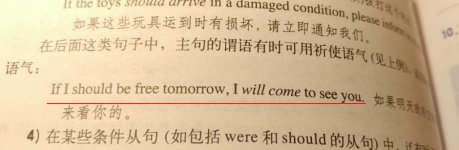
That's it! The original sentence in my grammar book is exactly the same as yours. Unfortunately, the author doesn't explain anything, only giving some examples.It would be more clear this way: "If I should be free tomorrow, I will come to see you." This means you don't know whether you'll be free, but if you are, you'll come.
.
Thank you again for your elaborate explanation.
Matthew Wai
VIP Member
- Joined
- Nov 29, 2013
- Member Type
- Native Language
- Chinese
- Home Country
- China
- Current Location
- China
Your grammar book says 「祈使语气」, which means the imperative mood rather than the subjunctive mood. I see no imperative mood in your sentences.Are the following subjunctive mood sentences correct?
- Joined
- Feb 5, 2017
- Member Type
- Student or Learner
- Native Language
- Chinese
- Home Country
- China
- Current Location
- China
I thought the author was wrong, so I made up my own sentences in my question which might have made you confused.Your grammar book says 「祈使语气」, which means the imperative mood rather than the subjunctive mood. I see no imperative mood in your sentences.
Matthew Wai
VIP Member
- Joined
- Nov 29, 2013
- Member Type
- Native Language
- Chinese
- Home Country
- China
- Current Location
- China
I think the author was not wrong. The imperative mood refers to the main clause of the following sentence, which is shown in your photo:
'If the toys should arrive in a damaged condition, please inform us ...'
'If the toys should arrive in a damaged condition, please inform us ...'
- Joined
- Feb 5, 2017
- Member Type
- Student or Learner
- Native Language
- Chinese
- Home Country
- China
- Current Location
- China
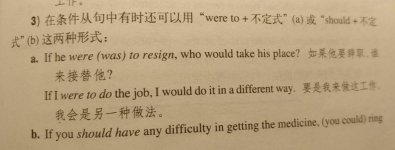
I think there are some others questions relating to your explanation.The second is okay, too, but would be more clear this way: "If I should be free tomorrow, I will come to see you." This means you don't know whether you'll be free, but if you are, you'll come.
- If he were to resign, who would take his place? (Does it mean I don't know if he will resign rather than he's unlikely to resign?)
- If I were to do the job, I would do it in a different way. (Does it mean I don't know if I will be given the job rather than it's impossible for me to do the job, and it's just my imagination?)
- If you should have any difficulty in getting the medicine, (you could) ring this number. (Does it mean I don't know whether you have any difficulty rather than you are unlikely to have any difficulty?)
- Joined
- Feb 5, 2017
- Member Type
- Student or Learner
- Native Language
- Chinese
- Home Country
- China
- Current Location
- China
The author is right. I mean at first I thought he was wrong.I think the author was not wrong.
Matthew Wai
VIP Member
- Joined
- Nov 29, 2013
- Member Type
- Native Language
- Chinese
- Home Country
- China
- Current Location
- China
- If he were to resign, who would take his place? (Does it mean I don't know if he will resign rather than he's unlikely to resign?)
- If I were to do the job, I would do it in a different way. (Does it mean I don't know if I will be given the job rather than it's impossible for me to do the job, and it's just my imagination?)
Source: https://www.ecenglish.com/learnenglish/lessons/how-use-were
Charlie Bernstein
VIP Member
- Joined
- Jan 28, 2009
- Member Type
- Other
- Native Language
- English
- Home Country
- United States
- Current Location
- United States
- Status
- Not open for further replies.
Similar threads

- Replies
- 1
- Views
- 81


- Replies
- 7
- Views
- 158
Ask a Teacher
If you have a question about the English language and would like to ask one of our many English teachers and language experts, please click the button below to let us know:
(Requires Registration)