take the time to do something

Status
Not open for further replies.

diamondcutter

Senior Member
Joined
Oct 21, 2014
Member Type
English Teacher
Native Language
Chinese
Home Country
China
Current Location
China
Judy: Which teacher will you miss the most after junior high school, Clara?
Clara: Mr. Brown. He guided me to do a lot better in science. He always took the time to explain things to me clearly whenever I couldn’t understand anything.

(from an English textbook for junior high school students by Cengage Learning and PEP)

I wonder if the “take the time to do something” is a set phrase. That is to say the definite article can’t be omitted or replaced by other words, say "much", "a lot of".
 
Judy: Which teacher will you miss the most after junior high school, Clara?
Clara: Mr. Brown. He taught me to do a lot better in science. He always took the time to explain things to me clearly whenever I couldn’t understand something.

(from an English textbook for junior high school students by Cengage Learning and PEP)

I wonder if the “take the time to do something” is a set phrase. That is to say the definite article can’t be omitted or replaced by other words, say "much", "a lot of".
We say:

- took time
- took the time
- took some time
- took lots of time
- took a lot of time
- took plenty of time

We do not say:

- took much time.
- took very time.
 
I wonder if the “take the time to do something” is a set phrase.

Yes, it can be described as a set phrase. The meaning is "take the (amount of) time needed/necessary to do something."

Sometimes the infinitival clause is left out, being understood in the context. Here's an example that came to mind from a famous self-help book:

". . . one day at the end of my thirty-seventh year, while taking a spring Sunday walk, I happened upon a neighbor in the process of repairing a lawn mower. After greeting him, I remarked, 'Boy, I sure admire you. I've never been able to fix those kind of things or do anything like that.' My neighbor, without a moment's hesitation, shot back, 'That's because you don't take the time.' I resumed my walk, somehow disquieted by the gurulike simplicity, spontaneity and definitiveness of his response. . . . The issue is important, because many people simply do not take the time necessary to solve many of life's intellectual, social or spiritual problems, just as I did not take the time to solve mechanical problems."

- M. Scott Peck,
The Road Less Traveled (1978)
 
Thanks Charlie and Phaedrus.

Hi Charlie,

Would you please tell me why you changed the two words (guided and anything)? Are they wrong there?
 
Something works better to refer to the specific thing/s you didn't understand when he helped you.
 
Thanks, Tdol.

What about “guided” and “taught”? Is “taught” also better than “guided” there?
 
With teachers, I'd stick with "taught" or "helped". "Guided" doesn't really fit.
 
Is the pattern "guide somebody to do something" idiomatic (grammatical)? I've consulted several dictionaries here, but I haven't been able to find it.
 
Is the pattern "guide somebody to do something" idiomatic (grammatical)? I've consulted several dictionaries here, but I haven't been able to find it.

It's new to me. And it's somewhat surprising that it's in a textbook on English.
:-|
 
Is the pattern "guide somebody to do something" idiomatic (grammatical)? I've consulted several dictionaries here, but I haven't been able to find it.

You won't find a five-word phrase in a dictionary.
 
You won't find a five-word phrase in a dictionary.

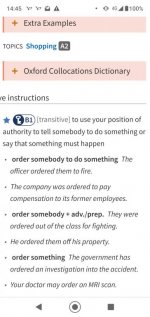
By "the pattern" I mean something like this:

Screenshot_20201203-144547.jpg
(Oxford Learner's Dictionary)

The image above shows how to use the verb "order" by using those "patterns (=parts in bold)".
 
I'm wondering if the "land" in that sentence is a noun.

Hmm...
 
No, it's a verb.
 
Status
Not open for further replies.

Ask a Teacher

If you have a question about the English language and would like to ask one of our many English teachers and language experts, please click the button below to let us know:

(Requires Registration)
Back
Top