
The before national adjectives

Status
Not open for further replies.

Rachel Adams

Key Member
Joined
Nov 4, 2018
Member Type
Student or Learner
Native Language
Russian
Home Country
Georgia
Current Location
Georgia
Hello.

Isn't 'the' unnecessary before all adjectives except the Iraqis, the Israelis, the Thais, the Chinese, the Congolese, the Portuguese, the Swiss?
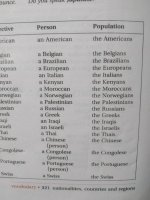
116771290_304773460876129_47820088739646935_n.jpg
 
Last edited by a moderator:
It depends on the context. There's no rule.
 
It depends on the context. There's no rule.
There are different rules in different books. This is what I have learnt so far:
'The Iraqis' just like the rest of the adjectives describe the whole nation. The Americans and similar adjectives which I haven't listed can be used without the article. With the article if I say 'the Americans' I am not talking about the whole nation but about a group of people who are American. 'The Americans who l work with are from Los Angeles.'
The whole nation: 'Americans are very friendly.'
 
The trouble with trying to find a one-size-fits-all example is that there isn't one.

For example, there are some some very unfriendly Americans – such as the notorious gangster, Hugh Doidy-Rett.
 
Your thread title should read "The" before national adjectives. The quotation marks are not optional. Please remember this in future posts.
 
The trouble with trying to find a one-size-fits-all example is that there isn't one.

For example, there are some some very unfriendly Americans – such as the notorious gangster, Hugh Doidy-Rett.

But do you agree that 'The Americans', 'The Italians', and other natinal adjectives that end with 'ian' or 'ans' when used with the definite article as given in this list refer to some specific people of that nationality and not the whole nation?
 
Not a teacher

But do you agree that 'The Americans', 'The Italians', and other natinal adjectives that end with 'ian' or 'ans' when used with the definite article as given in this list refer to some specific people of that nationality and not the whole nation?

I don't think so. We know that the definite article 'the' is used before a national name with a plural notion to denote a people collectively. The noun 'people' has two meanings. One is 'a nation' and the other is 'persons'. Please consider the following sentence.

'The Americans are a rich people' (nation).

A people = a nation
 
Last edited by a moderator:
I don't think so. We know that the definite article 'the' is used before a national name with a plural notion to denote a people collectively. The noun 'people' has two meanings. One is 'a nation' and the other is 'persons'. Please consider the following sentence.

'The Americans are a rich people' (nation).

A people = a nation

I not talking about such nouns as 'The French', 'The Japanese', I am asking about the ones with 'ian' and 'an' endings. 'Americans', 'Italians', for example. When talking generally about 'Americans', or 'Italians' or a similar national adjective the article should not be used. This is what I was taught. But I came across the rule in Swan that contradicts what I had previously learnt.
 
Last edited:
Did Swan really present it as a rule? The disagreement you're seeing indicates that you're in tendency territory.
 
Barman, please read this extract from the forum's Posting Guidelines:

You are welcome to answer questions posted in the Ask a Teacher forum as long as your suggestions, help, and advice reflect a good understanding of the English language. If you are not a teacher, you will need to state that clearly in your post.
 
Did Swan really present it as a rule? The disagreement you're seeing indicates that you're in tendency territory.
In Swan they are just listed. That rule was in another book I had. You don't agree with it either, do you?
 
I not talking about such nouns as 'The French', 'The Japanese', I am asking about the ones with 'ian' and 'an' endings. 'Americans', 'Italians', for example. When talking generally about 'Americans', or 'Italians' or a similar national adjective the article should not be used. This is what I was taught. But I came across the rule in Swan that contradicts what I had previously learnt.


[1] The Italians like pasta.

[2] *French like garlic.

[3] The French like garlic.

English uses different categories for different nationalities in generic contexts. In [1] with "Italian", the fact that we have plural "s" identifies the form clearly as the plural of a noun (it would be the plural of the inhabitant noun illustrated by "an Italian").

With forms like "the French", on the other hand, we can't say [2], so "French" must be an adjective as a fused modifier-head, no plural ending, and the singular (male) inhabitant noun is illustrated by "a Frenchman" rather than "*a French".

So, if we replaced "Italians" by "French", as in [3], it would become an adjective in a 'fused-head' construction.

"The French" is then similar to what we see with "rich", adjectival fused-head in "the rich".
 
[1] The Italians like pasta.

[2] *French like garlic.

[3] The French like garlic.

English uses different categories for different nationalities in generic contexts. In [1] with "Italian", the fact that we have plural "s" identifies the form clearly as the plural of a noun (it would be the plural of the inhabitant noun illustrated by "an Italian").

With forms like "the French", on the other hand, we can't say [2], so "French" must be an adjective as a fused modifier-head, no plural ending, and the singular (male) inhabitant noun is illustrated by "a Frenchman" rather than "*a French".

So, if we replaced "Italians" by "French", as in [3], it would become an adjective in a 'fused-head' construction.

"The French" is then similar to what we see with "rich", adjectival fused-head in "the rich".

Then what I studied before is wrong. 'The definite article isn't used before 'Italians', 'Brazilians', Russians,' when talking about them generally.' Before national adjectives ending with 'ian' or 'an'. 'Italians speak quickly.' All Italians. It may be a generalisation but we are talking about the whole nation.
But 'The Italians I work with are from Florence.' ='the Italians' some specific people.
In the same way 'Americans are friendly.' And 'The Americans I met last week came from Florida.'
 
Last edited:
Then what I studied before is wrong. 'The definite article isn't used before 'Italians', 'Brazilians', Russians,' when talking about them generally.' Before national adjectives ending with 'ian' or 'an'. 'Italians speak quickly.' All Italians. It may be a generalisation but we are here we are talking about the whole nation.
But 'The Italians I work with are from Florence.' ='the Italians' some specific people.


This pair illustrate the generic use of "Italians", meaning "any Italian that exists".

[1] Italians like pasta.

[2] The Italians like pasta.

However, [2] could also have a non-generic interpretation where it refers to a particular set of Italians, as opposed to all Italians that exist. Context will determine.
 
But do you agree that 'The Americans', 'The Italians', and other natinal adjectives that end with 'ian' or 'ans' when used with the definite article as given in this list refer to some specific people of that nationality and not the whole nation?
No.
 
This pair illustrate the generic use of "Italians", meaning "any Italian that exists".

[1] Italians like pasta.

[2] The Italians like pasta.

However, [2] could also have a non-generic interpretation where it refers to a particular set of Italians, as opposed to all Italians that exist. Context will determine.

Sorry I have to reask. Without the article "Italians like pasta" =All Italians in general.
"The Italians like pasta" =All Italians in general or a specific group of Italians.
But "Italians like pasta" without the article, can it also refer to a specific group of people? Could you please explain it to me once again?:-|
 
Sorry I have to reask. Without the article "Italians like pasta" =All Italians in general.

Yes.

"The Italians like pasta" =All Italians in general or a specific group of Italians.

Yes.

But can "Italians like pasta" without the article[STRIKE], can it[/STRIKE] also refer to a specific group of people?

No.

Could you please explain it to me once again?:-|
As you say, "All the Italians like pasta" and "All Italians like pasta" can mean exactly the same thing.

And as you also say, "All the Italians like pasta" can also refer to a specific group of people — for instance, the Italians at a wedding reception.

I notice that Paul said the same thing before you posted that. Is it clear yet?
 
As you say, "All the Italians like pasta" and "All Italians like pasta" can mean exactly the same thing.

And as you also say, "All the Italians like pasta" can also refer to a specific group of people — for instance, the Italians at a wedding reception.

I notice that Paul said the same thing before you posted that. Is it clear yet?

Yes, it is.

But if I change my sentence and say "All of the Italians" or "All Italians" it can only refer to people of this nation in general but not to a specific group of them? Am I right?
 
Status
Not open for further replies.

Ask a Teacher

If you have a question about the English language and would like to ask one of our many English teachers and language experts, please click the button below to let us know:

(Requires Registration)
Back
Top